

Long RS485 cable runs between gate entrances and central monitoring rooms create real problems in parking facilities. The distance forces expensive trenching, conduit installation, and weeks of construction. Adding more gates later means repeating the whole process.
There’s another way.
RS485 to Ethernet servers help old RS485 devices talk over regular computer networks. They change signals into TCP/IP. This way you can use your existing RS485 equipment on network setup.
- You do not need to lay down long cables.
- There is no need to close lanes, for construction work.
This guide explains how it works, with market data, technical standards, and a step-by-step implementation example.
Market Size: Smart Parking Is Growing Fast
Before diving into the technical details, it helps to understand why this matters. The smart parking market isn’t small.
| Metric | Value |
|---|---|
| Global smart parking market (2024) | USD 8.5 billion |
| Projected by 2030 | USD 26.8 billion |
| Annual growth rate (CAGR) | 20.1% |
Source: MarketsandMarkets, Smart Parking Market Report 2024
Most parking places already have the equipment they need like card readers and gate controllers and loop detectors that use RS485. The problem is not the RS485 equipment itself it is getting all of this equipment to work with the systems. This is usually an expensive process that involves a lot of construction.
What Makes RS485 Hard for Parking Applications
RS485 is a reliable standard. The TIA/EIA-485 specification defines it for up to 1,200 meters (about 4,000 feet) of cable. That sounds sufficient, but in practice:
- Long cable runs require trenching and conduit
- Installation costs scale with distance
- Troubleshooting buried cables is expensive
- Adding a new gate means digging another trench
In a parking facility with entrances at the perimeter and monitoring central, distances often exceed practical cable installation budgets.
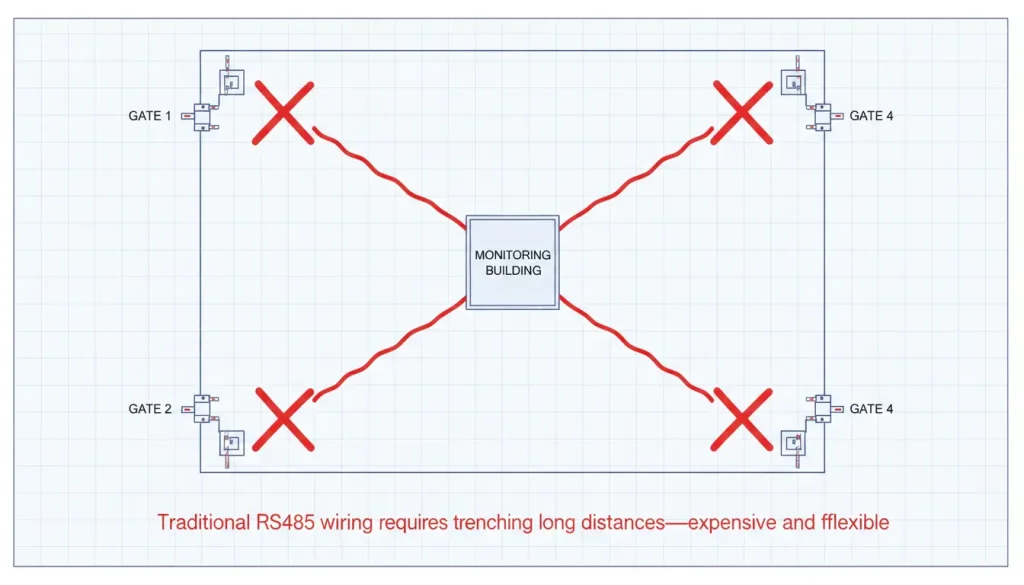
A Different Approach: RS485 to Ethernet Conversion
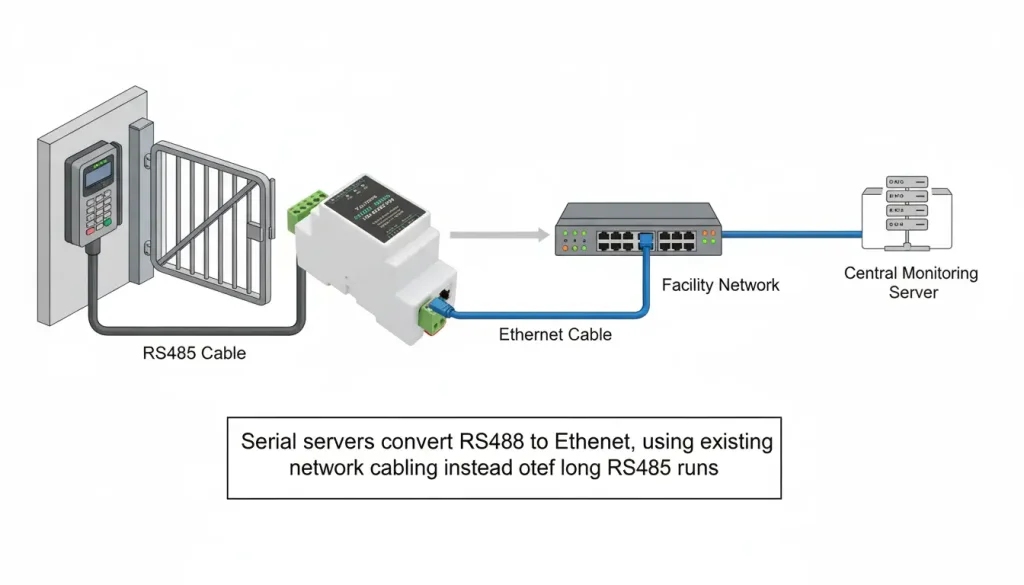
Instead of running long RS485 cables, install a serial server at each gate. The serial server connects to the card reader or gate controller via RS485. It then connects to the facility’s Ethernet network.
Data travels over existing network infrastructure to the central monitoring system. No new long cables. No trenching.
A Real Implementation: Step by Step
Here’s how this works in an actual parking facility that added four new gates without trenching new cable.
Gate-Level Setup
At each gate, a 1CH-RS485-ETH serial server handles the RS485 conversion.
- IP address: 192.168.0.200
- Serial port mapped to COM8 via virtual serial port software
- Connects to the card reader over RS485
The serial server’s job is straightforward: take RS485 data from the card reader, wrap it in TCP/IP, and send it over the network.

Central System Configuration
The parking management software runs on a server, in the monitoring room. It does not need to know that the gates are now connected over Ethernet.

In the parking management software COM8 is configured as the communication port. The parking management software uses serial port software to make the remote serial server appear as a local COM port. From the parking management softwares perspective nothing changed.. Physically hundreds of meters of RS485 cable were eliminated.

Gate Control
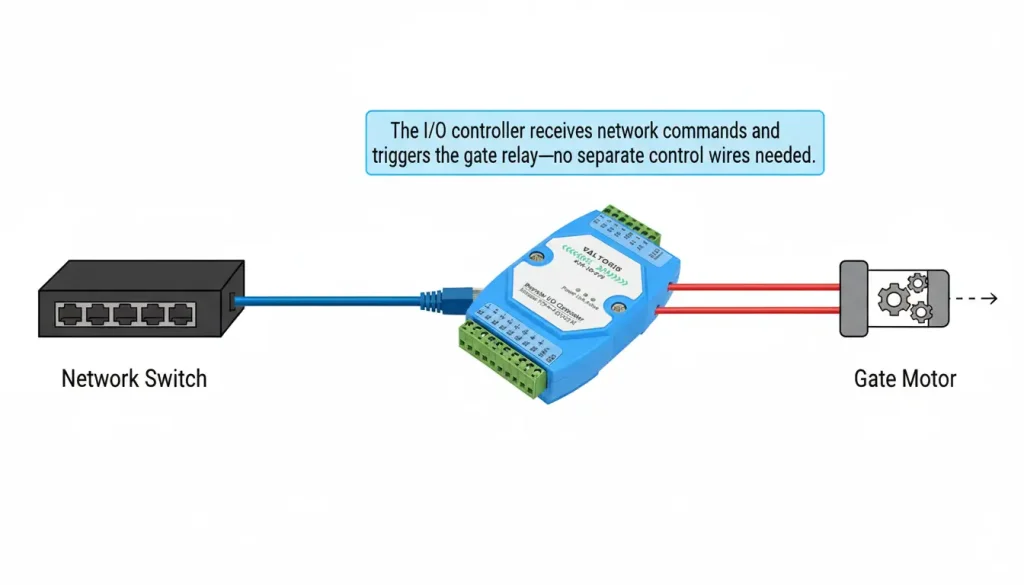
Gate lifting uses an Ethernet I/O controller (in this case, a 4CH-IO-ETH unit).
When the parking system authorizes a vehicle, it sends a command over the network to the I/O controller. The controller triggers a relay output, and the gate opens.
Both the card reader (via serial server) and the gate mechanism (via I/O controller) now share the same network infrastructure. No separate control wiring is needed.
RS485 Isn’t Going Away (And That’s Fine)
Replacing all RS485 equipment with native Ethernet devices sounds appealing, but it’s rarely cost-effective.
The global RS485 transceiver market was valued at USD 1.2 billion in 2024 and is projected to reach USD 1.9 billion by 2032, growing at 6.1% CAGR . RS485 remains the dominant interface for industrial sensors, meters, and controllers—including parking equipment.
Serial servers bridge the gap. They let existing RS485 equipment work in modern networked systems without replacement costs.
Protocol Support: Modbus RTU and Modbus TCP
Many parking controllers use Modbus over RS485. A good serial server supports both Modbus RTU (serial) and Modbus TCP (network).
The Modbus Protocol is an open standard maintained by the Modbus Organization. A serial server that handles both acts as a transparent gateway—no software changes needed in the parking management system.
What to Look for in Hardware
Parking facilities have demands that office-grade equipment can’t handle: temperature swings, electrical noise from motors and lighting, and the need for reliability.
| Feature | Office-Grade | Industrial-Grade |
|---|---|---|
| Operating temperature | 0°C to 40°C | –40°C to 85°C |
| Power input | 5V USB | 9–24V DC |
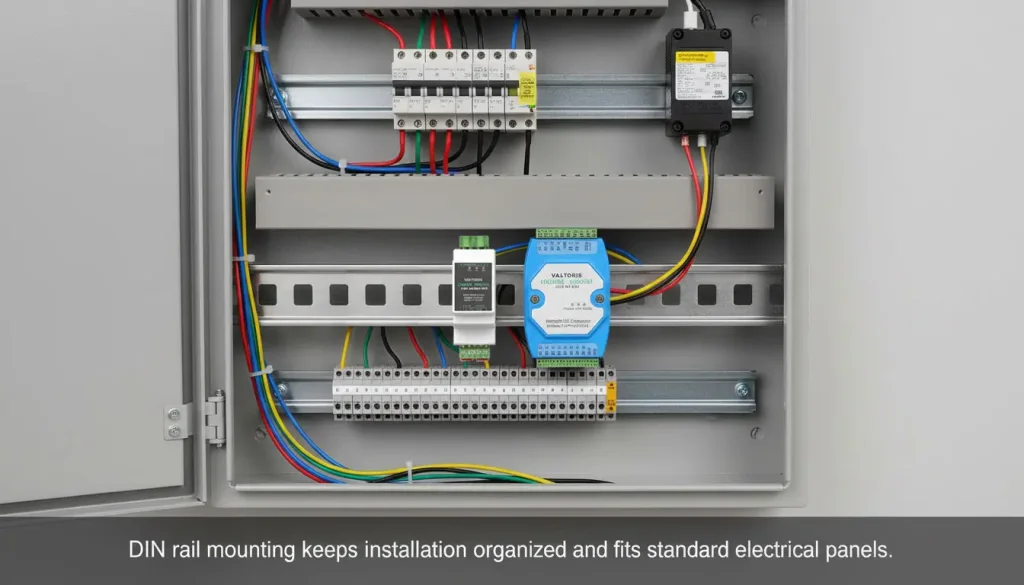
| Mounting | Desktop | DIN rail |
| EMI protection | Minimal | Built-in |
Industrial serial device servers are designed for these environments—metal cases, wide temperature ratings, and robust power supplies.
Common Questions
How many gates can be connected?
As many as the network can handle. Each serial server appears as a separate COM port or IP address. Parking management software can communicate with dozens of gates.
What happens if the network goes down?
Good serial servers automatically reconnect when the network returns. For parking gates, network reliability matters—but the same applies to RS485 cabling. Both rely on physical infrastructure.
Does the parking software need changes?
No. Virtual serial port software makes the remote serial server look like a local COM port. Most parking management systems work with COM ports, so no code changes are required.
What about security?
Network security best practices apply: VLANs to isolate parking devices, firewall rules to limit access, and encryption where supported. Industrial serial network gateways often include IP filtering and HTTPS configuration.
From Installation to Operation
Smart parking systems don’t require replacing all existing RS485 equipment.
The approach is straightforward:
- Existing card readers, gate controllers, and loop detectors stay in place
- A serial server at each gate converts RS485 to Ethernet
- Ethernet I/O controllers handle gate control
- Everything connects over the facility network
- Parking software talks to COM ports as it always has
No new trenches. No long cable runs. Just data over the network.
Start with one gate. Test the setup. Scale from there.