When evaluating modern iiot protocols or searching for viable mqtt alternatives, the choice of MQTT vs CoAP for your 2026 architecture is not a subjective preference—it is a hard calculation of physical constraints. These two application-layer heavyweights have been at the heart of the engineering debate for years.
In theory, any coap vs mqtt comparison often boils down to a simplistic “TCP vs. UDP” argument. The reality in the factory, or on a remote pumping station running on 4G Cat-1, is unforgiving.
The Architect’s Dilemma
“We often see engineering teams waste months trying to implement DTLS security over CoAP on resource-constrained edge nodes, only to realize the integration with mainstream public clouds (AWS/Azure) takes even longer. Understanding the boundary between Protocol Capability and Edge Hardware Capability is the key to a successful 2026 IIoT rollout.”
But to go beyond a theoretical comparison, we need to evaluate the performance of these protocols under the constraints of real hardware. In the following sections, we dissect the exact byte-level packet overhead, cellular Radio Resource Control (RRC) state impact and cryptographic load of the two protocols and how the deployment of modern edge computing (Industrial DTUs) ultimately overcomes these limitations.
📑 Quick Navigation Guide
Interactive Architect Tool: Identify Your Protocol Bottleneck
Select the primary challenge your edge network is currently facing to jump straight to the engineering solution.
Diagnosis: TCP Keep-Alive Overhead.
MQTT requires constant PINGREQ packets, preventing your 4G module from dropping into the RRC_IDLE state. CoAP (UDP) or an Edge Gateway resolves this.
Read the RRC AnalysisDiagnosis: Cryptographic Bottleneck.
DTLS over UDP (CoAP) requires heavy packet buffering. TLS over TCP (MQTT) is standard but heavy. The hardware solution is to offload encryption entirely.
Compare TLS vs DTLSDiagnosis: Architectural Mismatch.
MQTT requires a centralized Broker. If your WAN drops, local routing dies. You need a RESTful Peer-to-Peer architecture like CoAP for autonomous M2M.
Jump to Architecture ClashDiagnosis: Stop Writing Custom Firmware.
Do not force legacy RS485 PLCs to handle MQTT. Use an Industrial Edge Gateway to auto-poll Modbus RTU, encapsulate it in JSON, and secure it via hardware TLS.
View Hardware GatewaysThe Fundamental Divide: TCP-Based MQTT vs. UDP-Based CoAP
The core behavioral differences between MQTT and CoAP stem entirely from their Transport Layer (Layer 4) foundations.
MQTT: The Stateful TCP Heavyweight
MQTT operates over TCP. Before a single byte of sensor payload (e.g., temperature) is published, a TCP 3-way handshake must occur (SYN, SYN-ACK, ACK). According to the OASIS MQTT v5.0 standard, this creates a persistent, “stateful” connection.
The catch? TCP ensures that the packets are coming in order and lossless. This is brilliant for reliability. However, a TCP connection over cellular networks (4G LTE, Cat-1) needs to be kept alive by sending periodic PINGREQ and PINGRESP packets. When the link goes down, it’s a lot of radio energy to tear it out and build it back up.
CoAP: The Stateless UDP Challenger
CoAP is based on UDP as specified in IETF RFC 7252. It has a RESTful architecture (GET, POST, PUT, DELETE) optimized for Machine-to-Machine (M2M) telemetry. UDP sends packets without first making a connection.
If a remote sensor wakes up from deep sleep it sends a CoAP packet and immediately goes back to sleep. Built in, no handshake, no persistent state and basically no connection overhead.
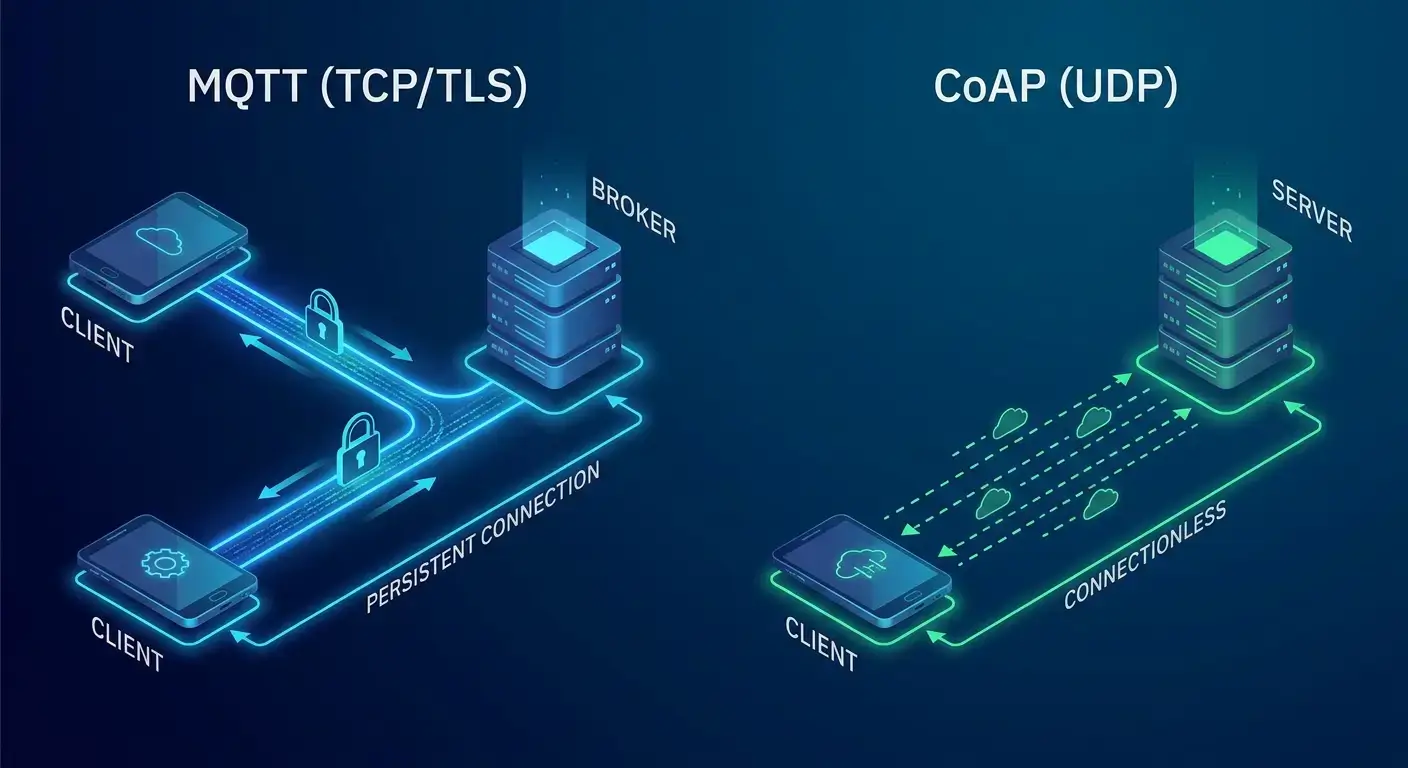
Figure 1: Transport Layer Dynamics — MQTT (Stateful TCP) vs. CoAP (Stateless UDP)
The Battery Drain Dilemma: When MQTT’s Reliability Costs Too Much
When deploying hundreds of remote gateways on 4G Cat-1 networks, data tariffs and power consumption metrics scale exponentially. Let’s break down the byte-level overhead that ultimately dictates the battery life of constrained devices.
| Technical Metric | MQTT (TCP-based) | CoAP (UDP-based) |
|---|---|---|
| Protocol Header Size | 2 Bytes (Fixed) + Variable | 4 Bytes (Fixed) |
| Connection Overhead | High (TCP 3-way handshake) | Zero (Connectionless) |
| Keep-Alive Requirement | Mandatory (PINGREQ) | None |
| 4G Radio Module (RRC) Impact | Keeps radio in “Connected” state longer | Allows immediate drop to “Idle” state |
The 4G LTE Cat-1 Reality: Cellular modules are in RRC_CONNECTED (high power) and RRC_IDLE (low power) states. 4G module takes longer to come back to RRC_IDLE state as MQTT needs to acknowledge TCP packets and keep sockets open. Because CoAP is a fire-and-forget UDP payload, the hardware can go to sleep almost immediately, cutting the mAH drain significantly.
Monthly Cellular Data Overhead Estimator
See how MQTT’s mandatory TCP Keep-Alive packets multiply your monthly 4G Cat-1 data usage compared to stateless UDP (CoAP) for a fleet of remote sensors.
*Calculation based on minimal TCP/IP header overhead. Excludes actual sensor payload.
The Hidden Cost: CapEx vs. OPEX vs. NRE
Let’s translate bytes into dollars. If you deploy 1,000 remote sensors on a pay-per-byte cellular plan, an aggressive 60-second TCP Keep-Alive interval doesn’t just drain batteries—it creates gigabytes of parasitic data overhead annually (OPEX).
Engineers often hesitate at the upfront hardware cost (CapEx) of deploying dedicated Industrial DTUs at every node. But the true silent killer of IIoT projects is NRE (Non-Recurring Engineering). Writing, debugging, and maintaining custom C/C++ firmware to handle DTLS encryption, packet fragmentation, and edge-case MQTT reconnections on a bare-metal MCU easily consumes 300+ engineering hours. At $100/hour, that is a $30,000 sunk R&D cost before deploying a single node. By investing in a COTS (Commercial Off-The-Shelf) edge gateway, you trade a massive, unpredictable NRE sink for a fixed, marginal CapEx—accelerating time-to-market from months to days.
Architecture Clash: Centralized Brokers vs. RESTful Peer-to-Peer
Beyond byte counts and battery life, the most critical divergence between these protocols is network topology.
MQTT enforces a strict Hub-and-Spoke architecture. Every edge device, sensor, or PLC must publish data to a centralized server known as a Broker (e.g., Mosquitto, EMQX, or AWS IoT). Edge nodes cannot communicate directly with one another. If the wide-area network (WAN) link to the cloud broker drops, local machine-to-machine (M2M) communication instantly halts, rendering the local factory floor blind.
CoAP embraces a Peer-to-Peer (P2P), RESTful architecture. Because it is modeled directly after HTTP semantics, CoAP operates without a middleman. A local PLC can send a direct GET or PUT request to a smart valve on the exact same local subnet. This decentralized approach makes CoAP incredibly resilient for closed-loop industrial networks operating entirely offline.
| Topology Feature | MQTT (Broker-Centric) | CoAP (Peer-to-Peer) |
|---|---|---|
| Single Point of Failure | High (Broker crash halts all traffic) | Low (Nodes can route locally) |
| Service Discovery | Manual topic subscription required | Native multicast support (IPv6) |
Payload and Bandwidth: QoS Guarantees vs. Confirmable (CON) Messages
A common fallacy is equating UDP with “unreliable data.” CoAP implements reliability directly at the application layer using Confirmable (CON) messages. When an edge device sends a CON message, the receiving server must reply with an ACK. If lost, CoAP uses an exponential back-off timer to retransmit.
However, MQTT handles network instability far more gracefully via its native Quality of Service (QoS) engine, giving you granular control over reliability versus bandwidth consumption:
- • QoS 0 (At most once): Fire and forget. Minimal bandwidth. (Similar to CoAP NON).
- • QoS 1 (At least once): Guaranteed delivery, but duplicates may occur if the ACK is lost in transit.
- • QoS 2 (Exactly once): The highest level of reliability. Ensures no data loss and no duplication, but requires an expensive 4-step handshake (highest bandwidth cost).
With CoAP, the burden of managing complex state machines, deduplication, and message queuing falls entirely on the firmware developer. With MQTT, the protocol stack handles the chaos of industrial networks transparently.
| Reliability Level | MQTT Mechanism | CoAP Mechanism | Bandwidth Impact |
|---|---|---|---|
| Best Effort | QoS 0 | Non-Confirmable (NON) | Minimal |
| Acknowledged | QoS 1 / QoS 2 | Confirmable (CON) | Moderate to High |
The Security Cost: Transport Layer TLS vs. Datagram DTLS
In 2026, unencrypted industrial communication is considered a critical vulnerability. Both protocols feature cryptographic variants, but the implementation cost differs wildly:
MQTT + TLS (Transport Layer Security)
TLS is universally supported, heavily optimized, and seamlessly integrated into almost all cloud providers (AWS IoT, Azure IoT Hub). Hardware cryptography accelerators in modern gateways handle TLS handshake latency effortlessly.
CoAP + DTLS (Datagram TLS)
Security of connectionless UDP packets is notoriously difficult. The cryptographic handshake in DTLS requires the stack to handle packet reordering and fragmentation. Implementing DTLS on bare-metal MCUs is a massive headache, often requiring an unacceptable amount of RAM.
| Security Metric | TLS (over TCP) | DTLS (over UDP) |
|---|---|---|
| Handshake Fragmentation | Handled natively by TCP | Requires custom application logic |
| Typical MCU RAM Requirement | ~30 KB to 50 KB | ~40 KB to 80 KB+ (Due to buffering) |
Figure 3: Security Overhead. DTLS over UDP often demands significantly more internal memory buffering from the edge device compared to standard TLS.
The Paradigm Shift: Solving Protocol Limits with Industrial Gateways
Engineers often face a paradox: They desperately want the cloud ecosystem compatibility and reliability of MQTT, but they fear the bandwidth and connection overhead on their remote, power-constrained sensors.
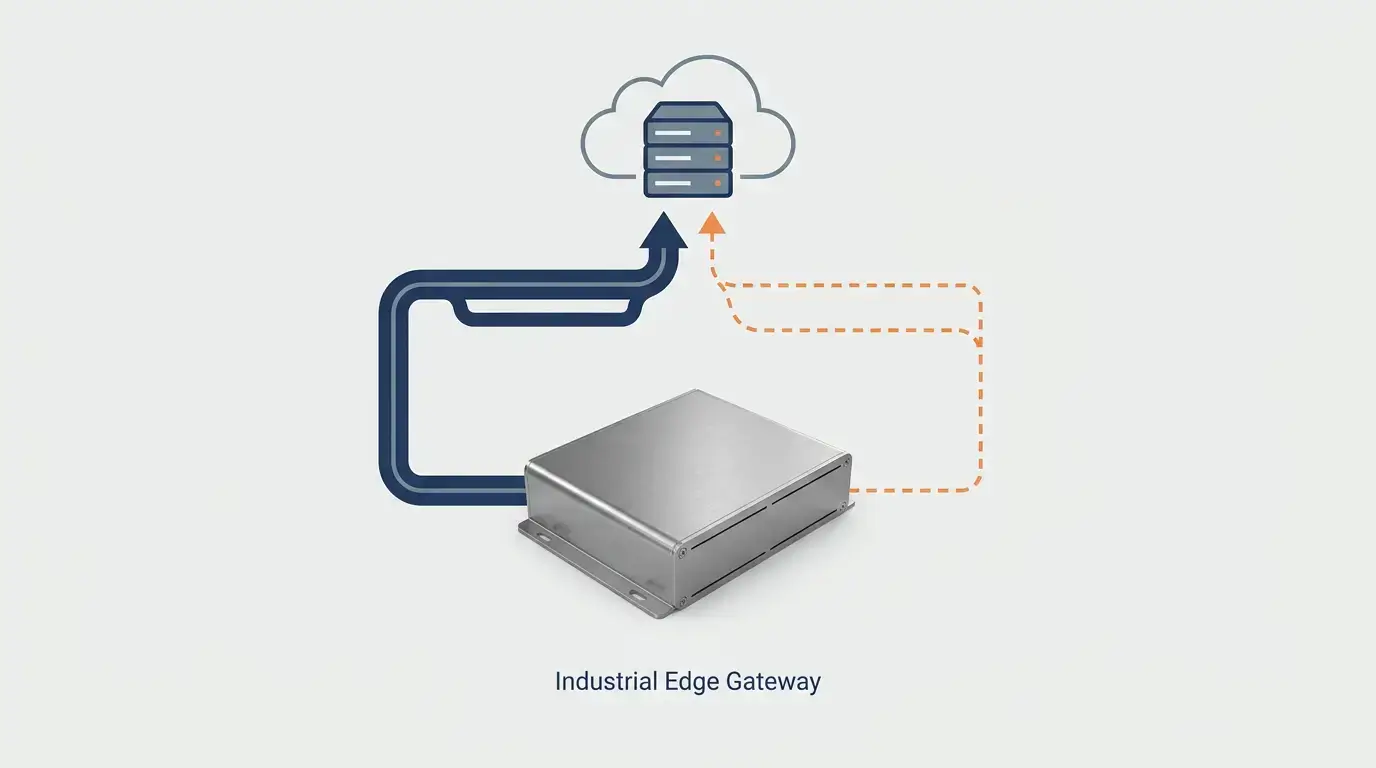
The modern architectural solution in 2026 is not to force the edge sensor to handle complex IP stacks. Instead, savvy system integrators deploy Industrial Cellular Gateways to act as the intelligent intermediary.
How a Smart Edge Gateway (e.g., Cat-1 LTE DTU) Bridges the Gap:
- Local Polling via RS485 (Storage Modbus): Instead of waking up a cellular modem for every single data request, advanced gateways utilize an “Auto-Query Storage” mechanism. The gateway autonomously polls connected PLCs or meters via Modbus RTU at high speeds, caching the register data in its internal RAM.
- Zero-Latency Cloud Response: When the central SCADA or Cloud Server queries data, the gateway responds instantly from its local cache (typically under 3 milliseconds). This eliminates RS485 bus congestion and prevents multi-host collision.
- Edge JSON Encapsulation & MQTT Uplink: Sending raw hex arrays over 4G wastes bandwidth. The gateway acts as a translator—it maps Modbus registers, cleans the data, encapsulates it into a lightweight, standard JSON format, and handles the heavy lifting of the MQTT TLS encryption. It then transmits exactly what the cloud needs, precisely when it needs it.
By delegating protocol translation, Keep-Alive maintenance, and cryptographic security to an industrial-grade LTE router, developers bypass the MQTT vs. CoAP software dilemma entirely. You get the bulletproof cloud integration of MQTT without exhausting the resources of your local industrial network.
| Data Processing Stage | Traditional Approach | Valtoris Gateway Approach |
|---|---|---|
| Polling Modbus RTU | Cloud sends direct TCP requests (High Latency) | Gateway auto-polls & caches locally (<3ms latency) |
| MQTT Keep-Alive | Sensor wakes up every 60s (Battery drain) | Gateway handles PINGREQ via main power |
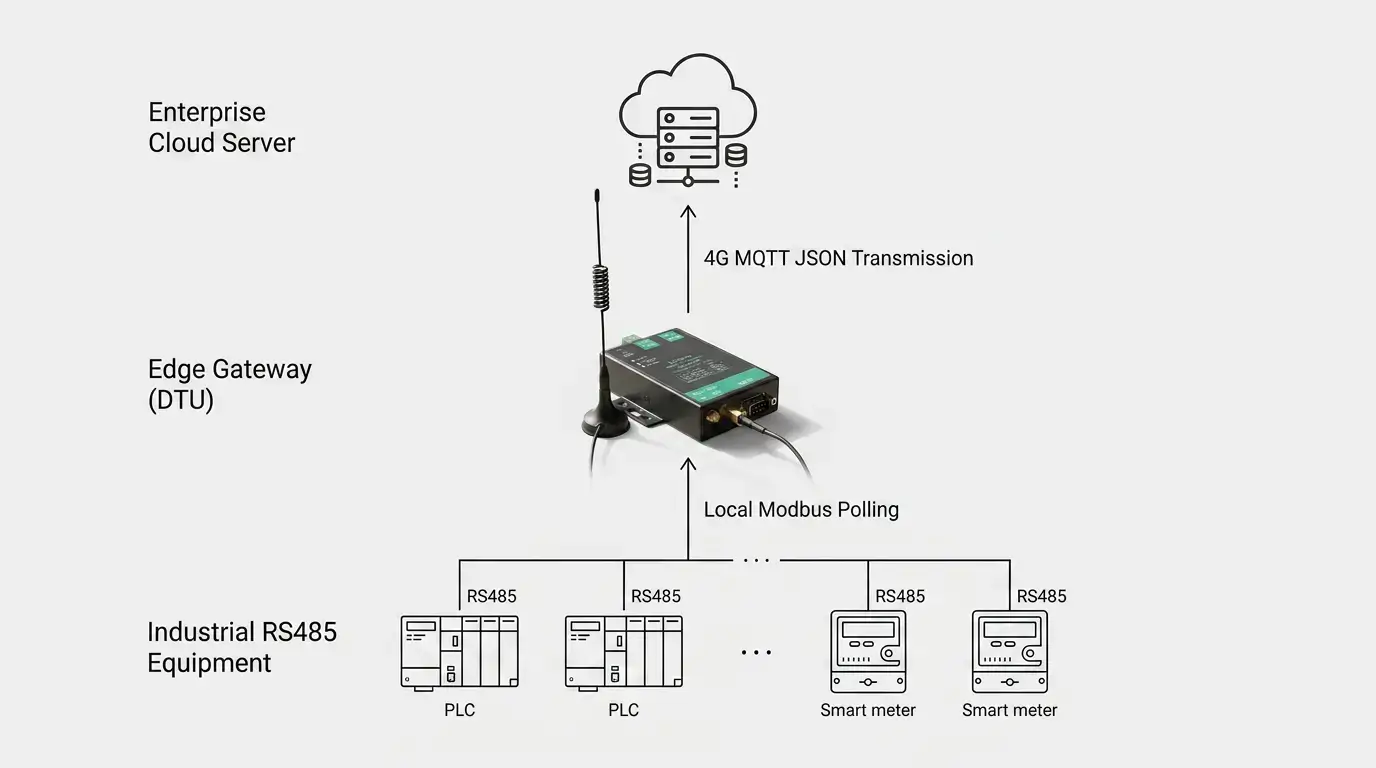
Figure 4: Edge Architecture — Delegating Modbus polling and MQTT/JSON encapsulation to the Industrial Gateway.
Decision Matrix: Selecting Your 2026 IIoT Protocol
If you are finalizing your hardware and software architecture today, here is the final cheat sheet:
Implement Pure CoAP If:
- Implement Pure CoAP When Design of a bare-metal node (e.g., smart water meter) to operate on a primary battery for 10 years under stringent constraints.
- Using strict LPWAN (NB-IoT/LoRaWAN) with very limited downlink messages.
- Your architecture requires direct Peer-to-Peer (M2M) communication, without a central cloud broker.
Use MQTT via an Edge Gateway If:
- You’re upgrading existing RS485/Modbus PLCs in a factory, solar farm, or pipeline.
- You want to plug and play with AWS IoT, ThingsBoard, Azure etc.
- You want to remove custom firmware coding. Hardware that natively translates protocols securely over TLS.
Accelerate Your IIoT Deployment
Stop fighting with protocol overhead on bare-metal MCUs. Equip your infrastructure with industrial routers featuring Storage Modbus, transparent RS485-to-JSON, and native Cat-1 4G/WiFi uplink capabilities.
Explore VALTORIS Edge GatewaysExpert FAQs: Industrial Protocol Integration
Can an Edge Gateway convert Modbus RTU directly to MQTT JSON without a middle server?
Why is MQTT’s “Keep-Alive” considered a liability for cellular data (LTE Cat-1 / NB-IoT)?
PINGREQ and PINGRESP packets to keep a TCP Keep-alive state across NAT firewalls This MQTT keep-alive overhead overhead prevents the 4G radio module from going into deep sleep mode, which uses up battery mAH and the limited monthly cellular data plans.