
Legacy PLC integration remains the ultimate hurdle, even as the industrial sector is currently consumed by an aggressive hardware and software frenzy. Every quarter, technology conglomerates unveil hyper-powerful AI servers, edge computing nodes, and cloud-native predictive maintenance platforms. These modern systems promise to revolutionize yield optimization, eradicate unplanned downtime, and fully realize the vision of Industry 4.0. Operations directors and facility managers subscribe to these state-of-the-art Edge AI platforms with multi-million dollar contracts, dreaming of a pristine, autonomous, data-driven smart factory.
Then the hard, unforgiving reality of brownfield deployment hits.
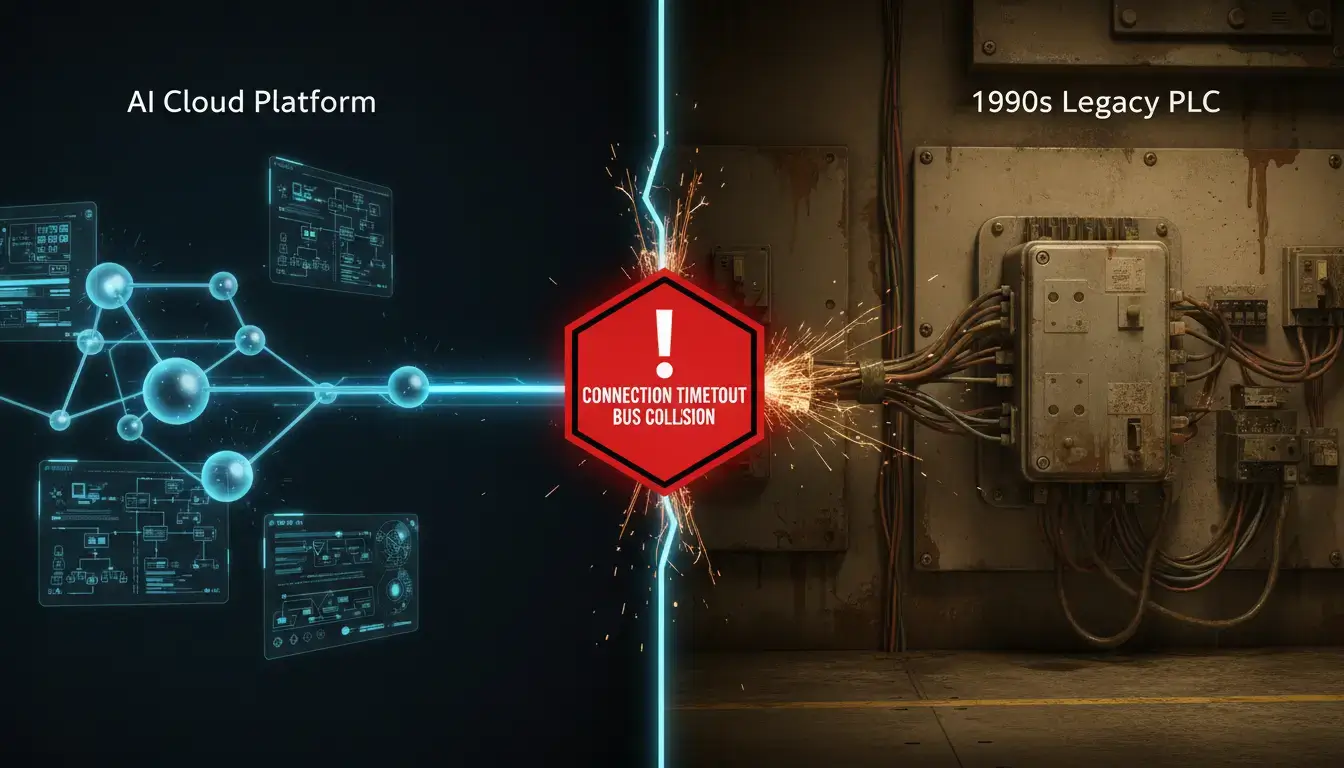
When these very sophisticated neural networks built for high speed, asynchronous, modern IT environments try to pull real-time operational data from a 1999 Siemens, Mitsubishi or Allen-Bradley Programmable Logic Controller (PLC) running a core industrial boiler, the system catastrophically and bewilderingly comes to a grinding halt.
No matter how sophisticated the artificial intelligence algorithms are, an AI model without clean, continuous, and structured data fuel is essentially useless. It is a Ferrari without gasoline. At the very beginning of this critical industrial data supply chain lies a muddy, twenty-year-old dirt road with a bandwidth of exactly 9600 bits per second: Legacy Modbus RTU.
Why Your Edge AI is Starving for Legacy Modbus Data
Many IT engineers, cloud architects, and data scientists approach Industrial IoT (IIoT) deployments and legacy PLC integration with a modern software engineering mindset. Accustomed to RESTful APIs, WebSockets, GraphQL, and highly asynchronous communication paradigms, their default assumption is dangerously simple: “I will just write a Python script on my edge server to poll the factory equipment every 50 milliseconds to feed my real-time dashboard.”
Applying this IT mindset directly to an Operational Technology (OT) brownfield environment is a recipe for immediate infrastructure failure. Legacy serial networks, specifically RS485, operate on a half-duplex physical layer. It is literally a single-lane road where only one device can “speak” at any given microsecond. When your high-powered Edge AI node aggressively polls multiple slave devices on a daisy-chained RS485 network, severe architectural failures begin to cascade across the facility.
The Catastrophe of Serial Bus Collisions
An RS485 bus doesn’t have the fancy gigabit switches to manage traffic, buffer packets, and prevent collisions like modern Ethernet networks do. An RS485 bus depends entirely on a strict Master-Slave polling hierarchy. For example, where an Edge AI gateway (Master) asks for data from Slave Node 1, the Master has to wait until the entire response has passed the physical wire before querying Slave Node 2.
When aggressive AI polling scripts—often multithreaded by developers who do not understand serial communications—send overlapping requests, electrical signals physically collide on the twisted-pair wires. This means corrupted data frames, CRC (Cyclic Redundancy Check) errors, dropped connections, and no visibility at all into the state of the machine.
Watchdog Timeouts and Unplanned Machine Crashes
Furthermore, the CPUs inside legacy PLCs, Variable Frequency Drives (VFDs), and industrial power meters are notoriously underpowered by today’s standards. Their primary, deterministic objective is to execute ladder logic and keep the heavy machinery running safely—not to serve as a high-speed SQL database for your cloud analytics.
When an AI platform inundates a legacy PLC with high frequency Modbus data requests, the communications interrupts totally swamp the microprocessor of the PLC. This typically causes an internal watchdog timeout. The PLC goes into a critical fault state, halts the production line and needs to be reset manually by a technician. Ironically, the very unplanned downtime your multi-million dollar predictive maintenance AI was purchased to avert has just happened.
🗣 Industry Expert Insight on IT/OT Convergence
“Major capital investments in cloud infrastructure haven’t solved the problem of integration complexity, which remains the biggest hurdle to scaled IoT adoption. Many organizations underestimate the profound architectural mismatch between scalable, asynchronous cloud IT platforms and highly deterministic, fragile legacy operational technologies. To bridge this gap requires specialized edge computing infrastructure, not just clever software scripts.”
Stop Sending Raw Hex Codes to the Cloud
Assuming you can throttle your AI polling rate down to a painfully slow interval to avoid crashing the PLC, you are immediately faced with the second major nightmare of legacy PLC integration: Exploding Cloud Infrastructure Bills and Bandwidth Choking.
To connect serial devices to networks, many engineers initially purchase traditional, low-cost “Transparent Serial Converters” (often referred to as basic serial device servers). These devices do exactly what their name implies—and nothing more. They take the raw, hexadecimal (Hex) Modbus RTU frames from the serial port, encapsulate them directly into TCP packets without inspection, and blindly stream them to a cloud broker like AWS IoT Core, Azure IoT Hub, or Google Cloud.
This passive, “dumb pipe” architecture triggers massive financial and operational consequences.
The Cost of Ingesting Useless Noise
Industrial machines operate normally 99% of the time. A motor spins at a constant RPM; a boiler maintains a steady temperature. If a basic transparent converter transmits a “temperature is normal” raw Hex payload every single second over a cellular LTE network to your cloud provider, you are generating billions of data points monthly. Cloud providers charge by the message, by ingest bandwidth, and by storage. You are essentially paying exorbitant cellular data fees and cloud compute costs to ingest useless, repetitive noise.
The “Storage Modbus” Paradigm Shift
To solve the polling crash and the bandwidth issues simultaneously, advanced IIoT architecture requires true edge decoupling. Instead of the cloud AI directly polling the PLC over a transparent tunnel, an intelligent edge gateway must be introduced.
This is where the Storage Modbus mechanism becomes critical. In this architecture, the edge gateway acts as an autonomous Master on the RS485 bus. It polls the legacy PLC at a safe, low, deterministic frequency tailored to the PLC’s limitations, and caches the latest register values in its own local high-speed memory. When the modern, high-speed Edge AI platform demands data, it aggressively polls the gateway’s internal memory via high-speed Ethernet. The fragile legacy PLC is completely shielded from the AI’s demands, resulting in zero collisions and zero crashes.
🔧 Technical Deep Dive: Edge Data Filtering
Beyond caching, true edge gateways optimize cloud bandwidth by implementing Report-by-Exception or Deadband filtering. Instead of pushing data constantly, the gateway monitors the cached Modbus registers locally. t will start a MQTT publish to the cloud only if a register value changes by a predefined threshold (e.g. Temperature changes >2°C) or a critical alarm coil is triggered. This lowers cellular data consumption and cloud ingest costs by up to 85% and provides zero latency transmission of mission critical anomalies.
The Context Gap: Turning “Dumb” Registers into AI-Ready Payloads
“Temp”: 85.5,
“Unit”: “C”
}
Once you have secured stable communication, the next phase of the legacy PLC integration challenge is arguably the most critical for data scientists and software developers: bridging The Context Gap.
When an AI algorithm, a machine learning model or a cloud data lake consumes information, they expect data that is structured, contextualized and self-describing. Modern IT applications want payloads with ISO 8601 timestamps, explicit variable names, clearly hierarchical structures, and floating point values. They anticipate an IT-friendly JSON payload that looks like this:
“device_id”: “Valtoris_Boiler_Zone_A”,
“timestamp”: “2026-06-08T09:15:30Z”,
“metrics”: {
“HoldingRegister_40001_Temp”: 85.5,
“Coil_0001_PumpStatus”: 1
}
}
However, what a basic transparent serial server actually spits out to the cloud is a continuous stream of raw Modbus RTU frames. It looks exactly like this:
This is meaningless garbage to an AI platform. No timestamp, no contextual metadata, and no decimal points. The hexadecimal payload 03 57 is 855 in decimal. The cloud system would have had to have a huge lookup table, constantly updated on its own, to know that this particular register from this particular slave ID required a 0.1 multiplier to get the real temperature of 85.5 degrees.
Forcing cloud servers to parse, multiply, align timestamps, and contextualize raw serial frames for thousands of field devices introduces massive latency, creates brittle codebases, and wastes expensive cloud compute resources.
Native Protocol Translation at the Edge
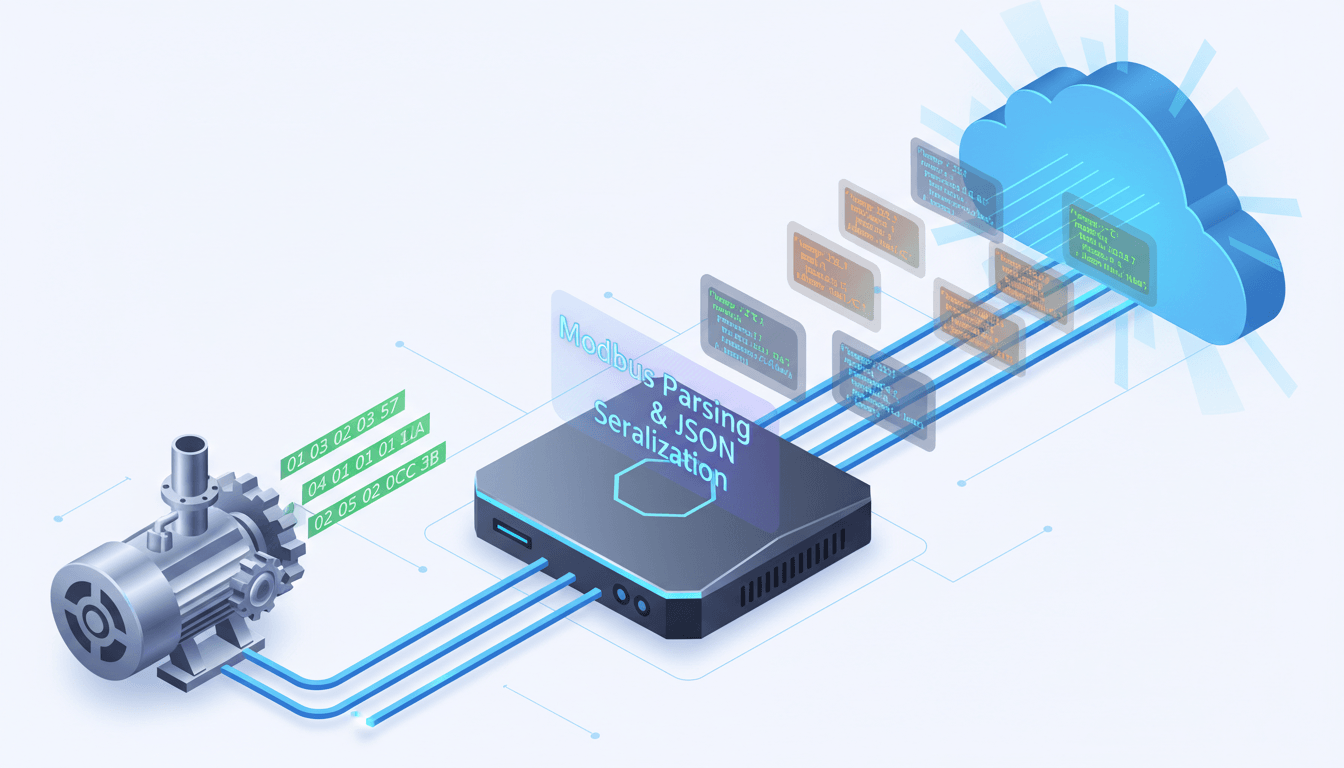
The solution is on the boundary of the network only. “Native Protocol Translation and JSON Serialization capabilities are a must have for a true Industrial IoT Edge Gateway. The gateway is an intelligent, bilingual translator between OT and IT, with Modbus-to-JSON conversion performed locally.
Advanced gateways allow engineers to map specific Modbus registers, apply mathematical multipliers locally, and format them into structured JSON payloads. The gateway then publishes these clean, contextualized payloads directly to an MQTT broker. This ensures that the data arriving at the cloud or the local AI inference engine is instantly actionable for machine learning models, requiring zero additional preprocessing.
Connecting the Unconnected Without Nuking Plant Security
When you successfully propose a legacy PLC integration project to connect a 30-year-old serial network to a modern IT infrastructure or a 4G LTE cellular network, your Plant Manager and OT Security Director will inevitably intervene. Their ultimate, highly justified nightmare is the exposure of vulnerable, unpatched, mission-critical control systems to the public internet.
Legacy serial protocols were designed in the 1970s and 1980s for closed-loop environments. The Modbus RTU protocol has no notion of encryption, user authentication or secure handshakes by design. Hook these devices up through a cheap consumer serial-to-Ethernet adapter and anyone who can get into the IT network (or the public internet, even worse) can easily send malicious “Write Coil” commands. They might hack critical infrastructure to disable it remotely, or change pressure settings or even physically sabotage production.
Enforcing the Purdue Model with Secure Gateways
The National Institute of Standards and Technology (NIST) has published authoritative guidelines for Industrial Control Systems (ICS) security, they recommend strict network segregation and secure boundary protection when bridging IT and OT networks.
🛡️ Cybersecurity Compliance Requirement
“Industrial Control Systems should be segmented from corporate networks and the internet. Any required connections between the ICS network and external networks should be routed through a securely configured firewall or VPN gateway that inspects and filters traffic, ensuring only explicitly permitted communications are allowed to reach legacy control nodes.”
Therefore, a simple protocol converter is a severe security liability. Bridging the massive gap between 1979 machinery and 2026 AI platforms requires a hardware gateway with integrated Routing and VPN capabilities.
Industrial-grade gateways do not merely convert protocols; they act as a secure fortress. By incorporating built-in router functions, Network Address Translation (NAT), and secure VPN tunneling protocols, these devices ensure that operational data can flow outward to the cloud securely over encrypted channels. Meanwhile, impenetrable edge firewalls block any unauthorized remote intrusion attempts from ever reaching the fragile, unencrypted serial bus.
Choosing the Right Architecture to Bridge 1979 and 2026
The global market is heavily saturated with devices claiming to connect RS485 serial ports to the internet. However, once you deeply understand the critical architectural bottlenecks of Edge AI deployments—polling crashes, cloud bandwidth explosion, JSON context gaps, and OT security vulnerabilities—the criteria for selecting the correct hardware become undeniably clear.
A simple transparent converter will only digitize your operational problems, sending them to the cloud to fail at a much larger and more expensive scale. An intelligent Edge Computing Gateway absorbs the friction locally. Here is an objective look at how the two architectures compare:
| Architectural Capability | Basic Transparent Serial Converter | Advanced Industrial Edge Gateway (Architecture Best Practice) |
|---|---|---|
| Data Polling Mechanism | Passive passthrough. High-frequency AI polling leads directly to severe RS485 bus collisions, CRC errors, and PLC watch-dog crashes. | Storage Modbus Caching. The gateway polls locally and caches data. High-speed AI platforms read exclusively from gateway memory. Zero PLC impact. |
| Payload Contextualization | Raw Hexadecimal data stream (e.g., 03 57). Unreadable by standard IT analytics tools without heavy, expensive cloud parsing. | Automated JSON Serialization. Native Modbus-to-JSON conversion over MQTT, delivering instantly actionable, structured data to AI engines. |
| Network Interoperability | Limited to basic Ethernet LAN. No failover capability, leading to data loss during network outages. | Comprehensive physical interfaces: RS232/485, Ethernet, and robust 4G LTE/Wi-Fi failover support ensuring continuous data streams. |
| OT Security & Isolation | No firewall capability. Leaves legacy serial protocols completely exposed to LAN/WAN network vulnerabilities. | Built-in Router & Firewall. Enterprise-grade routing features ensure strict IT/OT segregation and encrypted outbound-only data flows. |
To truly unlock the transformative power and return on investment of Edge AI, you must stop forcing decades-old industrial machinery to speak the highly complex language of modern cloud computing. They simply lack the processing power and the protocol vocabulary. They require an intelligent translator and a highly secure protective buffer.
By implementing a robust edge gateway equipped with Storage Modbus caching, automated JSON payload formatting, and secure network routing, you protect your invaluable legacy assets. More importantly, you provide your predictive maintenance models and AI platforms with the pristine, structured, and continuous data fuel they desperately need to succeed in a brownfield world.
💡 Need Help Bridging the OT/IT Gap?
If you’re struggling with Modbus polling timeouts, data formatting, or securing your legacy PLC networks, our engineering team is here to assist. Fill out the form below for technical advice on your specific architecture.