Industry Background: The Global Scale of the Challenge
Industrial facilities account for over 35% of global energy consumption, with manufacturing and buildings representing the largest shares . Most companies that make things are updating their machines to work better and cost less. This is what the numbers say. 62 Percent of these companies around the world are doing this to save money and be kinder to the earth. The market for RS485 transceivers is big. It was worth 1.2 billion dollars in 2024. It will be worth 2.4 billion dollars by 2034. This market is growing by 8.5 percent every year. RS485 transceivers are still the popular choice for automated machines in factories. They are used by 45 percent of the market. RS485 transceivers are important, for automation.

Across industrial parks, manufacturing sites, and commercial facilities, three persistent challenges drive the need for modernization:
- Rising labor costs – manual inspections require dedicated staff, and skilled labor shortages are increasing globally
- Energy waste – inefficient systems with no real‑time visibility lead to unnecessary consumption; according to the International Energy Agency (IEA) , industrial energy efficiency improvements could reduce global energy demand by 15–25%
- Safety risks – fire protection and critical equipment often rely on manual checks or outdated monitoring
The smart facility concept has emerged to address these pain points through “industrial IoT” integration—using cellular connectivity, cloud platforms, and edge devices to create connected, manageable environments.
This case study describes how an industrial park deployed a remote monitoring solution combining a 4G DTU and a remote IO controller to centralize energy and safety data, reduce costs, and improve operational visibility.
The Technical Challenge
The site had multiple buildings with:
- Power meters using Modbus RTU over RS485
- Fire protection equipment (pumps, alarms, sensors) requiring discrete I/O control
- No centralized monitoring—each building was managed separately
Key obstacles:
- Distance – buildings were spread across the site; running new RS485 cable was costly
- Interoperability – legacy Modbus RTU devices needed to communicate with a cloud platform expecting JSON over HTTP
- Control – fire equipment required relay outputs that could be triggered remotely
- Scalability – the system had to accommodate future buildings without redesign
Remote monitoring solutions are really good at saving money on cables. They can cut these costs by up to 60 percent. They also make things happen faster reducing the time it takes to get everything up and running by 75 percent compared to the way of doing things with wires.
For example a company in Europe that makes parts for cars used a system that works with 4G to keep an eye on things at its factory. This company got its money back on the equipment it bought within three months from saving energy. Remote monitoring solutions, like this one can make a difference.
Comprehensive Solution Architecture
2.1 Overall Solution Design
Overall Design
The solution integrated three layers:
- Field layer – power meters (RS485, Modbus RTU) and fire protection equipment (digital I/O)
- Gateway layer – an RS485 to 4G converter and a remote IO controller
- Cloud layer – a custom HTTP/MQTT server for data visualization and control
Data flow worked in both directions:
- Monitoring: Power meters → RS485 → 4G DTU → JSON over HTTP/MQTT → cloud platform
- Control: Cloud platform → 4G DTU → Modbus commands → remote IO controller → relay outputs → fire equipment
This architecture eliminated the need for long RS485 cable runs and provided real‑time visibility across the entire site.

Hardware Deployment Strategy
| Component | Function | Key Spec |
|---|---|---|
| Power meters | Measure voltage, current, power, energy | Modbus RTU over RS485 |
| RS485 to 4G converter | Converts Modbus RTU to JSON, uploads to cloud | Supports HTTP/MQTT, configurable JSON mapping |
| Remote IO controller | 8 digital inputs, 8 relay outputs | Controlled via Modbus RTU commands |
| Cloud platform | Data visualization, alerting, command generation | Custom HTTP/MQTT server, supports JSON payloads |
All field devices were installed in existing electrical cabinets, minimizing construction work. The 4G DTU and remote IO controller feature DIN rail mounting, –40°C to 85°C operating temperature, and 9–24V DC wide power input, making them suitable for installation in existing industrial panels without modification.

Software Implementation
Data Collection
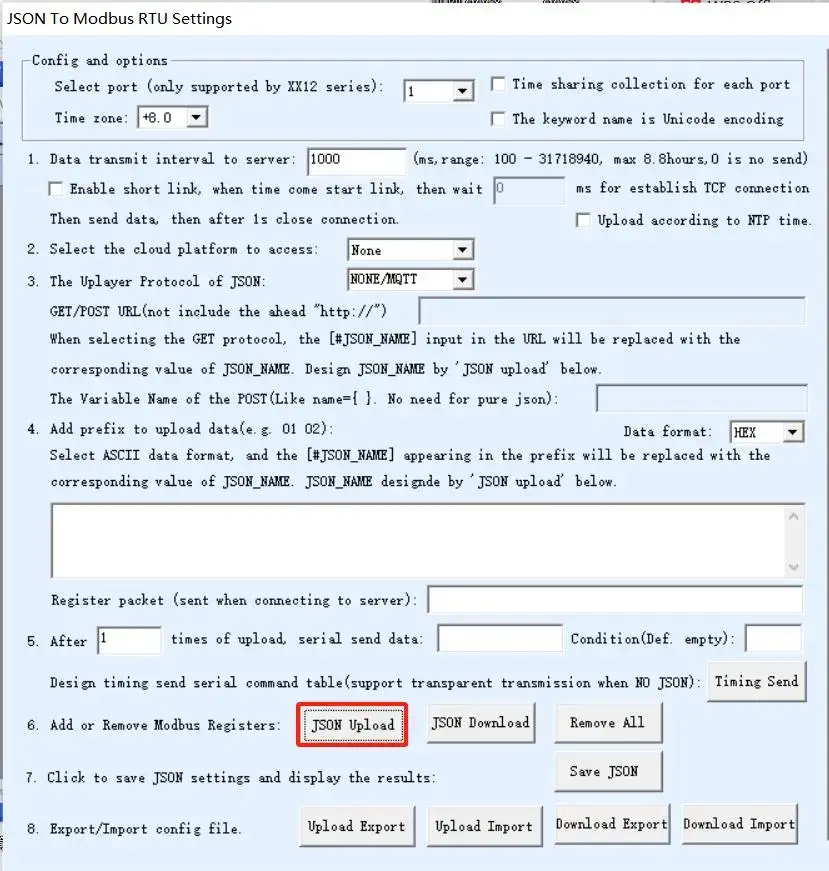
The 4G DTU was configured to:
- Poll power meters via Modbus RTU at regular intervals (e.g., every 5 minutes)
- Parse Modbus register values into meaningful readings (voltage, current, energy)
- Package readings into JSON format
- Upload JSON payloads to the cloud platform via HTTP POST or MQTT
Example JSON payload:
json
{
"device_id": "building_01",
"timestamp": "2024-03-24T10:30:00Z",
"voltage": 220.5,
"current": 12.3,
"power": 2.7,
"energy": 12450
}Remote Control
When the cloud platform detected abnormal conditions (e.g., power overload, fire alarm), it sent commands back to the 4G DTU:
- Cloud platform generates a JSON command with relay action
- 4G DTU receives command, converts to Modbus RTU
- Remote IO controller executes relay action (open/close)
- Safety equipment responds accordingly
This two‑way communication enabled automated responses to safety events without requiring on‑site personnel.
Results and Benefits
Data Centralization
The system consolidated energy and safety data from all buildings onto a single platform. Facility managers could now:
- View real‑time energy consumption across the site
- Receive alerts for abnormal conditions
- Access historical data for analysis
- Control safety equipment remotely
Operational Savings
According to the International Energy Agency (IEA) , real‑time energy monitoring alone can reduce consumption by 15–25% through optimized usage and early detection of inefficiencies. Combined with reduced manual inspections, operational costs typically drop by 30–50% .
For this deployment, the estimated annual savings exceeded $40,000 in labor and energy costs.
Safety Improvement
With remote control capabilities, fire equipment could be activated immediately upon alarm detection—without waiting for a technician to arrive on site. The system also logged all events for post‑incident analysis and regulatory reporting.
Industry Benchmarks
A North American industrial park that deployed a similar 4G‑based monitoring system reported:
- 80% reduction in routine site visits for meter readings
- 18% energy savings within the first year
- Zero unplanned outages related to equipment failure
According to IoT Analytics , investments in industrial IoT for facility management are growing at over 20% annually, driven by energy costs and sustainability requirements. The shift to cellular‑based monitoring (4G/5G DTUs) is accelerating as wired infrastructure becomes harder to justify in retrofit projects.
What to Look for in Similar Deployments
If you’re planning a smart industrial facility project, consider:
| Requirement | What to Look For |
|---|---|
| Legacy device integration | Modbus RTU support on the gateway |
| Cloud connectivity | HTTP/MQTT support, JSON formatting |
| Remote control | Relay outputs on IO controller |
| Environment | Industrial temperature range (–40°C to 85°C) |
| Installation | DIN rail mount, wide power input (9–24V DC) |
| Management | Remote configuration and firmware updates |