
Let’s be honest. When you hear about connectivity, all the buzz is about 5G—blazing speeds, self-driving cars, and futuristic tech. It’s easy to wonder if anything labeled “4G” is already on its way out.
But here is the reality that does not make headlines: when it comes to powering the not so exciting backbone of our connected world. The water sensors in remote reservoirs the diagnostic machines on factory floors the payment systems in mobile kiosks. The 4G modem is not just relevant the 4G modem is often the perfect tool for the job the most reliable tool.
If you are looking for 4G modems, you are probably not looking for the speeds. You are looking for something that works all the time. You need a 4G modem connection that’s reliable it works every day in good or bad conditions without costing too much money or needing to be checked all the time.
This article will cut through the noise. We’ll explain what a 4G modem truly is, how its mature technology actually works to your advantage, and why it might be the smartest connectivity choice you can make for your industrial or commercial project.
More Than Just Speed: The 4G Modem’s Real Job
At its core, a 4G modem (also called a 4G cellular modem or 4G LTE modem) is a specialized translator and a bridge. Its primary mission isn‘t to stream 4K video; it’s to solve a very practical problem: getting data from “thing A” to “cloud B” reliably, over long distances, without cables.
Think of it this way:
- Your Equipment (The “Thing”): This could be an old water meter with a serial (RS-485) output, a modern environmental sensor with Ethernet, or a PLC controller in a manufacturing line. They speak their own native, often local languages (like Modbus, raw serial data, or simple TCP).
- Your Management System (The “Cloud”): This is your server, dashboard, or IoT platform (like AWS IoT, Azure, or a custom SCADA system). It lives on the internet and understands universal IP-based protocols.
The 4G modem sits squarely in the middle. It connects physically to your equipment, understands its data “language,” packages it up, and then uses widespread 4G LTE cellular networks—the same networks your phone uses—to ferry that data to the internet and onward to its destination. It does the same in reverse, bringing commands from the cloud back down to your device.

A Peek Under the Hood: How Simplicity Breeds Reliability
Understanding what the system does is the step. We need to know what the system does. Understanding how the system does it reliably is what helps us trust the system. Let us follow the path of a piece of data like a temperature reading, from a remote sensor.
Step 1: The Handshake & Translation
Your sensor sends out information in a format through its RS-485 port. For example it might say “Register 3001 = 72.5°F” in a Modbus RTU frame. The modem has an interface that can be set up to match the sensors speed and format. When the information gets to the modem it does an important job, This job is called protocol conversion. Your sensor and the modem need to be able to understand each other so the modem converts the information, from the sensor into a format it can work with. The modem takes the serial frame and turns it into something the internet can understand. This new format is like a JSON payload inside an MQTT message or a data point in an HTTP POST request. The modem might translate this raw serial frame into a more internet-friendly format, like a JSON payload within an MQTT message or a data point in an HTTP POST request. It‘s translating from a “machine dialect” to the “web’s lingua franca.”
Step 2: The Cellular Journey
Now packaged as an IP packet, the data is handed to the modem‘s built-in 4G module. Using a SIM card (often an IoT/M2M-specific one for better rates and management), it authenticates on the local 4G network, much like your phone does. It establishes a stable data session, gets an IP address, and sends the packet wirelessly to the cell tower. From there, it’s routed across the public internet to your pre-configured server address.
Step 3: The Secret to “Always-On”: Heartbeats and Smarts
This is where a good 4G modem earns its keep. Cellular networks aren‘t perfect; connections can drop. A naive device might just go silent. An industrial-grade 4G cellular modem uses a heartbeat packet—a tiny, regular “I’m still here!” message sent to your server. If the heartbeats stop, the server knows there‘s an issue. Even better, the modem itself can detect a lost connection and automatically reconnect, often before your system even registers a problem. This self-healing capability is crucial for unattended operations.
Step 4: Management in Your Pocket
Modern 4G modems are not things you just set up. Then forget about. They are things that you can actually manage and take care of. You can use web pages or cloud platforms to do things to your 4G modems from far away like:
- Check real-time signal strength.
- View data usage.
- Update firmware to patch security or add features.
- Change configuration (like the destination server IP) for all your deployed devices at once.
This remote management turns a potential logistical nightmare (physically visiting sites to update 100 modems) into a few clicks.
| Stage | Location | Key Action | Why It Matters |
| 1. Collection | At your equipment | Modem reads serial/Ethernet data. | Must match the device‘s exact language (baud rate, protocol). |
| 2. Translation | Inside the modem | Converts data to IP-based protocol (MQTT, HTTP, etc.). | Makes legacy equipment data understandable by modern cloud apps. |
| 3. Transmission | Over the air | Encrypted data travels via 4G LTE networks. | Leverages vast, existing cellular coverage for wide-area reach. |
| 4. Assurance | Continuous | Heartbeat packets and auto-reconnect monitor health. | Provides “always-on” reliability without manual intervention. |
| 5. Management | From your office | Remote monitoring, updates, and configuration. | Enables scaling to hundreds of devices with minimal operational cost. |
4G versus 5G for Internet of Things: It is not an upgrade.
This is an important decision. A lot of people think that 5G is better just because it is newer. When it comes to Internet of Things that is not usually true:
- Coverage & Penetration: 4G networks are everywhere. They are very stable. The signal gets into buildings and rural areas really well. On the hand 5G networks, especially the super fast kind do not reach very far. You can usually only find 5G networks, in cities where a lot of people live.
- Power Consumption: The 4G modules, the Cat-1 or Cat-M1 kinds that are used for Internet of Things do not use a lot of power. They can work for years on just one battery. On the hand the 5G modules use a lot more power, which means they need to be charged more often or they need bigger batteries. The 4G modules are a choice when you want something that can run for a long time on a small battery.
- Cost: 4G modules, SIM plans, and the modems themselves are significantly cheaper due to economies of scale and mature technology.
- Needs: Does your sensor really need to send a lot of information like one thousand bytes, every ten minutes at a very fast speed of one gigabit per second? No. What your sensor needs is a connection that’s stable and does not cost too much and also uses very little power. That is what 4G is really good, at.
The Verdict: If you need something to work fast and have a lot of data to move like watching high definition video from a car in real time then you should choose 5G. But for most other jobs like keeping an eye on things and controlling machines you should use a 4G LTE modem. This is because 4G LTE is more reliable works in places and is cheaper to own over time.
The Industrial-Grade Difference: Why Your Project Demands It
You can buy a cheap 4G USB dongle meant for a laptop. It will probably work… until it doesn‘t. The environment where IoT devices live is not a cozy office.
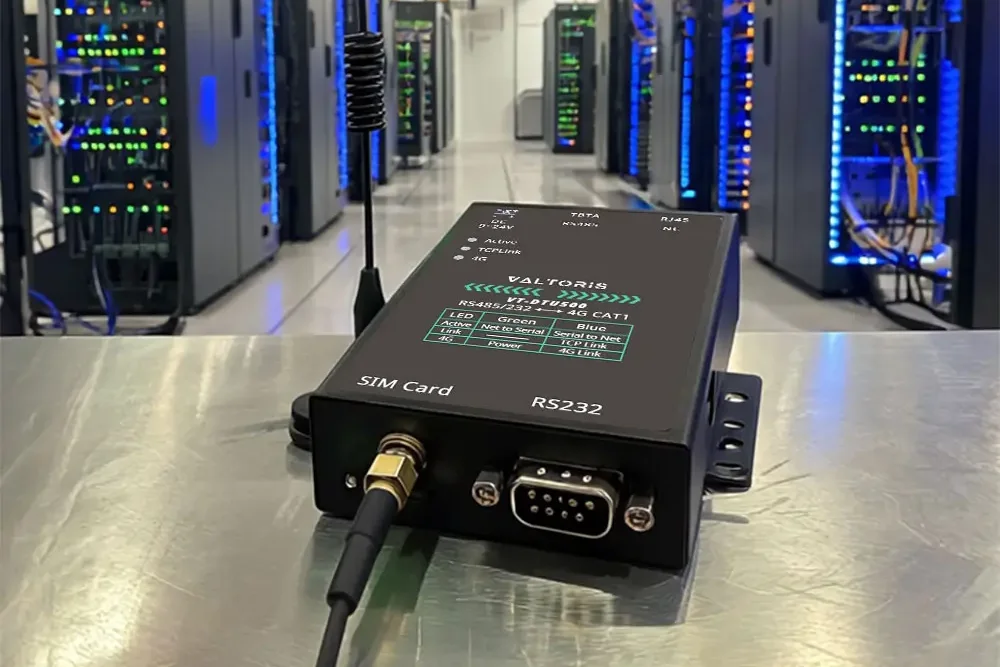
An industrial 4G modem, like those engineered by companies focused on this space such as Valtoris, is built to a different standard. The design choices directly answer the harsh realities of the field:
- Toughness: The Environmental Toughness of this thing is really good. It is put in a metal box. You can mount it on a DIN-rail so it does not get damaged when it is moved around a lot in a factory or when it is in a vehicle that is driven on a bumpy road. The parts of the Environmental Toughness device are made to work in very cold and very hot temperatures from -40°C to 85°C so it can be used outside in the winter when it is very cold or inside a hot cabinet, in the summer when it is very hot.
- Electrical Robustness: it can handle a range of direct current power like from 9 to 48 volts. This is the kind of power you often see in settings and in systems that use solar panels or batteries. Electrical Robustness also protects against jumps, in voltage and reverse polarity, which are common problems people have with electrical panels and Electrical Robustness can deal with these issues.
- Interface Flexibility: This thing is really flexible. It does not just have a USB port. It actually has the kinds of interfaces that you need for work. You get screw-terminal RS-485/RS-232 for machines and an Ethernet port for newer devices. This means the Interface Flexibility of this device is very good and it can connect to any device you have, like the Interface Flexibility allows you to use it with old and new devices.
- Software for Integration: It works with the protocols that your system uses every day like Modbus TCP for networks or MQTT for modern cloud platforms. This means you do not have to spend months creating custom software.
Yes, this ruggedness and capability come at a higher initial cost than a consumer dongle, and the configuration might require a bit more technical understanding (though good vendors provide clear tools). But this investment is trivial compared to the cost of a single site visit to replace a failed unit, or the business impact of lost data from a critical asset.
The Valoris Perspective: Building Connectivity You Can Trust
For us at Valoris, designing a device like our industrial 4G modem routers isn‘t about cramming in the most features. It’s about thoughtfully addressing the “what-ifs” that keep project managers up at night.
When we specify a temperature range of -40°C to 85°C we are thinking about a place like that site, in North Dakota where there is no air conditioning. We want the equipment to work well in cold and very hot temperatures.
When we include both RS-485 and Ethernet ports we are making sure that the new sensor and the old pump controller can be connected without needing two devices. This is convenient because you do not have to deal with boxes.
The ultimate goal is for the modem to be the one part of your solution that becomes invisible—not because it’s unimportant, but because it works so consistently and reliably that you simply stop worrying about it. In the world of IoT, that peace of mind is the most valuable feature of all.
Choosing a 4G modem, therefore, is less about purchasing a component and more about selecting a long-term data integrity partner. It‘s about recognizing that in a world obsessed with the next big thing, there’s immense value in the proven, robust, and deeply understood technology that quietly powers progress every single day.