
Industrial Fiber Media Converters
Extend Critical Networks Over 20km & Eliminate EMI Interference
Valtoris fiber optic media converters (often deployed as industrial fiber optic modems) convert your Ethernet or RS485/232 signals to lossless light pulses, delivering rock-solid data links in punishing factory environments.
Ethernet to Fiber Converters
Overcome the standard 100m copper limit. Delivering reliable media conversion, this fiber to ethernet converter seamlessly bridges your networks, ideal for expanding campus IP surveillance and substation LANs.
Serial to Fiber Converters
Achieve absolute EMI immunity for your critical control loops. Whether you need a transparent serial to fiber optic converter or an advanced RS485 to fiber converter with Modbus TCP/IP routing, we offer zero-delay hardware solutions.
The Valtoris Fiber DNA
Whether you are transmitting IP packets or Modbus RTU data, every Valtoris fiber converter is engineered with the same industrial-grade resilience.
Complete EMI Immunity
Fiber optic technology is non-conductive and immune to ground loops, lightning strikes, and RFI/EMI, guaranteeing data integrity in high-voltage environments.
Single-Mode Single-Fiber
Maximize your infrastructure budget. Utilizing advanced optical technology, our industrial transceivers achieve 20km ranges using just a single strand of fiber.
Harsh Environment Ready
Designed for the field, not the office. Featuring -40°C to 85°C extreme operating temperatures, wide 9~24V DC inputs, and rugged metal DIN-rail enclosures.
Is Optical Fiber Right For Your Application?
Transparency saves time. Here is exactly when you should upgrade to Valtoris fiber optics, and when standard copper cabling is actually the better choice.
Ideal Use Cases (Choose Fiber)
- High EMI Environments: Substations, VFD motor control centers, or heavy manufacturing where copper suffers from data loss.
- Long Distance Runs: IP networks exceeding 100 meters or RS485 networks exceeding 1.2km (extends up to 20km).
- Outdoor / Lightning Exposure: Absolute ground loop isolation is mandatory to protect expensive PLCs, servers, and cameras.
Not Recommended (Stick to Copper)
- PoE Requirements: Fiber optic glass cannot carry electrical power. Remote IP cameras must have local DC power sources.
- Short, Clean Runs: If transmitting under 100m indoors with zero high-voltage equipment nearby, standard CAT6 is more cost-effective.
- Multi-Mode Infrastructure: Valtoris converters use Single-Mode technology. They will not work over legacy dual-core Multi-Mode fiber cables.
Featured Optical Media Converters
From zero-delay transparent serial transmission to advanced Modbus network gateways.
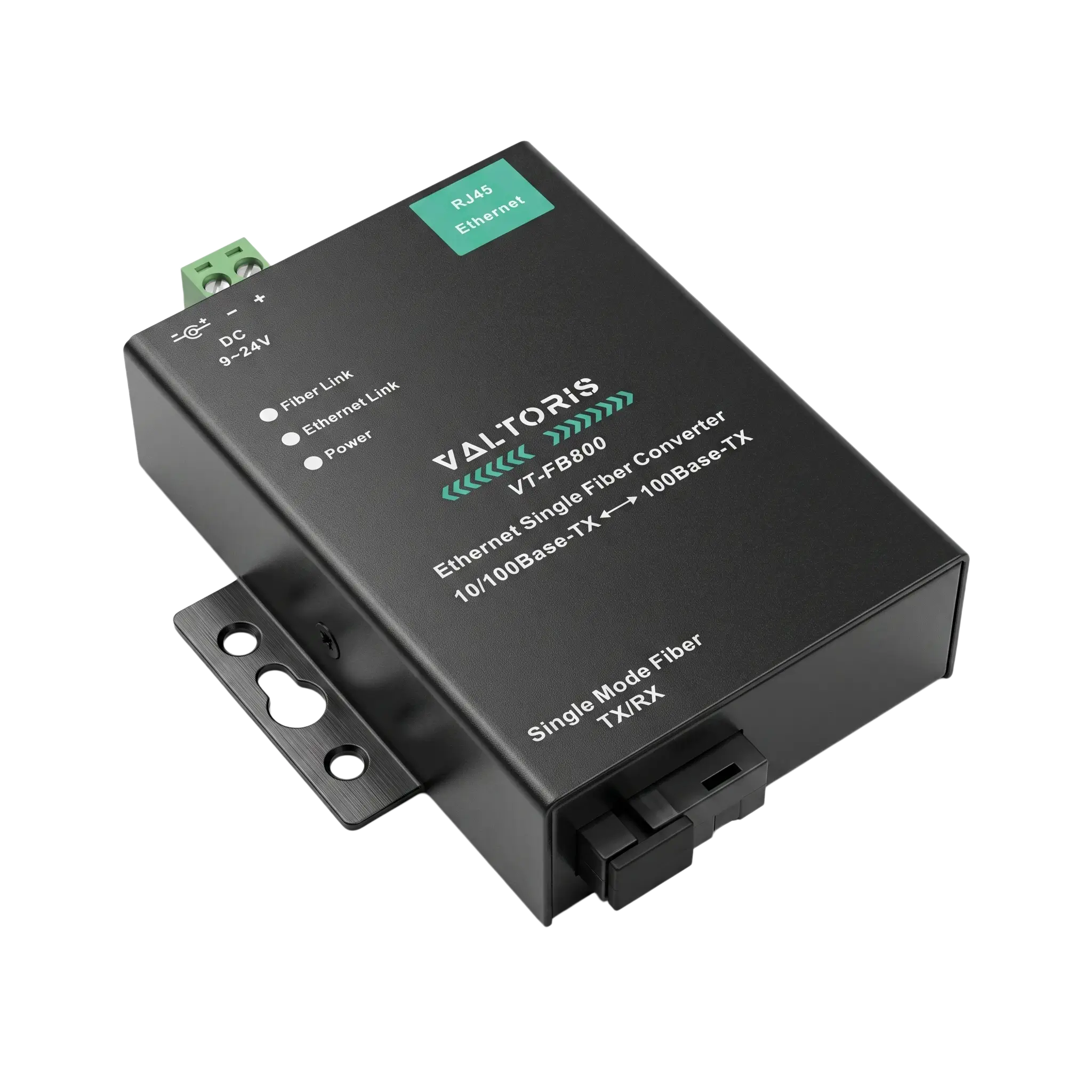
VT-FB800 Media Converter
Transparent 10/100Base-TX RJ45 to 100Base-FX optical conversion. Plug-and-play network extension up to 20km for IP cameras and remote LANs.
View Details →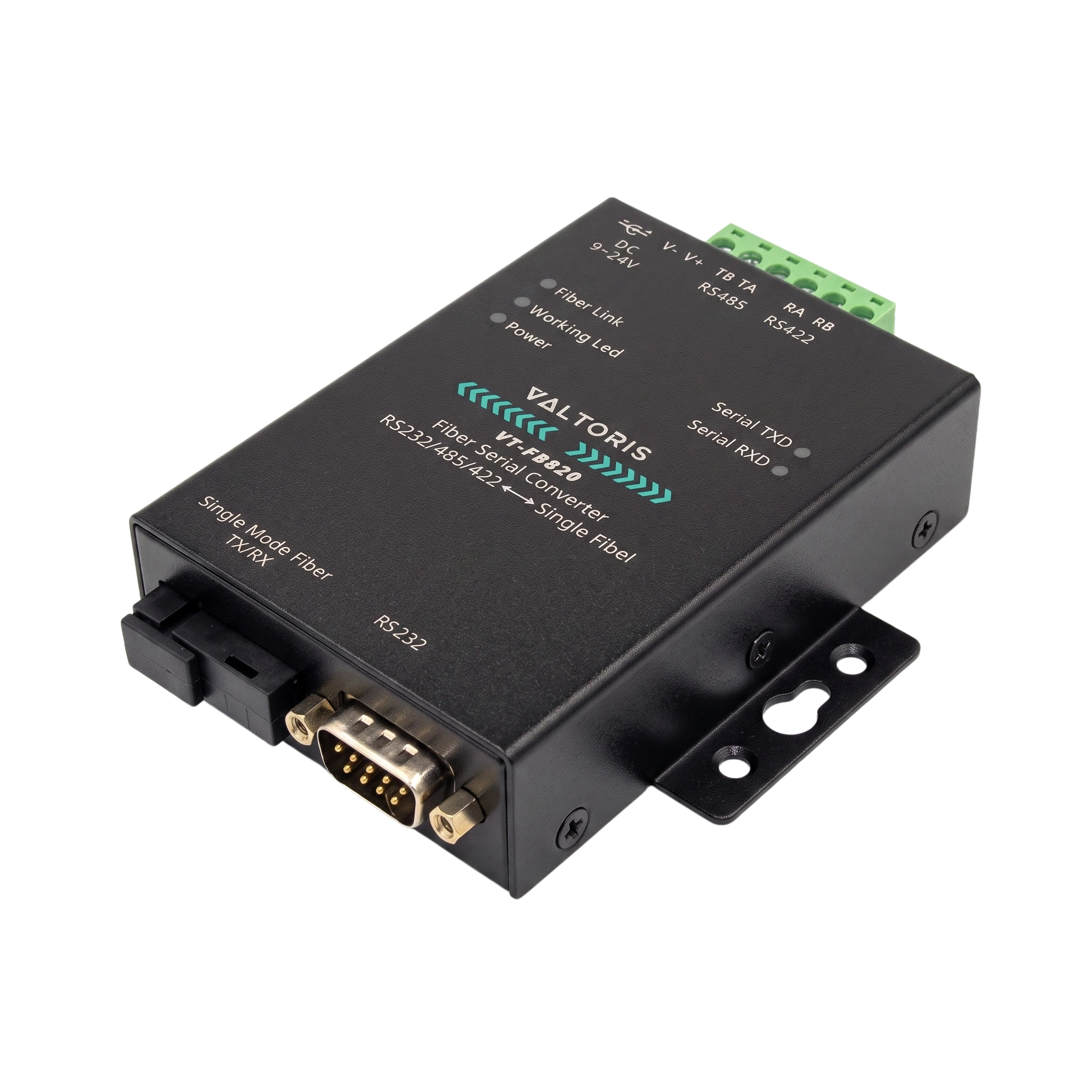
VT-FB820 Zero-Delay Modem
Pure physical layer extension with up to 115200bps baud rate support. Uses hard decoding for zero-delay transmission. Note: Designed for paired use only, cannot integrate into optical switches.
View Details →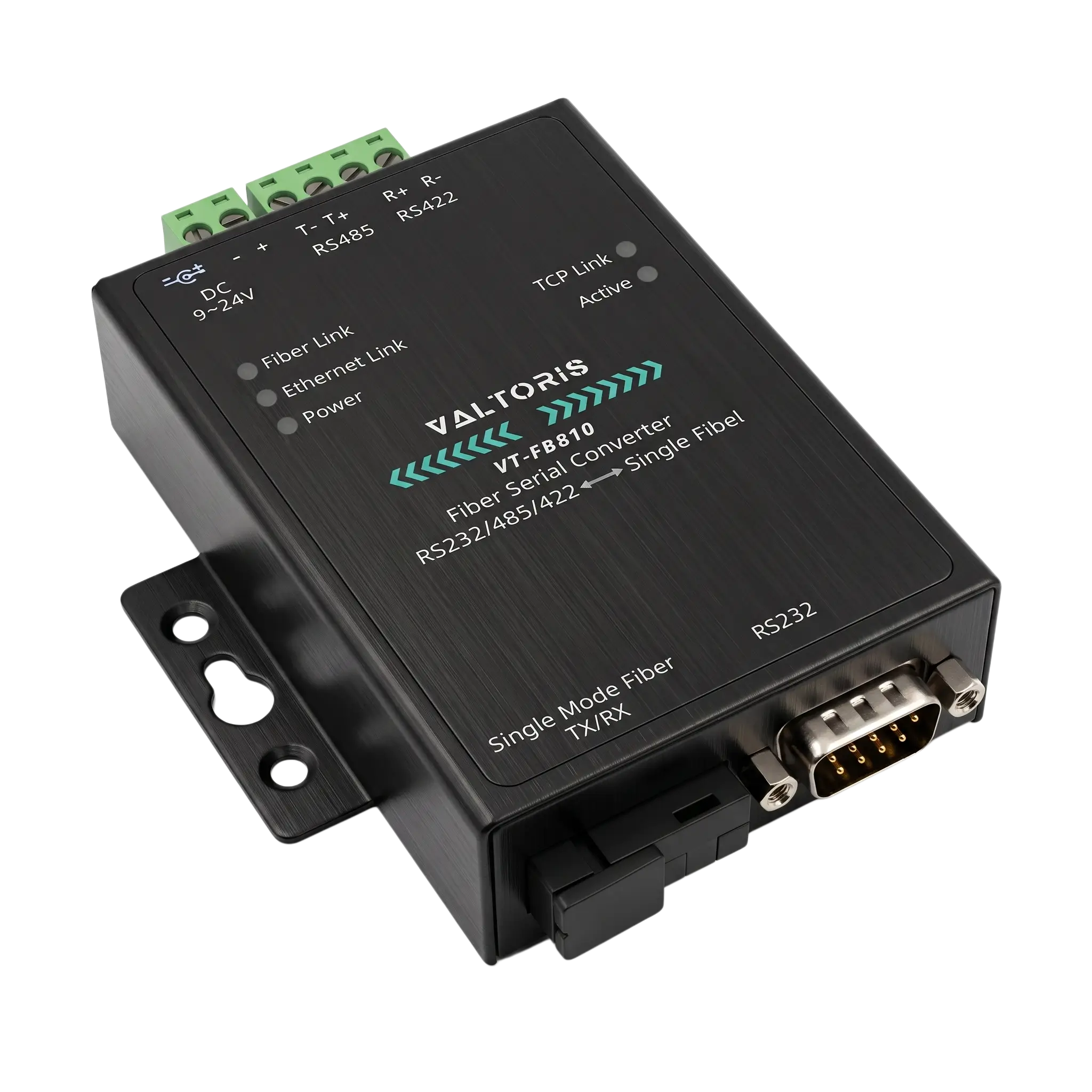
VT-FB810 Fiber Serial Server
Engineered to transform serial data into TCP/IP packets. Seamlessly integrates legacy SCADA into your existing optical switch network. Supports Modbus RTU to Modbus TCP routing.
View Details →Not Sure Which Optical Converter Fits Your Architecture?
Whether you need A/B end pairing for a simple RS485 loop, or a direct TCP/IP integration into an existing optical switch network, review our technical specs (9~24V DC, -40°C to 85°C rated) or let our engineers guide you.
Technical Guides & Applications
Deep dive into optical conversion technology, architectural best practices, and real-world industrial deployments.
What Is a Fiber Media Converter? (And When You Actually Need One)
Understand the fundamental mechanics of media conversion, common misconceptions, and the specific scenarios where upgrading to fiber becomes a critical necessity for your network.
Read Guide Industry ApplicationsRS485 & RS232 Over Fiber: How Different Industries Use Them
Explore how legacy serial protocols remain relevant by leveraging fiber optics to achieve absolute EMI immunity and extended reach in substations, manufacturing, and traffic control.
Read GuideFrequently Asked Questions
Q1: Do I need an A-End and B-End converter? Why can’t I use two identical units?
A: Valtoris industrial fiber converters utilize “Single-Mode Single-Fiber” technology to save cable costs. This means transmission and reception happen on different light wavelengths over a single glass core. Thus they have to be used in matched pairs. For example, if unit A transmits on 1310nm and receives on 1550nm, unit B must do the reverse (transmit on 1550nm, receive on 1310nm) for a handshake.
Q2: What is the difference between the VT-FB820 and the VT-FB810 for serial data?
A: VT-FB820 is a transparent hardware modem for fiber line, It employs zero-delay decoding – ideal for strict timing protocols without the need for an IP address.
The VT-FB810 is an advanced Serial Device Server. It actively converts RS485/232 data into standard TCP/IP packets, serving as a robust fiber to ethernet converter. This allows a remote PC to read serial data over your routed optical LAN.
Q3: Will these converters work with my existing fiber optic switch?
A: Yes, but only if you select the correct model. If you are extending a standard LAN, the VT-FB800 (Ethernet to Fiber) can connect to a third-party optical switch. If you are connecting serial devices, you must use the VT-FB810 (which outputs standard network TCP/IP packets over fiber). Always verify the wavelength (1310nm vs 1550nm) of your existing switch port to choose the matching A or B end unit.
Q4: Can fiber media converters be installed outdoors or in high-voltage substations?
A: Yes, this is exactly what they are built for. Because optical fiber is made of glass, it is completely non-conductive. This physically isolates your control equipment from the massive ground potential rise and EMI found in substations. Our units are also in a heavy-duty SECC metal enclosure and work perfectly from -40°C to +85°C making them ideal for unconditioned outdoor NEMA enclosures.