

In many solar monitoring projects, RS485 looks deceptively simple.
A few inverters, some meters, one Modbus master, twisted-pair cables — everything works fine during commissioning. Data comes in, dashboards light up, and the project moves forward.
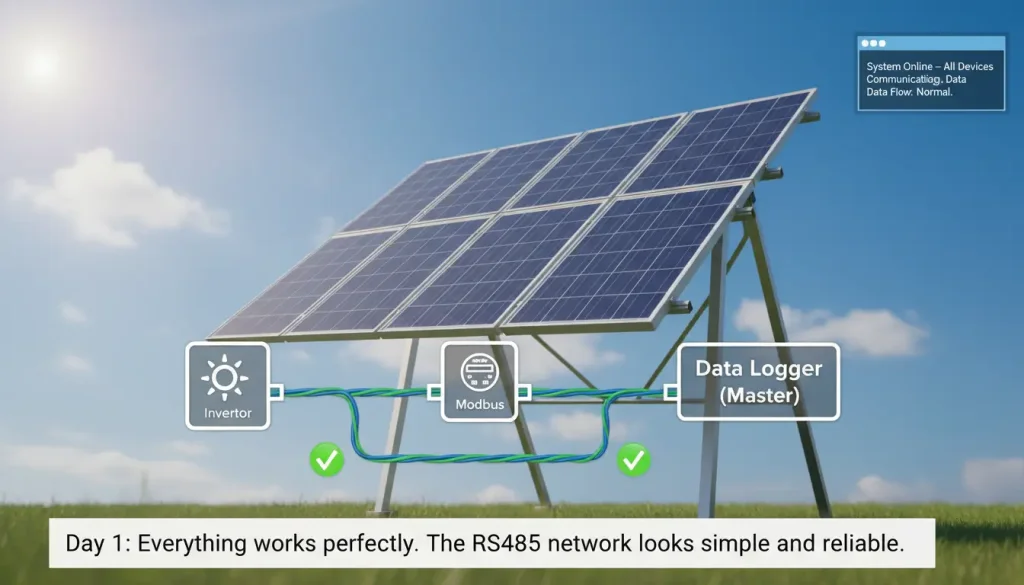
Then the site expands.
More strings, more sensors, longer cable runs. Suddenly, the same RS485 network that “used to work” starts behaving strangely. Random timeouts. Devices disappearing. Communication errors that come and go without a clear pattern.
At this point, many teams start asking the wrong question.
They ask: “Which device is faulty?”
But the real question should be: “Did we design this network for what it would become?”
The Pitfall Most Projects Don’t Realize They’re Walking Into
Here’s the mistake we see over and over again:
The RS485 network was designed only for today’s device count, not tomorrow’s.
In early-stage solar plants, star wiring often looks convenient. All RS485 devices are pulled back to a central cabinet, saving time on installation. On paper, it feels clean.
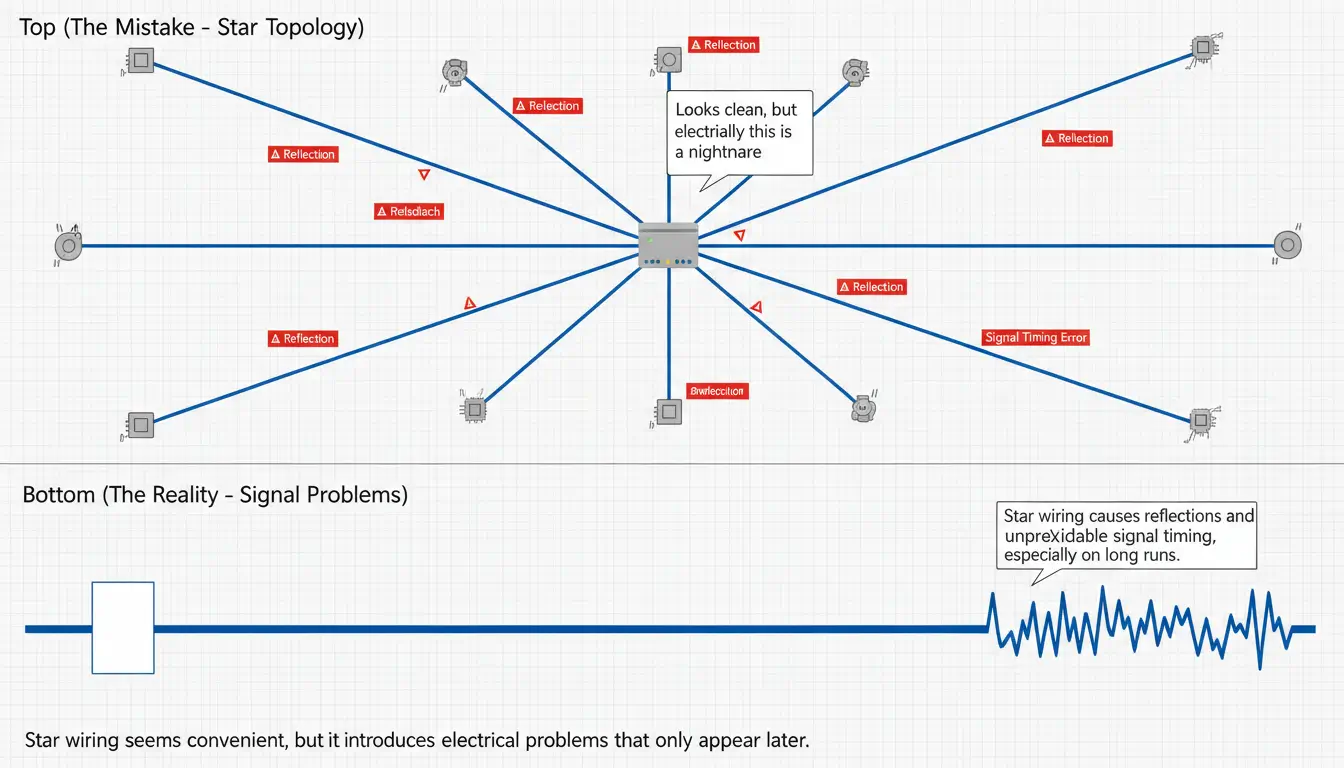
In reality, this is where long-term problems start.
Star topologies introduce reflections, uneven line impedance, and unpredictable signal timing. These issues don’t always show up immediately — which is why they’re so dangerous. They surface later, under load, during expansion, or after months of operation.
At that stage, troubleshooting becomes expensive. Not just in money, but in time.
Why “Just Add a Repeater” Often Doesn’t Fix It
When RS485 communication becomes unstable, a common reaction is to add repeaters or replace cables.
Sometimes that helps. Often, it doesn’t.
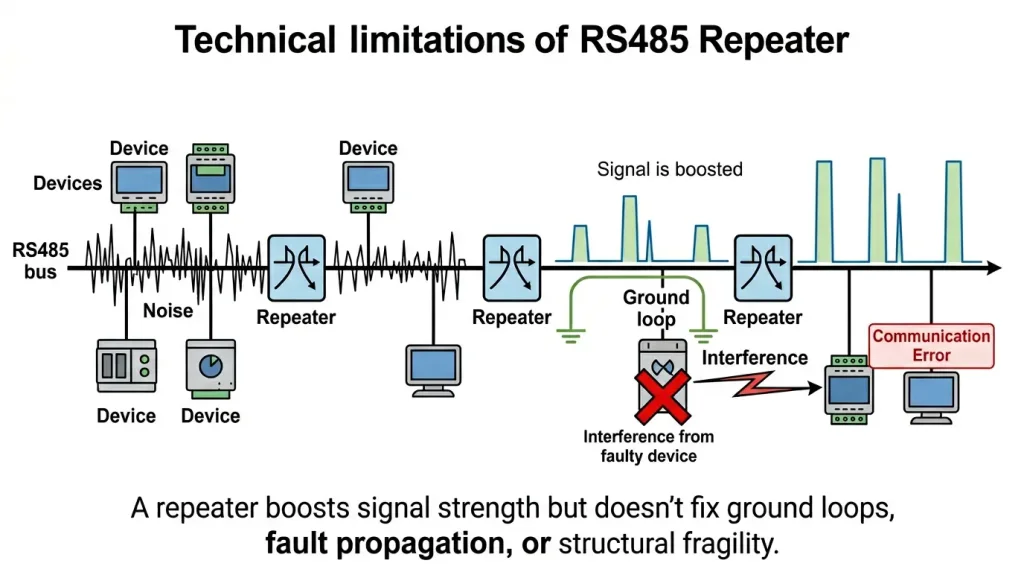
A repeater extends distance, but it doesn’t fundamentally change how devices are electrically connected. Ground loops, common-mode voltage differences, and branch interference still exist — especially in large outdoor solar installations where grounding conditions vary across the site.
This is why two projects with similar devices and similar cable lengths can behave completely differently.
The difference isn’t the protocol.
It’s the network structure.
Where an RS485 Multiport Hub Changes the Game
This is where an RS485 multiport hub becomes less of a “nice-to-have” and more of a design tool.
A properly designed RS232/RS485 Hub does three critical things at once:
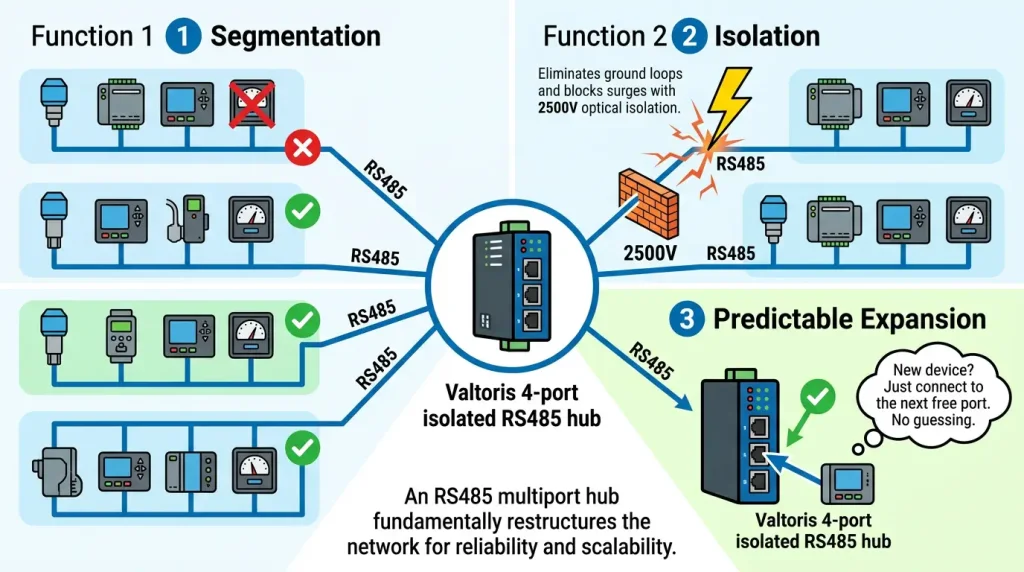
- It breaks one unstable bus into multiple isolated segments
Each RS485 branch becomes electrically independent, reducing reflections and preventing one faulty branch from dragging the entire network down. - It eliminates ground loop headaches before they appear
With optical isolation on each channel, devices can float relative to each other. This is especially important in solar fields where grounding potential differences are unavoidable. - It makes expansion predictable
Instead of guessing whether the next device will “still work,” each new branch connects to a dedicated channel. No trial-and-error. No midnight site visits.
The result isn’t just better communication — it’s fewer surprises.
A Real-World Example from Solar Monitoring Sites
In one mid-sized solar plant, operators struggled with intermittent Modbus dropouts after expanding their inverter count. The original RS485 bus had been stable for over a year.
No firmware updates fixed it.
No cable replacement solved it permanently.
The issue wasn’t noise. It was structure.

After deploying an isolated RS485 multiport hub, the same devices, same protocol, same baud rate — the network stabilized immediately. More importantly, future expansion stopped being a risk factor.
That’s when teams usually realize the uncomfortable truth:
The earlier RS485 design “worked” — but it was fragile.
What This Means When You’re Choosing Hardware
This is where many buyers get misled.
On spec sheets, most RS485 devices look similar. Same baud rates. Same terminals. Same protocols.
But an industrial RS232 hub designed as a true RS485 system expander behaves very differently from a simple splitter or passive distributor.
A solution like the Valtoris isolated RS485 multiport hub is built specifically for these real-world conditions:
- Industrial-grade RS232 RS485 communication hub design
- 2500V channel isolation for surge and ground loop protection
- DIN rail RS232 RS485 interface hub format for control cabinets
- LED diagnostics that save hours during installation (and mis-wiring happens more than people admit)
Is it the cheapest option? No.
Is it cheaper than repeated site debugging and unexpected downtime? Absolutly.
| Feature | Simple Splitter / Passive Hub | Valtoris Industrial Isolated Hub |
|---|---|---|
| Segmentation | No – all ports are still one electrical bus | Yes – each port is an independent, isolated segment |
| Fault Isolation | None – one faulty device can bring down all ports | Excellent – fault isolated to its segment only |
| Ground Loop Protection | None | 2500V optical isolation on each channel |
| Surge Protection | Minimal or none | Built-in, protects master equipment |
| Expansion Predictability | Low – adding devices is risky | High – each new branch is a clean start |
| Diagnostics | None or basic LEDs | Per-port LEDs for power and activity |
| Enclosure | Often plastic | Rugged metal, DIN-rail mountable |
| Long-Term Reliability | Unpredictable | Designed for years of 24/7 operation |
The Question You Should Be Asking Before Deployment
Instead of asking:
“Will this RS485 setup work?”
A better question is:
“Will this still work after we expand, rewire, or replace devices?”
That’s the difference between a project that merely runs — and one that stays reliable.
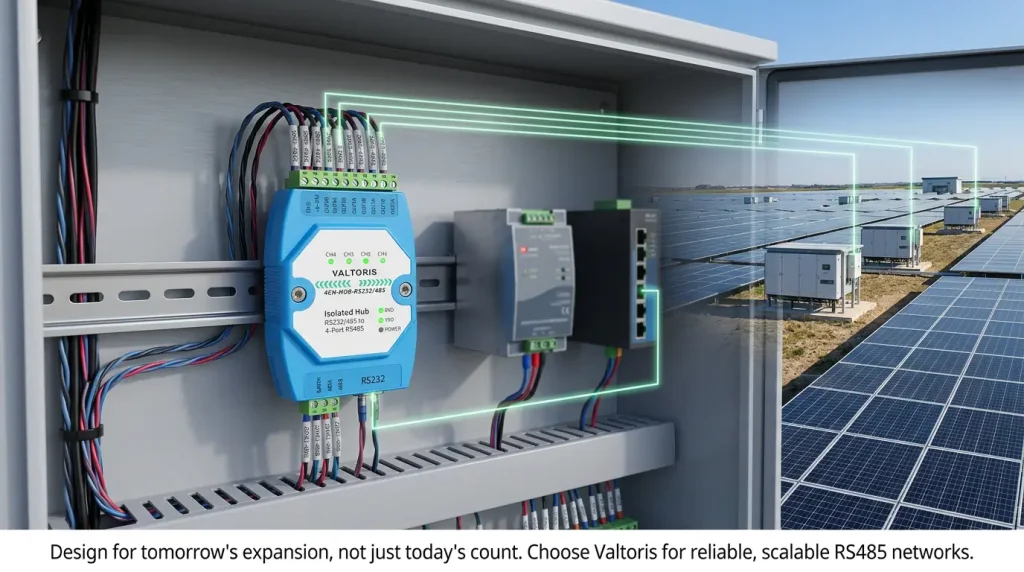
If you’re designing solar monitoring systems today, planning for structure upfront is one of the few decisions that genuinely reduces risk later.
REQUEST A QUOTE
Related Posts
No posts