
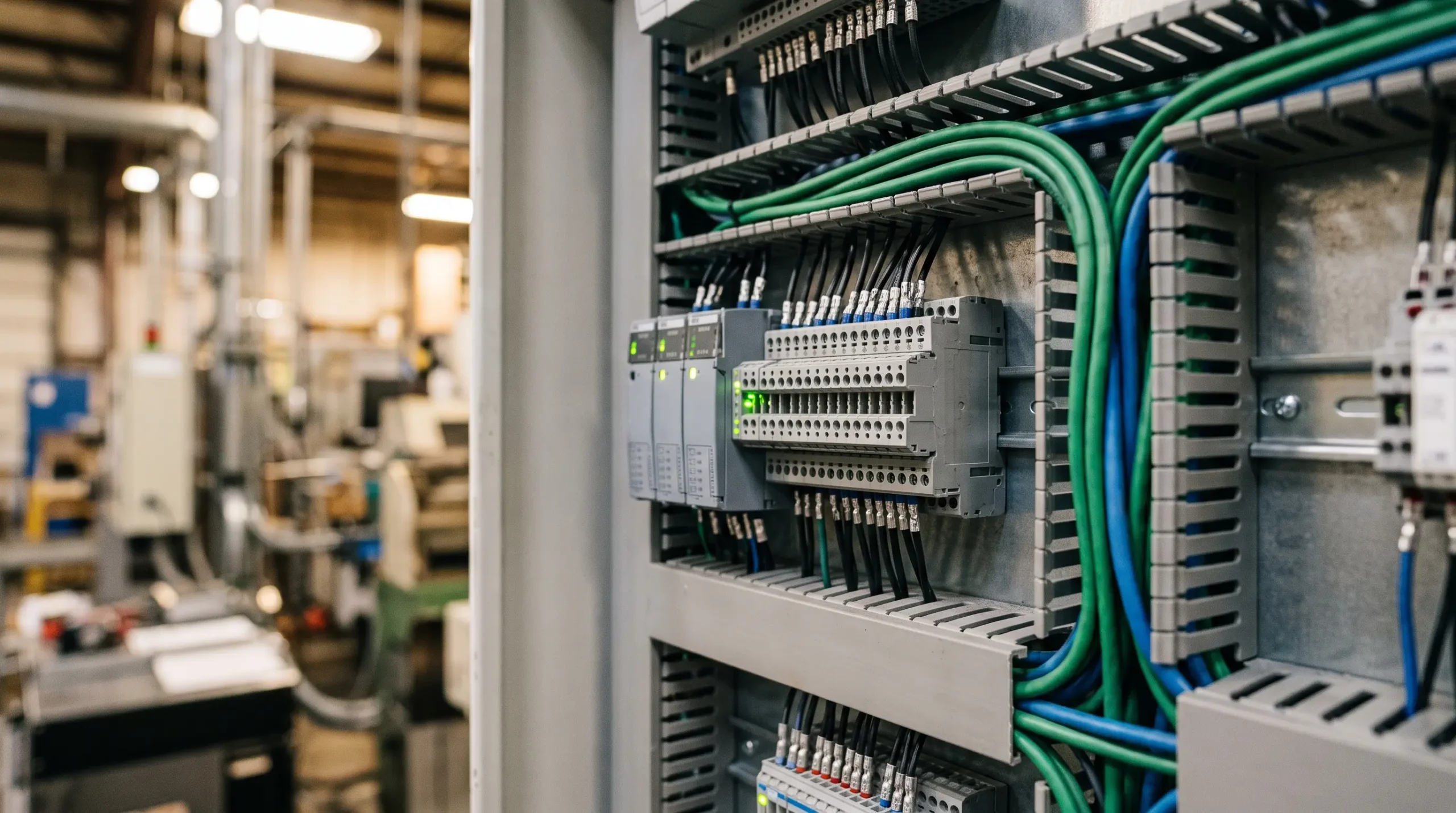
When you add remote I/O to an industrial control system, you inevitably reach an architectural crossroads. You have three major protocols to choose from: EtherNet/IP, PROFINET and Modbus TCP. The rule of thumb that is passed down from engineer to engineer seems pretty straightforward: if you have a Siemens PLC in your panel, use PROFINET. If you have a Rockwell Automation PLC, use EtherNet/IP. For everything else, fall back to Modbus TCP.
That rule works great in a pristine single-vendor lab. But on the factory floor, mixed PLC brands, wireless telemetry links, and tight capital expenditure (CapEx) budgets make architectural decisions difficult. If your project mandate requires 100% native PROFINET I/O nodes with GSDML files regardless of price, this guide might not be for you. However, if you are struggling with the exorbitant costs of single-vendor I/O ecosystems, or dealing with PROFINET dropping out over Wi-Fi, this whitepaper will show you how to build a highly cost-effective Heterogeneous Architecture: utilizing dedicated PROFINET switches for the rigid control core, while deploying intelligent Modbus TCP/IoT nodes at the edge.
The industrial Ethernet market is consolidating rapidly around these giants. According to the highly anticipated HMS Networks’ 2026 Industrial Network Market Shares Report, industrial Ethernet now accounts for a staggering 79% of all new installed network nodes globally. Within this massive ecosystem, PROFINET has strengthened its lead at 30%, followed closely by EtherNet/IP at 25%. Meanwhile, Modbus TCP continues to grow, maintaining a highly strategic, universally supported 5% market share as the ultimate fallback protocol.
This deep-dive engineering whitepaper will compare PROFINET vs Modbus TCP vs EtherNet/IP specifically through the perspective of selecting Remote I/O modules. We will discuss data exchange models, granularity of diagnostics, microsecond determinism, resilience of network topologies and the hidden hardware costs. We hope to provide you with the precise technical justification you need to build a resilient, inexpensive heterogeneous network.
⚙️ Interactive: Remote I/O Protocol Matrix
Input your project constraints below. Our logic engine will evaluate latency, topology, and cost constraints to recommend the most architecturally sound protocol path.
The Elephant in the Room: Your PLC Usually Dictates the Protocol
Before we get into packet headers and jitter, we need to talk about the defining reality of the industry, ecosystem lock-in. The IDEs of the automation giants are written to be heavily biased toward their own rigorously guarded protocols. It’s not just a preference in software, it’s down in the protocols exchanging data at the lowest levels.
If your panel utilizes an Allen-Bradley ControlLogix controller, EtherNet/IP is the path of least resistance. It operates on a Producer/Consumer model via the Common Industrial Protocol (CIP). Nodes multicast data, and any interested controller can consume it. The protocol is deeply embedded into Rockwell’s Studio 5000 software via Custom Add-On Profiles (AOPs), making device discovery near-instantaneous.
Conversely, if your plant is standardized on the Siemens S7-1200 or S7-1500 families, PROFINET is the undisputed king. Operating on a highly optimized Provider/Consumer model, PROFINET skips the TCP/IP layers for cyclic data (RT), dropping payloads directly onto the Ethernet MAC layer for maximum efficiency. TIA Portal’s hardware catalog and topology views are built specifically to ingest PROFINET nodes seamlessly.
Can you link the ecosystems? Definitely. Yet, to make a native PROFINET Remote I/O module talk to a Rockwell PLC, requires costly protocol gateways, complex data mapping and introduces unwanted single points of failure. The profinet vs ethernet ip battle starts with recognizing the pull of gravity of your primary controller brand.
Device Integration Effort: EDS vs GSDML Files vs Register Maps
The true cost of a Remote I/O module isn't just the invoice price—it’s the engineering hours spent trying to establish communication, and more importantly, the hidden costs of diagnosing faults during unplanned production downtime. Here is how the software integration experience and diagnostic granularity radically diverge.
PROFINET (GSDML) & EtherNet/IP (EDS): These protocols use standardized XML or text based device description files provided by the I/O manufacturer. When you import an EDS (Electronic Data Sheet) or GSDML (General Station Description Markup Language) file into your PLC software, the IDE immediately knows exactly how many inputs and outputs the module has, what parameters can be tuned, and automatically creates named tags. when it works it is a plug-and-play experience. Troubleshooting configuration mismatches caused by a badly written or outdated GSDML file from a third-party vendor with syntax errors may result in days of downtime in TIA Portal.
However, their greatest strength lies in Diagnostic Granularity. Because the device structure is defined, a PROFINET Remote I/O module can tell the Siemens PLC not just that it failed, but specifically: "Channel 3 Digital Output: Short Circuit to Ground" or "Channel 1 Analog Input: Wire Break." This allows maintenance teams to fix physical wiring issues in minutes.
Modbus TCP (Manual Mapping): Modbus TCP does not have this abstraction. It employs a simple Client/Server (Master/Slave) polling model. No proprietary integration files are available. You simply give the module an IP address, open a generic MB_CLIENT block in your PLC, and point that to a specific hex holding register. It’s manual, it has to look at the manufacturer’s PDF register map, and you’ve got to create your own tags manually.
The tradeoff? It is utterly transparent, immune to IDE software version conflicts, and arguably the most bulletproof way to execute cross-brand integration. However, diagnostics are limited. If a sensor wire breaks, standard Modbus TCP generally won't alert you directly unless you poll it.
The Edge Automation Advantage: To overcome traditional polling lag, advanced remote I/O nodes (like the Valtoris 4CH and 8CH series) feature built-in Active Reporting (Auto-report) and Peer-to-Peer DIDO Control. Instead of waiting for the PLC's read cycle, the module autonomously pushes the state change to the controller or triggers another I/O module instantly. This event-driven mechanism slashes network bandwidth usage and mimics the responsiveness of high-end deterministic protocols without the heavy ASIC hardware tax.
| Protocol | Configuration File | Diagnostic Granularity | Complexity vs. Flexibility |
|---|---|---|---|
| PROFINET | GSDML (XML based) | High (Channel-level Wire Break/Short Circuit) | Low effort, high reliance on vendor file quality. |
| EtherNet/IP | EDS (Text based) | High (CIP specific extended diagnostics) | Low effort, deeply tied to ODVA conformance. |
| Modbus TCP | None (PDF Register Map) | Low (Basic timeouts, generic Exception Codes) | Higher initial setup time, absolute cross-brand flexibility. |
Speed and Determinism: Do You Really Need Microsecond Polling?
Now if you look at profinet vs modbus tcp the conversation always comes down to speed. But engineers regularly conflate “fast” and “deterministic.” PROFINET and EtherNet/IP justify their engineering complexity with determinism, the absolute mathematical guaranty that a packet will arrive exactly on the microsecond it is expected every single cycle, regardless of network traffic.
To achieve this, PROFINET physically alters how Ethernet works. According to the PI (PROFIBUS & PROFINET International) specifications, PROFINET RT (Real-Time) operates directly at Layer 2, stripping away the TCP/IP overhead. It delivers cycle times between 1-10 milliseconds.
For highly synchronized motion control, PROFINET IRT (Isochronous Real-Time) utilizes hardware-based time-slicing. It reserves dedicated bandwidth on the wire specifically for control data, achieving sub-millisecond precision (<1ms) with near-zero jitter (network delay variation). EtherNet/IP achieves similar determinism for motion via CIP Sync, relying on IEEE 1588 Precision Time Protocol.
Modbus TCP, conversely, encapsulates its data payload inside a standard TCP/IP wrapper. It must traverse the entire OSI model stack (IP routing, TCP handshakes). Typical polling latency ranges from 20ms to 100ms, heavily dependent on how many other devices (like HMI screens or cameras) are consuming bandwidth on the same switch.
| Protocol Mechanism | Typical Cycle Time | Network Jitter | Ideal Application (Remote I/O) |
|---|---|---|---|
| PROFINET IRT / CIP Sync | < 1 ms | < 1 µs | High-speed packaging, multi-axis robotic synchronization. |
| PROFINET RT / Implicit EtherNet/IP | 5 - 20 ms | Moderate | Standard conveyor logic, rapid discrete sorting, pneumatics. |
| Modbus TCP (Standard TCP Polling) | 50 - 200 ms | High | Pump stations, temperature monitoring, general telemetry. |
Network Topology: Daisy-Chaining, DLR, and MRP Resilience
Deploying Remote I/O on a massive factory floor forces engineers to confront physical cable routing. Standard IT networks rely on a "Star" topology, where every single end device runs a dedicated cable back to a central switch in a server room. In industrial automation, pulling 40 individual Ethernet homerun cables across 300 feet of harsh manufacturing space is a catastrophic waste of copper, conduit, and skilled labor.
Modern industrial Remote I/O modules integrate a built-in 2-port unmanaged switch, allowing engineers to daisy-chain devices sequentially down the line. However, a linear daisy chain introduces a severe vulnerability: if a forklift cuts the cable in the middle, every module downstream loses communication instantly.
To combat this, the leading protocols offer proprietary ring redundancy technologies that loop the end of the daisy chain back to the main switch:
- EtherNet/IP uses DLR (Device Level Ring): Guided by ODVA standards, a DLR ring utilizes Beacon frames to monitor link status. It can detect a cable break and reroute traffic in less than 3 milliseconds, ensuring a continuous control loop without bumping the PLC into a fault state.
- PROFINET uses MRP (Media Redundancy Protocol): Designed for industrial ring topologies, an MRP manager actively monitors the ring and can logically unblock the redundant port, reconfiguring the network in under 200 milliseconds following a physical fault.
The Crucial Catch for PROFINET: you need to have an underlying infrastructure that supports the protocol to gain the benefits of PROFINET’s real-time capabilities and MRP ring topologies. PROFINET RT utilizes IEEE 802.1p Quality of Service (QoS) tags heavily to give priority to control data over normal TCP/IP traffic. If you run that traffic through plain commercial IT switches, the switch will strip the QoS tags and destroy the deterministic timing. The use of dedicated PROFINET Unmanaged Switches is a strict operational requirement to guaranty real-time packet prioritization across your Siemens architecture.
| Protocol | Ring Redundancy Standard | Typical Recovery Time | Switch / Infrastructure Requirement |
|---|---|---|---|
| EtherNet/IP | DLR (Device Level Ring) | < 3 ms | DLR-capable switches and endpoint devices. |
| PROFINET | MRP (Media Redundancy Protocol) | < 200 ms | Managed PROFINET Switches supporting QoS and MRP. |
| Modbus TCP | RSTP (Rapid Spanning Tree) | 1 - 3 Seconds | Standard IT or Industrial Switches (Not ideal for fast control). |
The Cost Factor: Why is Modbus TCP Remote I/O Cheaper?
When hardware quotes are reviewed by purchasing agents and project estimators, they often see a confusing discrepancy. A 16-channel Digital Input module which communicates over Modbus TCP is often 30% to 50% less expensive than the exact same physical module with a PROFINET or EtherNet/IP interface. This is not arbitrary brand markup, but the result of hard realities in silicon hardware and institutional licensing.
Modbus TCP is an open , royalty free protocol that runs on standard TCP/IP software stacks . This can be processed in an efficient way by a standard low cost microcontroller (MCU) present inside the I/O node. There are no mandated organization fees to implement it, allowing manufacturers to pass the savings directly to the integrator.
Conversely, achieving the extreme determinism of PROFINET IRT or EtherNet/IP CIP Sync usually requires specialized silicon hardware. Manufacturers must embed costly Application-Specific Integrated Circuits (ASICs)—such as the Siemens ERTEC chip, netX, or HMS Anybus hardware modules—into the I/O node just to process the protocol in hardware. Furthermore, to legally brand the module with the PROFINET or EtherNet/IP logos, the manufacturer must pay expensive membership fees to PI or ODVA and pass rigorous, thousands-of-dollars compliance testing laboratories.
The Heterogeneous Architecture Hack: Savvy integration engineers use this cost delta to build high-performance, budget-conscious networks without sacrificing stability. They protect their high-speed core automation backbone with PROFINET Switches (ensuring IEEE 802.1p QoS for Siemens PLCs and servos). But for the dozens of edge sensors, tank floats, and AGVs? They deploy highly cost-effective Modbus TCP / WiFi Remote I/O blocks. The S7-1200 or ControlLogix consumes this data through the native MB_CLIENT instruction, eliminating costly ASIC hardware fees and reducing total I/O CapEx by as much as 50%.
| Protocol Ecosystem | Processing Hardware Required | Licensing & Conformance Testing | Relative Hardware Cost |
|---|---|---|---|
| PROFINET / EtherNet/IP | Specialized ASICs / FPGAs (e.g., ERTEC) | High (PI / ODVA Mandatory Certifications) | Highest ($$$) |
| Modbus TCP | Standard Microcontrollers (ARM Cortex MCU) | Zero (Open Source, royalty-free) | Lowest ($) |
Wireless Remote I/O: Why Modbus TCP over WiFi Handles Packet Loss Best
The industrial layouts are changing fast. Engineers are often required to get I/O data from rotating turntables, mobile AGVs (Automated Guided Vehicles), overhead cranes or tank farms across a river that are too remote to run physical copper conduit or it is too expensive. In these cases, the conversation turns to how to implement remote io module protocols over wireless spectrum (Wi-Fi 802.11 or 4G LTE).
If you run PROFINET RT or EtherNet/IP cyclic data over an industrial Wi-Fi network, you can almost count on having serious reliability issues that lead to PLC faults. It's all down to Watchdog Timers. These deterministic protocols require very tight continuous timing. They expect a packet every X ms . Wireless networks (CSMA/CA collision avoidance) are inherently subject to RF interference, multipath fading, and variable latency (jitter). For example a dropped Wi-Fi packet may cause a PROFINET node to miss three consecutive cyclic frames (which usually is a matter of just a few millisecond span of time) and the Watchdog timer expires. The PLC faults the node immediately and flashes a red SF/BF error LED and halts the physical process for safety.
This is exactly why searching for modbus tcp over wifi yields the best engineering solution for wireless telemetry. Because Modbus TCP utilizes standard TCP/IP request-response polling without strict cycle deadlines, it inherently tolerates network hiccups. If a packet is lost to interference, the TCP stack simply initiates a standard retransmission. The SCADA system or PLC waits an extra 50 or 100 milliseconds for the data to arrive. Because there is no rigid Watchdog looking for microsecond accuracy, the system does not trip.
For applications demanding cable-free flexibility without the threat of constant cyclic timeouts, deploying ruggedized edge devices like the Wi-Fi and 4G LTE Remote I/O nodes ensures continuous, robust telemetry across the harshest RF environments.
A Note on Cybersecurity and IT/OT Convergence
You can’t forget security as networks grow. Modbus TCP sends data in the clear on port 502, with no native encryption or authentication. Directly placing a Modbus TCP Remote I/O node on a corporate IT network is a significant security hole. Contemporary architecture requires that these field level I/O devices be strictly located within a segmented OT(VL)AN.
As data has to travel from the factory floor to enterprise ERP or cloud systems, engineers traditionally rely on expensive protocol gateways to convert edge data into secure, cloud-ready formats like MQTT or OPC UA. However, adding gateways increases both hardware CapEx and single points of failure.
Modern edge architectures bypass this middle-tier entirely. By deploying cellular or Wi-Fi-enabled I/O nodes that natively support MQTT, JSON, and HTTP POST, the edge device can serve two masters simultaneously. It handles local logic via Modbus TCP for the SCADA system, while securely publishing formatted JSON payloads directly to AWS, Azure, or Alibaba Cloud over a 4G LTE link—perfectly bridging the IT/OT gap straight from the sensor level.
Real-World Engineering Examples
To crystallize these concepts, let's examine three distinct field architectures.
Example 1: Automotive Assembly Line (PROFINET RT)
A Tier 1 automotive supplier deployed 24 remote I/O racks on a chassis welding line using Siemens S7-1500 PLCs. The cycle times weren’t too long, about 100 ms, and the maintenance team was fully trained by Siemens.
Choice: PROFINET RT. Native import of GSDML files directly into TIA Portal. The built-in topology view allowed maintenance techs to quickly identify wiring faults (e.g., “Port 2 Link Down”). The MRP line topology saved thousands in switch hardware.
Example 2: Municipal Water Treatment Plant (Modbus TCP)
A municipality needed to collect telemetry from 12 remote pump stations that were miles apart. The core SCADA network was a hodgepodge of old Modbus RTU serial PLCs and newer Ethernet controllers.
Choice: Modbus TCP It was supported out of the box on every single piece of hardware. The polling latency (500ms) was perfectly acceptable for massive water tanks and connectivity could be troubleshot by the electricians simply by “pinging” the IP addresses from their laptops.
Example 3: High-Speed Packaging Machine (PROFINET IRT)
An OEM designed a blistering-fast packaging cell utilizing 32 synchronized servo axes and 128 discrete I/O points for optical registration control, requiring cycle times firmly under 2 ms to prevent mechanical jamming.
Choice: PROFINET IRT. Standard Modbus TCP could not deliver the microsecond determinism required to align the servos with the optical triggers, ensuring the packaging film was cut precisely every millisecond.
EtherNet/IP vs PROFINET vs Modbus TCP: Remote I/O Comparison Chart
| Decision Criteria | PROFINET | EtherNet/IP | Modbus TCP |
|---|---|---|---|
| Native PLC Ecosystem | Siemens (TIA Portal) | Rockwell (Studio 5000) | Universal / SCADA / Edge IPCs |
| Real-Time Determinism | Excellent (IRT <1ms) | Excellent (CIP Sync) | Poor (50ms+ TCP Polling Jitter) |
| Diagnostic Granularity | Deep (Channel-level faults) | Deep (CIP specific faults) | Basic (Exception Codes / Timeouts) |
| Ring Redundancy | MRP (Requires QoS hardware) | DLR (Fast recovery) | RSTP (Slow recovery, not for control) |
| Wireless Suitability (Wi-Fi/4G) | Not Recommended (Watchdog Trips) | Not Recommended (Watchdog Trips) | Highly Recommended (TCP Resilient) |
| Hardware CapEx Cost | High (ASIC + PI Certifications) | High (ASIC + ODVA Certifications) | Low (Standard MCU + Royalty Free) |
Industrial networking is about practical engineering, not blind brand loyalty. PROFINET and EtherNet/IP infrastructures are an operational expense that you must have if you want absolute synchronization in a Siemens or Rockwell fortress. But for the vast majority of standard factory automation, auxiliary telemetry and wireless expansion projects, the most financially astute way to expand your data footprint without sacrificing reliability is to deploy industrial grade Modbus TCP I/O modules.
Stop Overpaying for Edge I/O. Start Architecting Smartly.
Are expensive ET200SP modules blowing up your project budget? Is PROFINET constantly timing out on your mobile AGVs? Tell us about your PLC topology, and our automation architects will design a custom Heterogeneous Solution—combining Valtoris PROFINET Switches for your core with our ultra-resilient Modbus TCP/Wireless Edge Nodes to cut your I/O CapEx in half.
Frequently Asked Engineering Questions
Can I connect a Modbus TCP Remote I/O module to a Siemens S7-1200 PLC directly?
MB_CLIENT and MB_SERVER instruction blocks within TIA Portal. You can write simple ladder logic to poll third-party Modbus TCP Remote I/O modules directly over the standard Ethernet port. This heterogeneous approach allows you to avoid expensive PROFINET hardware costs for non-critical edge sensors.