

Market Reality: Smart Waste Management Is Growing Fast
Here’s a number that puts this in context: the global smart waste management market was valued at $2.53–2.7 billion in 2024 and is projected to reach $4.78–5.6 billion by 2030, growing at a CAGR of 11–13% . China is leading the growth with a forecasted 17.7% CAGR, expected to reach $1.2 billion by 2030 .
Why does this matter for industrial 4G modem devices? Because 60–70% of smart waste equipment relies on cellular connectivity—and most of those installations are in locations without wired internet access . Smart recycling bins, weighing systems, cameras, and sensors all need reliable communication to send data to cloud platforms.
According to industry data, the global industrial DTU market was valued at over $1.8 billion in 2024, growing at 12.3% annually . Environmental monitoring and municipal applications account for a significant portion of this growth.
This guide explains how industrial 4G modems enable smart waste recycling systems, with market data, real-world deployment examples, and step-by-step configuration guidance.
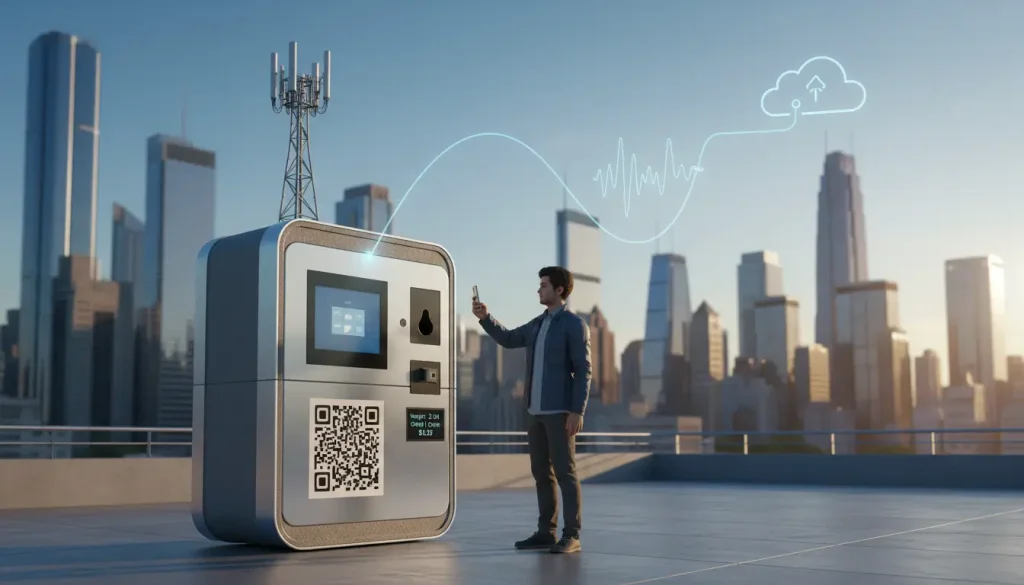
These smart recycling systems are often in places where they cannot connect to the internet using wires. So they need devices called4G Modem devices that use a SIM card to send important information to and from the main computer. This includes pictures from cameras and other important system information. The Industrial 4G Modem for monitoring is very important for modern waste management infrastructure, in smart city environments. This means that smart waste recycling systems need Industrial 4G ModemU devices to work properly and send information back and forth.
What Is a Smart Waste Recycling System?
Smart recycling systems let users sort waste (paper, plastic, glass, metal) into bins, scan a code, and receive payment or credits based on weight. The system:
- Identifies the user (via QR code or RFID card)
- Weighs the deposited material
- Calculates value based on current market prices
- Credits the user’s account
- Transmits all data to a central management platform
Recycling systems that are really good at helping people do the right thing let users sort their trash into bins for paper, plastic, glass and metal. They can scan a code and get money or credits for how much they recycle. The recycling system is a way to make people want to recycle more.
- It helps people sort things correctly
- It gives them a reason to do it
The recycling system is very helpful because it makes it easy for people to recycle paper, plastic, glass and metal and they get something in return, for doing it.
What an Industrial 4G Modem Brings That Consumer Devices Don’t
Smart recycling equipment faces challenges that consumer-grade devices can’t handle:
| Environment Factor | Impact on Equipment |
|---|---|
| Outdoor placement | Temperature extremes, moisture, dust |
| Unstable power | Voltage fluctuations from solar or municipal supply |
| Long distance from network infrastructure | No wired internet available |
| Physical vibration | From doors opening/closing, vehicle traffic |
| Public access | Risk of tampering |
Industrial 4G Modems are designed for these conditions. According to industry specifications, key industrial-grade features include :
| Feature | Industrial Requirement | Why It Matters |
|---|---|---|
| Operating temperature | –40°C to +85°C | Works in winter cold and summer heat |
| Power input | 9–36V DC (wide range) | Compatible with solar, 24V panels, or battery |
| Enclosure | Metal with DIN rail mount | EMI shielding, secure installation |
| MTBF | ≥100,000 hours | Years of unattended operation |
| Cellular failover | Dual SIM with auto‑switch | Keeps connection if one carrier fails |
| Protocol support | Modbus RTU, MQTT, JSON | Direct cloud integration |

Technical Requirements for Smart Recycling Systems
1. High-Speed Video Transmission
Smart recycling cabinets often include surveillance cameras to:
- Verify waste types (prevent contamination)
- Monitor user activity
- Provide security footage
A 4G Modem with Ethernet port and dynamic IP assignment allows cameras to stream real-time video to the monitoring center. The DTU functions as both a data terminal and a 4G router.

2. Robust System-to-Server Connection
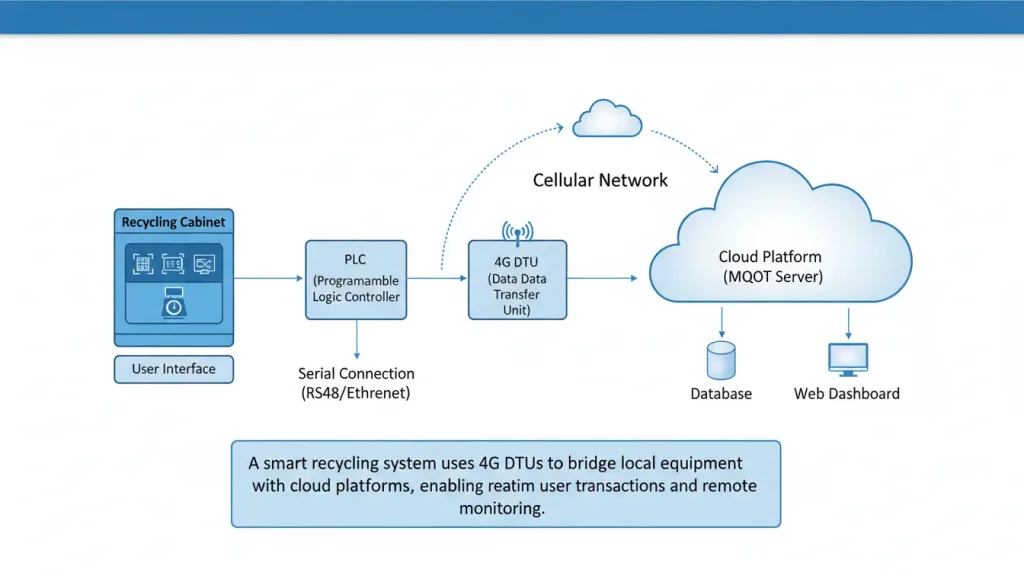
The recycling system’s PLC communicates via Modbus RTU over RS485. The 4G DTU must:
- Convert Modbus RTU to TCP/IP for network transmission
- Support MQTT protocol for cloud platform integration
- Format data as JSON for web applications
- Maintain persistent connections with auto‑reconnect on drop
According to industry data, MQTT is used in 50–60% of IoT deployments due to its low bandwidth consumption and efficient publish‑subscribe model .

3. Data Upload Capabilities
Typical data uploaded from each recycling transaction includes:
- User identification (unique ID)
- Cabinet identification code
- Waste type (plastic, glass, metal, paper)
- Individual item weight
- Cumulative weight per user/session
- Timestamp
- System error codes
- Payment amount credited

4. Protocol Conversion: Modbus RTU to JSON
Since most cloud platforms expect JSON over MQTT, the 4G DTU must perform real-time protocol conversion. A DTU with JSON node configuration allows:
- Mapping PLC registers to named fields
- Setting data types (float, integer, string)
- Defining upload triggers (on-change, scheduled, or event-based)
- Adding custom headers for authentication
This eliminates the need for an intermediate gateway server, reducing system complexity and cost.
Real-World Deployment Example
Case: Municipal Smart Recycling Program – 50 Locations
A city deployed 50 smart recycling cabinets across parks, shopping centers, and residential areas. Each cabinet had:
- RFID card reader for user identification
- Weighing scale with load cell
- PLC with RS485 output
- IP camera for verification
- 4G LTE DTU with dual SIM failover
Deployment steps:
- Each cabinet received a 4G DTU configured with:
- Static APN for the city’s cellular carrier
- MQTT broker connection with TLS encryption
- JSON mapping for Modbus RTU registers
- The PLC was wired to the DTU via RS485:
- Baud rate: 9600, 8 data bits, no parity, 1 stop bit
- Modbus slave ID: unique per cabinet
- The camera connected to the DTU’s Ethernet port
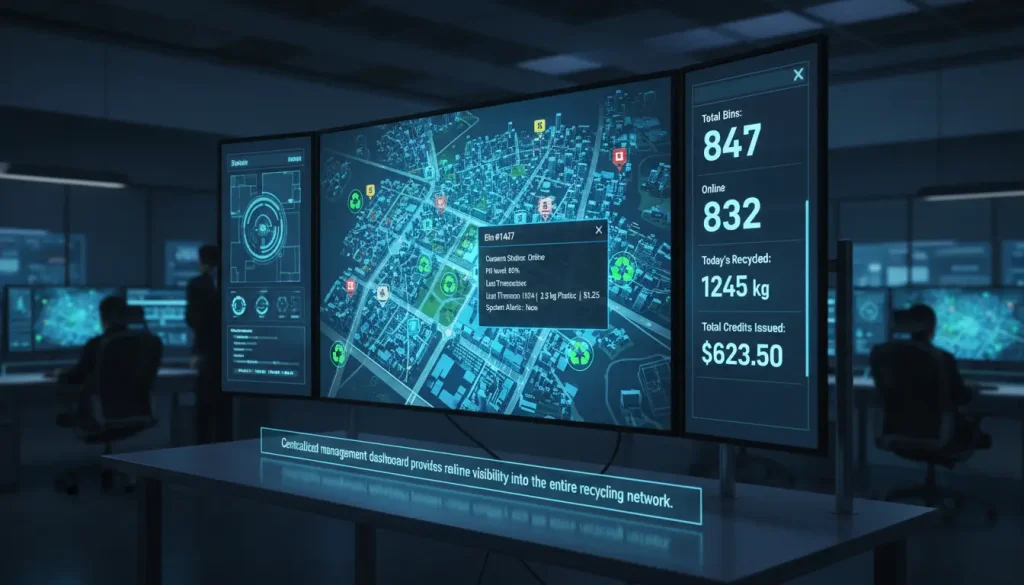
- All data was sent to a central MQTT server, then to a dashboard for operations monitoring
Results after 12 months:
- 99.5% uptime across all locations (dual SIM failover prevented outages)
- 35% reduction in collection frequency (real-time fill-level data optimized routes)
- $85,000 annual savings in fuel and labor compared to fixed-schedule collection
- Zero data loss during cellular outages (DTU buffered data and retransmitted)
Configuration Guide: Setting Up a 4G DTU for Smart Recycling
Step 1: Wiring
| Connection | Converter Terminal | Device Terminal |
|---|---|---|
| RS485 A | A or Data+ | PLC A+ |
| RS485 B | B or Data- | PLC B- |
| Power | 9–36V DC+ | 24V supply |
| Ground | DC GND | Supply GND |
Step 2: SIM Card and Cellular Setup
- Insert SIM card (ensure data plan supports MQTT traffic)
- Configure APN (from carrier)
- Set preferred network mode (4G preferred, fallback to 3G if needed)
- Enable dual SIM failover if applicable
Step 3: Serial Port Configuration
Set parameters to match the PLC:
| Parameter | Typical Value |
|---|---|
| Baud rate | 9600, 19200, 115200 |
| Data bits | 8 |
| Parity | None |
| Stop bits | 1 |
Step 4: Protocol Conversion Setup
Configure JSON node mapping:
json
{
  "device_id": "cabinet_01",
  "timestamp": "$register_40001",
  "user_id": "$register_40002",
  "waste_type": "$register_40003",
  "weight_kg": "$register_40004",
  "cumulative_kg": "$register_40005",
  "error_code": "$register_40006"
}
Step 5: MQTT Configuration
| Parameter | Setting |
|---|---|
| Broker address | mqtt.[your-broker-domain].com |
| Port | 8883 (TLS) |
| Client ID | Unique per DTU |
| Username | [assigned] |
| Password | [assigned] |
| Publish topic | recycling/{cabinet_id}/data |
| Subscribe topic | recycling/{cabinet_id}/command |
| TLS/SSL | Enabled |
Step 6: Testing
- Power on the DTU. Verify cellular registration (LED indicators)
- Trigger a test transaction at the recycling cabinet
- Check cloud platform for incoming data
- Verify JSON structure matches expected format
- Test remote command (e.g., reboot cabinet) via subscribe topic
What to Look for When Choosing a 4G DTU for Smart Waste
| Feature | Why It Matters |
|---|---|
| Dual SIM failover | Ensures connectivity if one carrier’s network drops |
| Modbus RTU to JSON conversion | Eliminates need for separate protocol gateway |
| MQTT with TLS support | Secure cloud communication |
| Ethernet port | Connects IP cameras without extra switch |
| Wide temperature range | Operates in unheated outdoor cabinets |
| DIN rail mounting | Standard industrial panel installation |
| Metal enclosure | EMI shielding, heat dissipation |
| Auto‑reconnect and data buffer | Prevents data loss during network interruptions |
| OTA firmware updates | Remote upgrades without site visits |
According to industrial DTU specifications, devices meeting these criteria achieve MTBF over 100,000 hours, making them suitable for 7×24 unattended operation .
Common Questions
Q: Do I need a separate router if I use a 4G DTU?
No. A 4G DTU with Ethernet port functions as both a data terminal and a router. It can connect multiple devices (PLC, camera, local HMI) while maintaining the cellular uplink.
Q: What if cellular signal is weak?
Use a DTU with external SMA antenna ports. Install a high‑gain antenna outside the metal cabinet. Some DTUs also support multiple LTE bands for better coverage.
Q: How much data does a smart recycling system use?
Typical usage: 500MB–2GB per month per location, depending on video transmission. Weight and transaction data use minimal bandwidth; video is the primary consumer.
Q: Can I use the same DTU for multiple recycling cabinets?
Each cabinet typically needs its own DTU for local connectivity, but multiple DTUs can report to the same cloud platform.
Your Pre‑Deployment Checklist
Before deploying, confirm:
- Cellular coverage — Test signal strength at each installation location
- Power availability — 24V DC from solar or municipal supply? Battery backup?
- SIM cards — Data plans sized for expected traffic (including video)
- PLC compatibility — Modbus RTU settings match DTU configuration
- MQTT broker — Endpoint accessible from cellular network
- JSON mapping — All required fields mapped from PLC registers
- Antenna placement — External antenna routed outside metal cabinet
- Environmental rating — DTU temperature range meets site conditions