
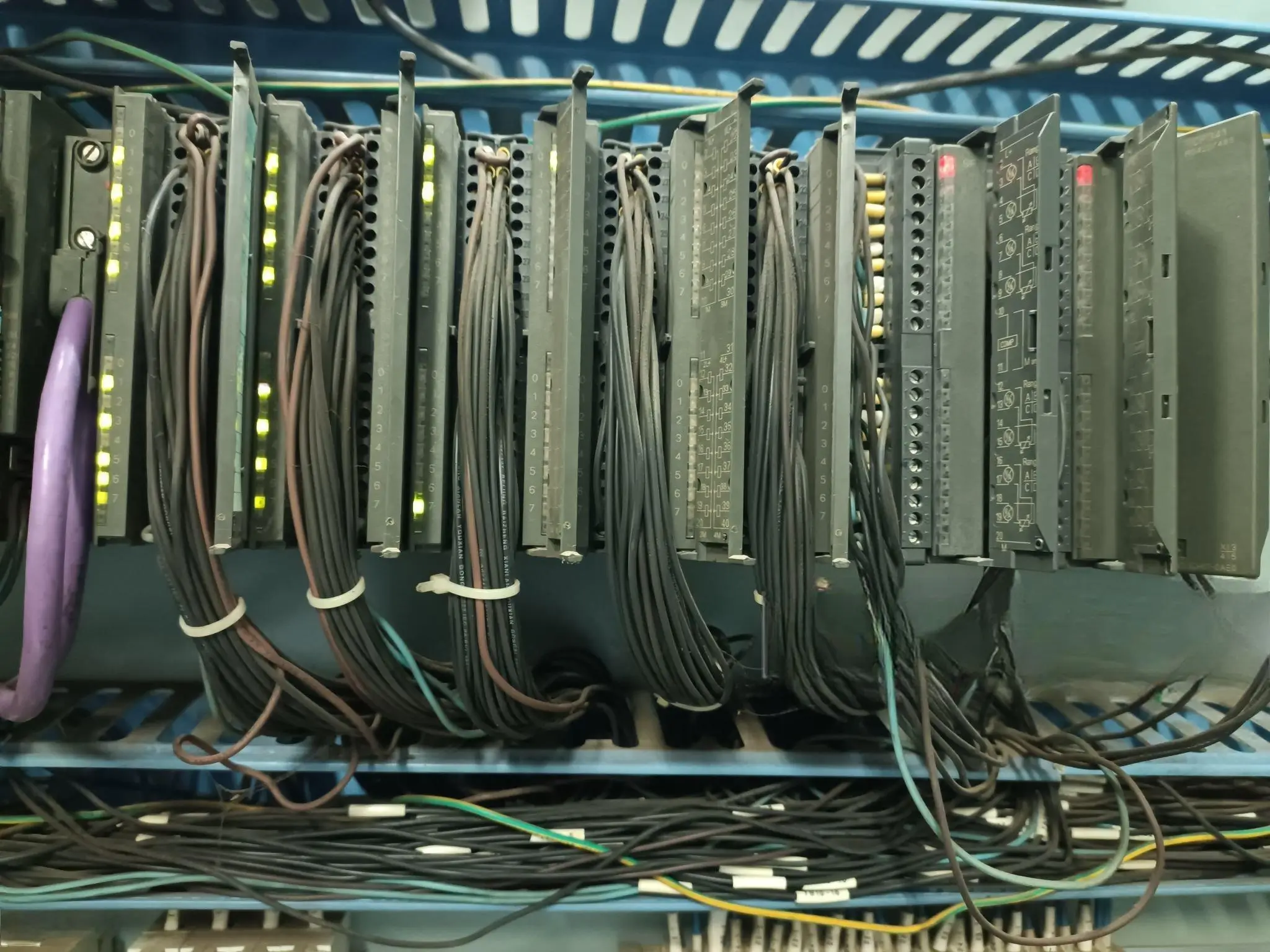
In today’s Industrial Internet of Things (IIoT) deployments, engineers often find themselves in a frustrating dilemma at the edge: how to reliably get data from local sensors and into the cloud without breaking the bank on the project.
A very common but extremely inefficient way is to purchase a micro PLC just to act as a modbus master vs slave polling engine, then install a secondary networking module to manage the cloud connection. This two-device architecture consumes valuable DIN-rail space, complicates programming and increases the Bill of Materials (BOM).
In this guide we’ll break down the physical constraints of edge polling, explain why polling directly to the cloud causes communication collapse, and explore how modern edge architectures resolve these protocol bottlenecks without sacrificing system reliability.
The Classic Edge Trap: Why Are You Buying a PLC Just to Poll Data?
Consider a standard remote pumping station. The requirement is straightforward: read holding registers from three Modbus RTU power meters and send that telemetry to AWS.
Because standard power meters are passive Slaves, they cannot initiate communication. A Master must continuously ask them for data. Following traditional architecture, an engineer might specify a micro-PLC (acting as the Master) to execute ladder logic that polls the meters, and then attach a Modbus RTU to MQTT gateway to bridge the PLC’s data to the cloud.
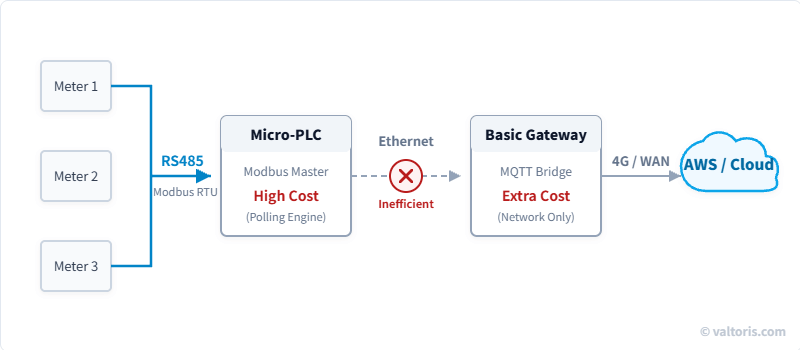
You are essentially purchasing a sophisticated deterministic control engine (the PLC) merely to perform the mundane task of data collection.
| Component | Role in Architecture | Physical Footprint | Engineering Effort |
|---|---|---|---|
| Micro-PLC | Modbus RTU Master (Polling Engine) | High (Consumes valuable DIN-rail space) | High (Requires Ladder Logic / IEC 61131-3) |
| Basic Gateway | Network Bridging to Cloud | Medium | Low (Basic Web UI) |
| Legacy Architecture | Dual points of failure | Redundant space required | Unnecessary integration overhead |
If this dual-device setup is so inefficient, why is it still the industry standard?
The answer is not in hardware choices, but in the hard, unavoidable rules of the legacy communication protocols used by these edge devices. To understand why you are forced to buy a PLC just to read a meter we need to understand how Modbus actually works.
The Root Cause: The Modbus “Master vs. Slave” Rule
If we are to understand why engineers fall into the PLC trap, we have to go back to the very basic rules of the Modbus protocol. Modbus is request-response only, and has a very strict hierarchy.
| Attribute | Modbus Master (The Commander) | Modbus Slave (The Subordinate) |
|---|---|---|
| Initiation | Always speaks first. Sends queries. | Silent. Only speaks when spoken to. |
| Quantity on Bus | Strictly One (on a standard serial bus). | Multiple (Up to 247 on a single segment). |
| Device Types | SCADA, HMI, PLC, Active Gateways. | VFDs, Meters, Sensors, Basic I/O. |
Take the Master out of the network, and the bus goes dead quiet. Slave devices (your meters or standard Modbus RTU I/O modules) will never push data by themselves. Hence there must be an active Master at the edge.
This single protocol rule is what sets the hardware trap. Basic network gateways only bridge internet connections, they can not be Modbus Masters, so engineers have to put in a micro-PLC into the panel. The PLC is not there to control a complex process. It is there just to be a “polling engine” to satisfy the Modbus hierarchy. You buy a controller , write ladder logic , and waste DIN-rail space to ask a meter what its current reading is.
Why Cloud-Based Polling is a Disaster for RS485
A logical question at this point is: If the PLC is just acting as a simple Master, why not just remove it and let your Cloud server (AWS/SCADA) do the polling?
Engineers often try to save the PLC cost by using a cheap “transparent” serial-to-cellular modem. The idea is to have the Cloud poll the RS485 slaves directly over the 4G/WAN network. But this clever-seeming workaround has a fatal technical flaw.
According to the official Modbus Organization Serial Line Specification (Section 2.5) Modbus RTU is based on strict timing constraints. A message frame is separated by a silent interval of at least 3.5 character times. If a delay exceeds 1.5 character times during transmission, the receiving Slave considers the message incomplete and discards it, resulting in a CRC error.
When you poll directly from the cloud, the unpredictable latency (jitter) of cellular networks destroys this fragile timing.
Input your expected 4G/LTE cellular network latency (ping to cloud) to see if it violates the strict Modbus RTU timing constraints at a standard 9600 baud rate.
Result: Imminent Communication Failure
At 9600 baud, the maximum allowable gap between bytes is approx 1.5ms. Your 150ms network jitter exceeds the Modbus RTU timing threshold by 10,000%. The Slave will discard the fragmented packets, causing constant timeouts.
| Architecture | Where Polling Occurs | Latency Impact | System Stability |
|---|---|---|---|
| Cloud Direct Polling (via Transparent Modem) | Over the Internet (WAN) | 50ms – 500ms (High Jitter) | Failure. High CRC errors and timeouts. |
| Active Edge Polling (via Storage Gateway) | Locally on the DIN-rail (LAN/Serial) | < 2ms (Zero Jitter) | Excellent. Zero timing violations. |
The Solution: Decoupling Communication from Control
That leaves engineers in a frustrating position: the physics of cellular latency don’t allow for reliable polling from the cloud, and project budgets don’t allow putting a PLC in every remote panel just to be a Modbus Master.
To solve this, the industry knew we had to separate communication from control. We required a device that sits locally on the DIN-rail to meet strict Modbus timing rules, but speaks native IT languages to the cloud without needing ladder logic. This architectural shift has created a new class of devices, Intelligent Edge Gateways..
But swapping out a modem for a basic gateway isn’t enough. To truly solve network latency and eliminate hardware redundancy at the edge, engineers must ensure their architecture meets 5 essential design criteria:
- Autonomous Local Polling: The edge node must be a hard RTU Master polling downstream slaves locally over RS485. Since the serial traffic is purely local, the system is totally immune from WAN jitter which ensures zero timing violations.
- Event-Driven MQTT & JSON Push: The architecture should be event-driven and not be passively waiting for the Cloud SCADA to initiate a TCP query. The edge node needs to automatically package Modbus registers into standard JSON payloads and actively push them over MQTT. This saves huge amounts of bandwidth and eliminates meaningless background polling traffic.
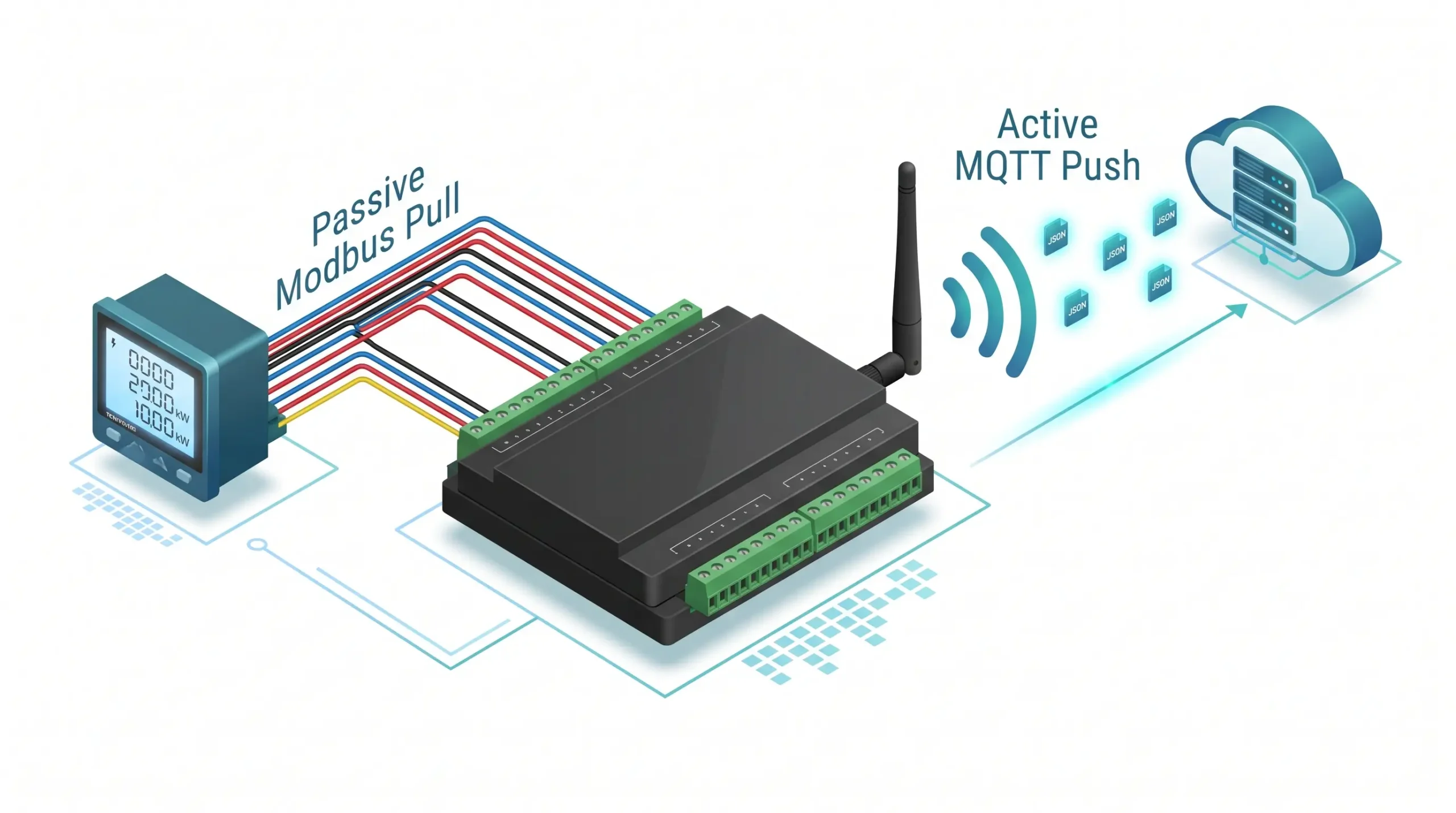
 The Architecture Shift: Passive Pull vs. Active Push
- I/O Consolidation (Native I/O): The edge node must do more than just be a protocol converter to really reduce the BOM. It should have onboard Digital Inputs (DI), Digital Outputs (DO) and Analog Inputs (AI) so you can read 4-20mA sensors into Modbus TCP or MQTT without needing to fit separate I/O modules, saving valuable DIN-rail space.
- Data Resilience (Offline Caching): Industrial WAN dropouts are not predictable, so the architecture must be able to handle offline situations. To avoid data loss, the gateway shall have non-volatile memory to automatically cache the polled telemetry when the MQTT broker disconnects and then send the backlog in sequence when the network is back up.
- Physical Industrial Resilience: Reliability in the edge environment is much more than software protocols. The hardware selected needs to be equipped with Level 4 EMC immunity, dual power inputs and wide operating temperature ranges to cope with electrical noise and harsh panel conditions.
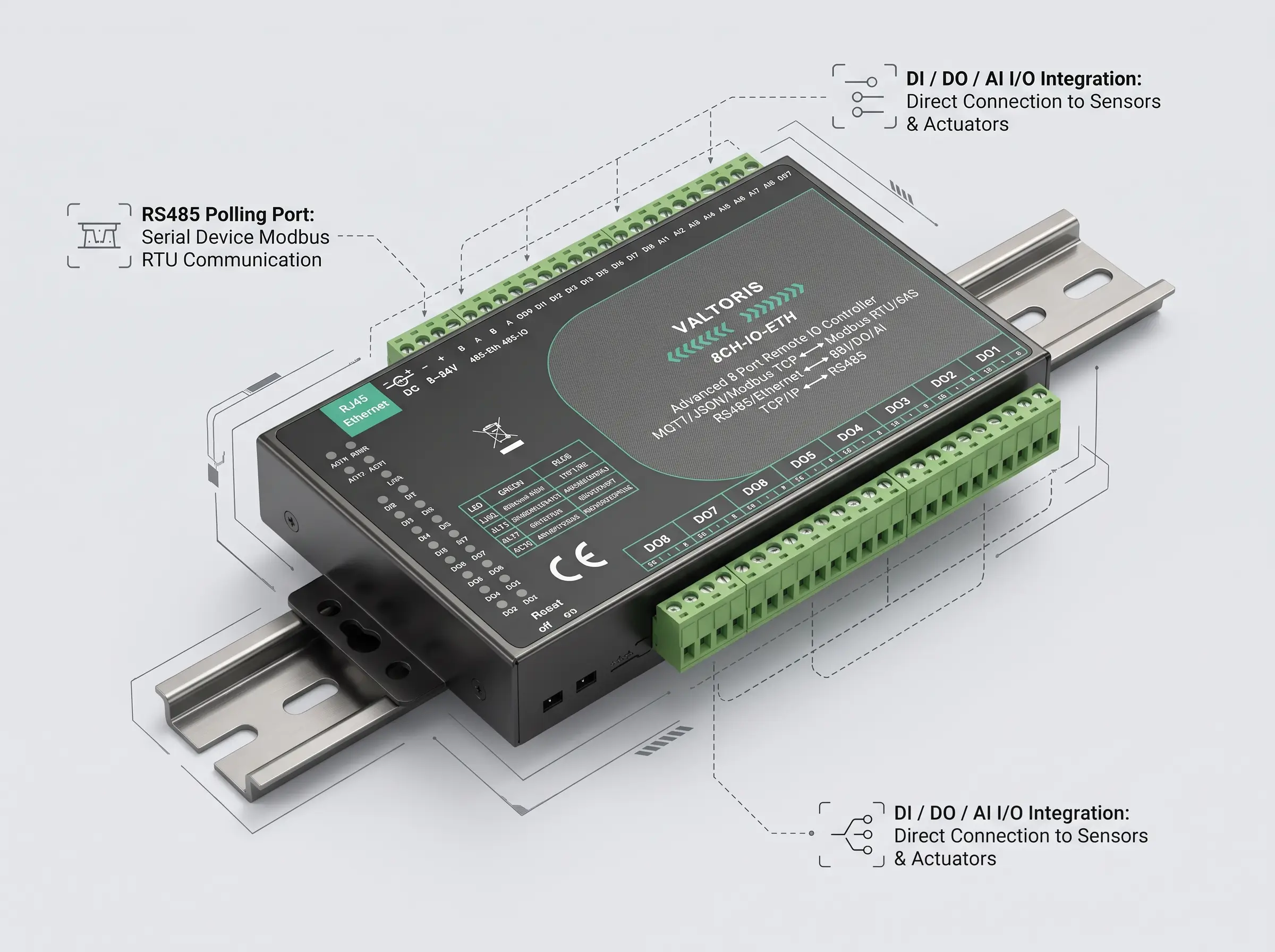
Furthermore, since the gateway is the only Master on the serial bus with the cache, it naturally resolves the RS485 multi-master conflict. Multiple cloud applications or local HMIs can query the gateway over Ethernet at the same time, without ever crashing the underlying serial bus.
| Feature | Transparent Gateway (Dumb) | Intelligent Edge Gateway (Smart) |
|---|---|---|
| Polling Behavior | Waits for Cloud SCADA to initiate. | Actively polls slaves autonomously. |
| Cloud Integration | Requires cloud to parse raw Modbus Hex. | Directly publishes standard JSON via MQTT. |
| Hardware Integration | Requires external I/O modules for sensors. | Native I/O (DI/DO/AI) built-in. |
Bridging the OT/IT Gap: The Payload Transformation
While meeting the five criteria above solves the physical polling bottlenecks on the plant floor, a major hurdle remains at the software layer: cloud applications do not naturally speak Modbus.
Parsing raw modbus Hex is a huge waste of time for software teams and IT engineers. An intelligent gateway closes the OT/IT gap, automatically turning raw register data into clean, actionable JSON key-value pairs before it ever reaches your MQTT broker.
Most importantly, this transformation is now performed by modern edge nodes using visual mapping utilities. Instead of writing complex parsing scripts (Python, Lua, etc.), OT engineers configure the mapping through a built-in Web UI or Windows utility (VirCOM). The internal firmware engine translates hex to decimal automatically and wraps it in JSON.
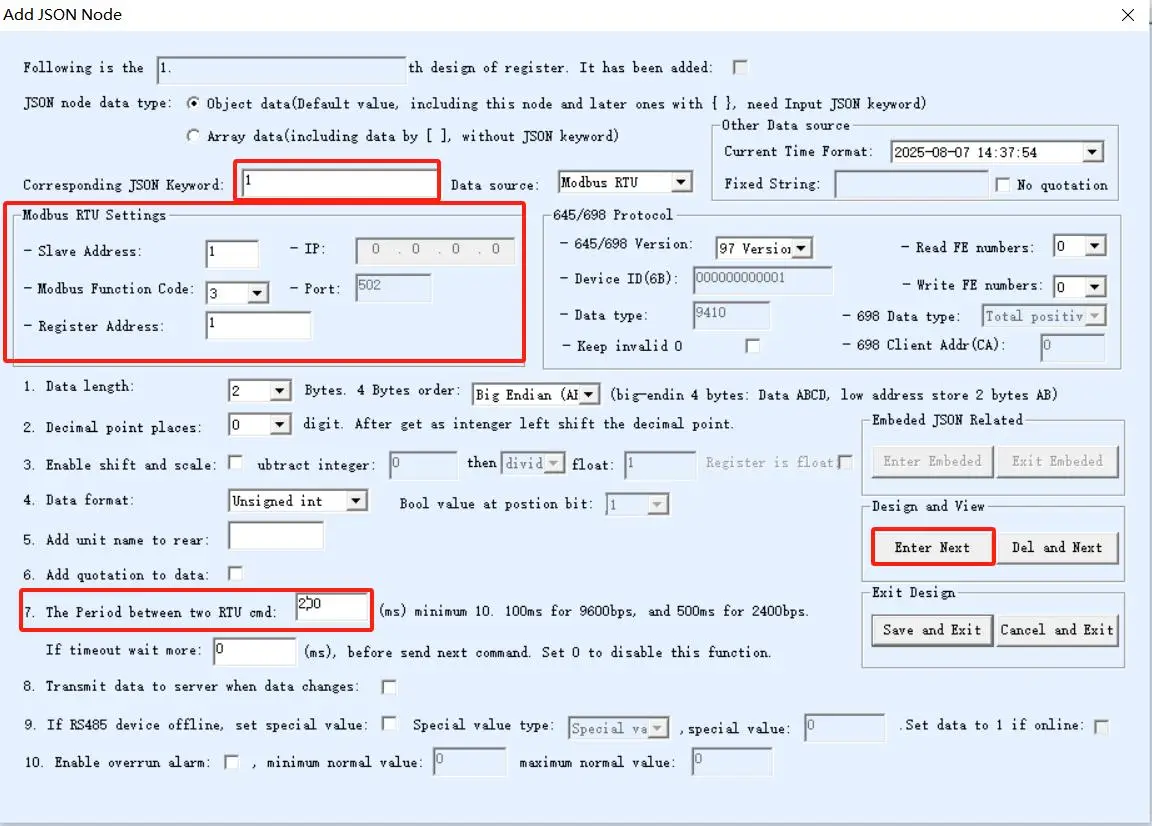
This creates a perfect handover: IT teams receive clean, ready-to-use JSON payloads natively, while OT teams completely skip the burden of writing code.
This is what the OT/IT handover looks like in practice. Here is the final JSON payload that the gateway automatically generates and pushes to your MQTT broker. You can see that the raw Modbus Hex has been converted into clean, ready-to-use IT data:
{
  "timestamp": "2023-10-27T14:38:59Z",
  "device_id": "GATEWAY_PUMP_01",
  "data": {
    "meter_1_voltage": 220.5,
    "meter_1_current": 15.2,
    "pump_status_DI1": 1,
    "tank_level_AI1": 3.85
  },
  "network_status": "online"
}
Integration Tip: Need a real-world example? Check out how modern industrial edge gateways are mapping hundreds of Modbus registers straight into AWS IoT Core or Azure. All from a Web UI, no parsing script required.
Checklist: When Do You Actually Need a PLC at the Edge?
When you see how seamlessly an intelligent gateway handles data polling and OT/IT translation, it can be tempting to try to eliminate PLCs entirely from your edge architecture. But from a pure engineering standpoint that would be a mistake.
An intelligent gateway is the ultimate tool for Data Acquisition (DAQ), but it is not a deterministic controller. To build a truly reliable system, you must deploy the right hardware for the right job. Use this matrix to clearly define the boundary between when an edge gateway is your best choice, and when you absolutely must use a PLC.
| Application Requirement | Optimal Edge Device | Reasoning |
|---|---|---|
| Data Acquisition & Telemetry (DAQ) | Intelligent Gateway | Onboard native DI/DO/AI eliminates separate I/O modules, while autonomous MQTT/JSON push requires zero cloud programming. |
| Solving RS485 Bus Collisions | Storage Gateway | Internal memory caching isolates multiple TCP clients from the serial bus. |
| Complex PID Loop Control | PLC | Gateways lack the deterministic execution required for advanced mathematical process control (e.g., maintaining exact boiler temperature). |
| High-Speed Safety Interlocks | PLC | Safety-critical logic (e.g., emergency stops triggering within nanoseconds) requires hardcoded ladder logic. |
| Proof of Concept (PoC) & Deep Customization | Industrial IPC / Raspberry Pi + Node-RED | It gives you the maximum flexibility and access to the open source ecosystem. Good for lab testing or highly bespoke logic, but carries hidden costs in ongoing OS maintenance, security patching and script debugging. |
Conclusion: Rethinking Edge Architecture for the IIoT Era
The core challenge of modern IIoT is bridging two very different worlds: the rigid, deterministic timing rules of legacy OT protocols such as Modbus and the asynchronous, unpredictable latency of IT cloud networks. For years, engineers have been left with an expensive tradeoff between risking network failure by forcing the cloud to poll serial devices directly, or bloating project budgets with the deployment of micro-PLCs just to act as glorified data messengers.
But building a scalable industrial network shouldn’t require choosing between reliability and cost efficiency. The true solution lies in a fundamental architectural shift: decoupling data communication from machine control.
Moving the polling engine to a dedicated intelligent edge node, you locally meet the strict timing requirements of RS485, and natively pass clean, event-driven JSON payloads to the cloud. You remove the physical WAN latency bottlenecks, you eliminate the need for extra DIN-rail hardware, and you free your engineering team from the chore of writing protocol parsing scripts.
The engineering takeaway is straightforward: Keep your PLCs on what they were really designed for – mission critical process control, complex logic and high speed safety interlocks. Let a dedicated communications specialist handle the heavy lifting of data acquisition, payload translation and secure cloud connectivity.
Stop Buying Two Devices for Edge Nodes. Meet Your Dedicated Communications Specialist.
Stop forcing PLCs to do a gateway’s job. Eliminate redundant hardware and bypass WAN latency issues by deploying a purpose-built edge node. See how it combines autonomous RS485 polling, native I/O, and direct MQTT/JSON integration within a single DIN-rail footprint.
Frequently Asked Questions
Do I need an expensive static public IP for the edge node to communicate with the cloud?
No. Because intelligent edge controllers utilize MQTT (a publish/subscribe protocol), they initiate an outbound connection to your cloud broker. This completely eliminates the need for expensive static IPs or inbound port forwarding on cellular WAN networks.
How does the system handle data if the cellular connection drops?
Industrial-grade edge nodes come with embedded non-volatile flash memory. They automatically locally cache polled Modbus telemetry (JSON payloads) during network outages. Once connection is restored, the backlog is published sequentially to the MQTT broker providing zero data loss.
Modbus RTU lacks native encryption. Is my data secure when pushed over the internet?
The local RS485 serial bus is physically isolated and highly secure uplink. Modern edge gateways encrypt the JSON payloads with TLS/SSL (MQTTS) before sending them over the WAN/cellular network, meeting strict enterprise IT security requirements.
Can a Modbus RTU network have two masters?
Not over a normal RS485 serial bus. The physical layer is half duplex, i.e. concurrent transmissions result in voltage collisions. If you want to support multiple masters (e.g. Cloud SCADA and local HMI) you must use an edge node acting as a Storage Gateway to handle the polling queue locally and handle multiple concurrent TCP requests.