
Why Rural Sewage Monitoring Needs a Different Approach
The numbers tell a clear story. According to the U.S. Environmental Protection Agency (EPA) , about 25% of public wastewater treatment facilities in the U.S. use lagoon systems—pond-like basins that rely on natural processes to treat sewage. These systems are common in rural and semi‑urban areas because they’re less expensive to build and operate than mechanical treatment plants.
The problem is that most of these facilities still check things by hand. Someone drives out to check the water levels, pump status and basic water quality every day or every week. If something breaks between visits it can go unnoticed for days. This means that untreated sewage can get into waterways.
It is similar in China. Rural water pollutants make up over 50% of the national discharge.. The sewage treatment rate in rural areas has been very low, only 10-20%. The government wants to increase treatment rates to 40-60% by 2025 depending on the region.. The monitoring infrastructure is still not good enough. Than 30% of rural sewage monitoring sites are connected to central control systems according to industry data.
This gap between installed treatment capacity and real‑time monitoring creates a real problem: you can build the equipment, but if you can’t see what it’s doing, you can’t manage it effectively.

In a lot of places sewage that has not been treated is still being released into rivers, ponds or underground. This is a problem because it can make the water people drink unsafe and it can also hurt the animals and plants that live in the water over time. The old ways of checking for pollution are not working well because the sources of pollution are, over the place there are not enough people to check everything and some of the sites are just too far away. Remote sewage monitoring is something we need to think about and remote sewage monitoring is becoming more important every day.
What Traditional Monitoring Gets Wrong
In rural sewage projects, the issues usually aren’t about sensors—it’s about connectivity.
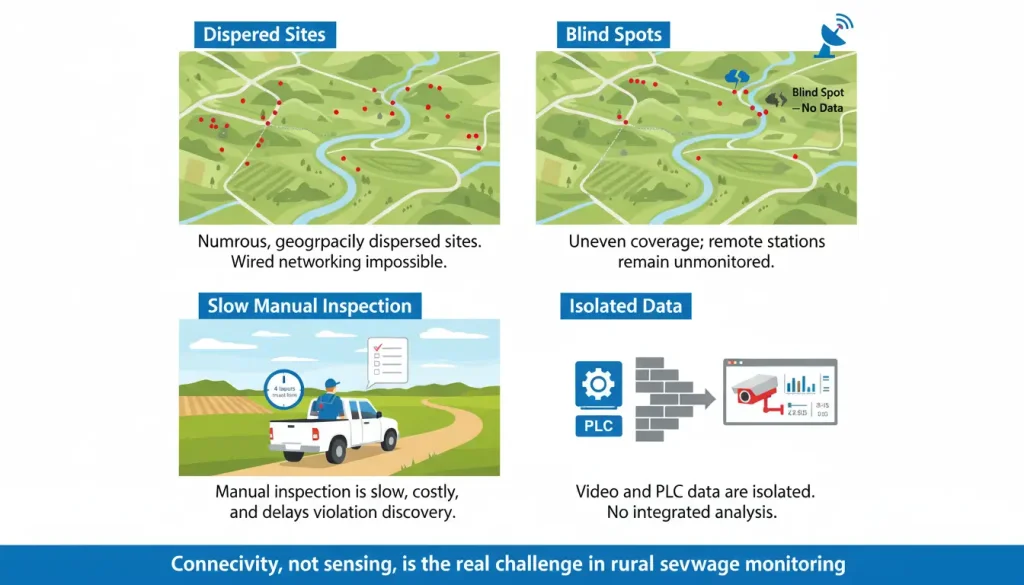
- Monitoring points are spread out across villages, hillsides, or farmland. Running fiber or even copper cable to each site is prohibitively expensive.
- Coverage is uneven. Some stations are connected; others remain “blind spots” simply because they’re too far or too hard to reach.
- Manual inspection is slow and costly. An operator visiting 20 sites per week spends most of their time driving, not fixing problems.
- Data is siloed. PLC data sits in one system; video surveillance in another. When an alarm triggers, you can’t see what’s actually happening at the site.
A survey in 2024 showed that, than 60% of rural sewage projects do not get bigger after a small test. This is not because the treatment method does not work. It is because the communication system makes it too costly to run the project over time.
How Much Does Remote Monitoring Actually Save?
Let’s put numbers on it.
A typical rural sewage station might have:
- 1 PLC for pump and level control
- 1 IP camera for visual verification
- 1 flow meter or water quality sensor
Manual inspection model:
- Weekly site visits: 52 visits/year
- Travel time: 2 hours per visit (round trip)
- On‑site time: 1 hour
- Labor rate: $45/hour (including vehicle, overhead)
- Annual cost per site: $7,020
Remote monitoring model (industrial 4G router installed):
- Hardware (one‑time): $400–600
- Cellular data: $20/month
- Remote troubleshooting: 2–4 hours/year
- Annual operating cost per site: $240–300
The payback period for remote monitoring hardware is under one year. Over five years, a single site saves $30,000–35,000 in avoided travel and faster response times. For a district with 50 sites, that’s $1.5 million in operational savings.
These numbers explain why utilities and engineering firms are moving toward cellular‑based monitoring—not because it’s new technology, but because it pays for itself quickly.
Solution architecture based on Industrial 4G LTE Router
A better way to do things is to put the machines that clean sewage, the controllers that use computers, cameras and a system that lets us watch everything from one place. We can connect all these things using a kind of router that works well in places where big machines are used. This router uses 4G to send information.

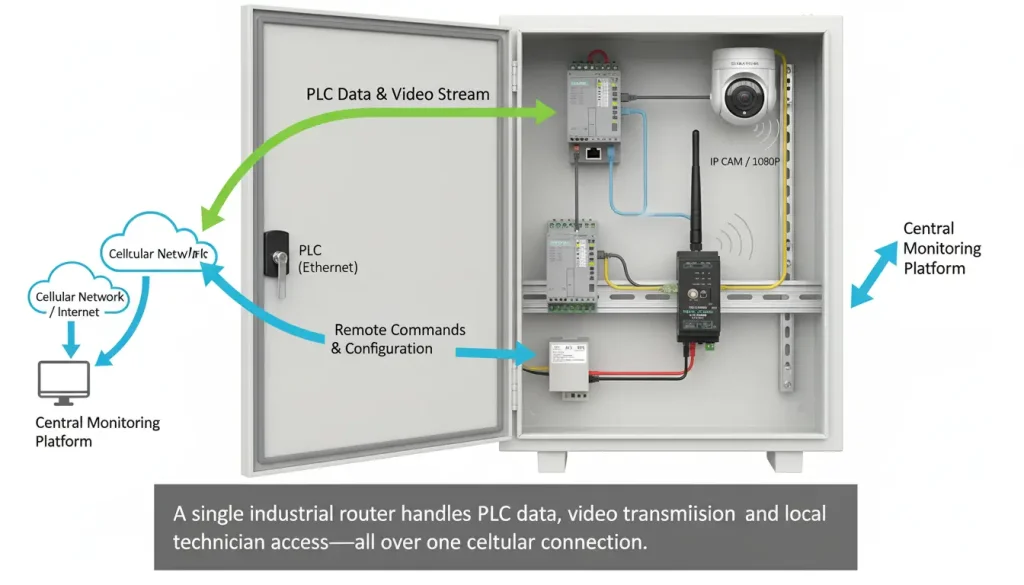
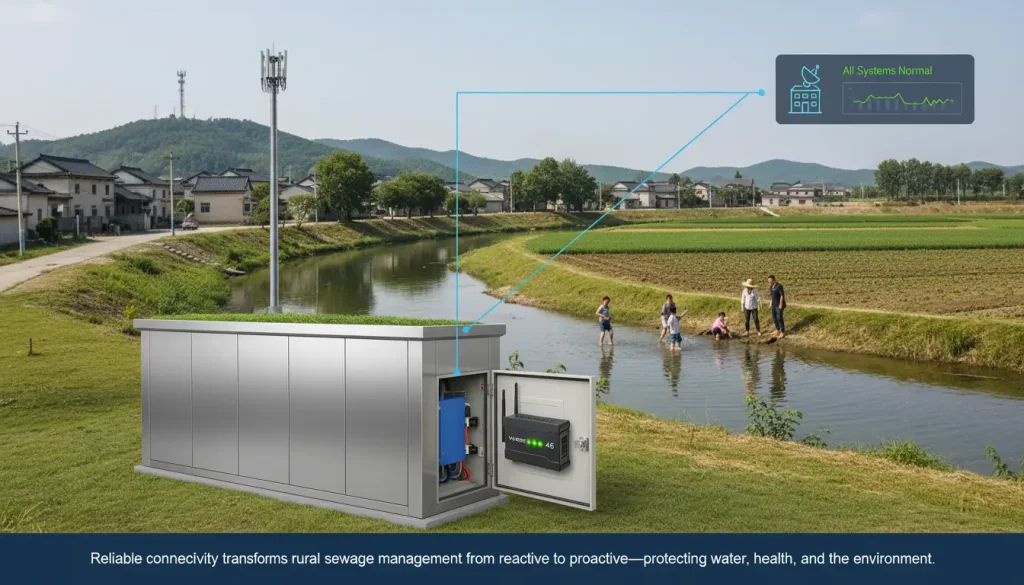
At each sewage station, the industrial 4G router with SIM slot connects directly to the PLC and IP camera. Data such as water level, flow rate, pump status, and alarm signals are transmitted through the cellular network to the monitoring center in real time.
The monitoring platform can also send control commands back to the field.
These commands go through the 4G network to the router. Then to the Programmable Logic Controller, which allows people to start or stop things from a distance.
This means they can also change settings and fix problems with the monitoring platform without having to be, in person.
Why an industrial router matters here
Industrial 4G routers are different from the devices we use at home. An industrial 4G router is made to work all the time in really tough conditions.
Rural sewage stations have to deal with a lot of problems. They have to handle high humidity. The temperature can go up and down a lot.
There is also a lot of interference from things like pumps and motors, at rural sewage stations. Industrial 4G routers have to be able to work in these conditions.
The Valtoris Industrial 4G LTE Router integrates firewall protection, encryption, and supports industrial router with Modbus TCP support, allowing secure and standardized PLC communication. Protocols such as MQTT and HTTPS make it easier to integrate the system into modern IoT platforms or cloud dashboards.
The router has another thing going for it which is that it is very flexible when it comes to networking.
It has a lot of ways to connect, like 4 LAN ports, 1 WAN port, WiFi and 4G.
This means the router can let many devices connect to it at the time without needing any extra switches.
The router makes it easier to design the cabinet. It also reduces the number of things that can go wrong with it like failure points.
This is an advantage of the router.
One Router, Three Data Types
The key to effective remote monitoring isn’t just having a connection—it’s using the same connection for multiple purposes.
1. PLC data (Modbus TCP)
The router communicates with the PLC using Modbus TCP, an open protocol standardized by Modbus.org . Data like water level, flow rate, pump status, and alarm codes are sent to the central platform every few minutes.
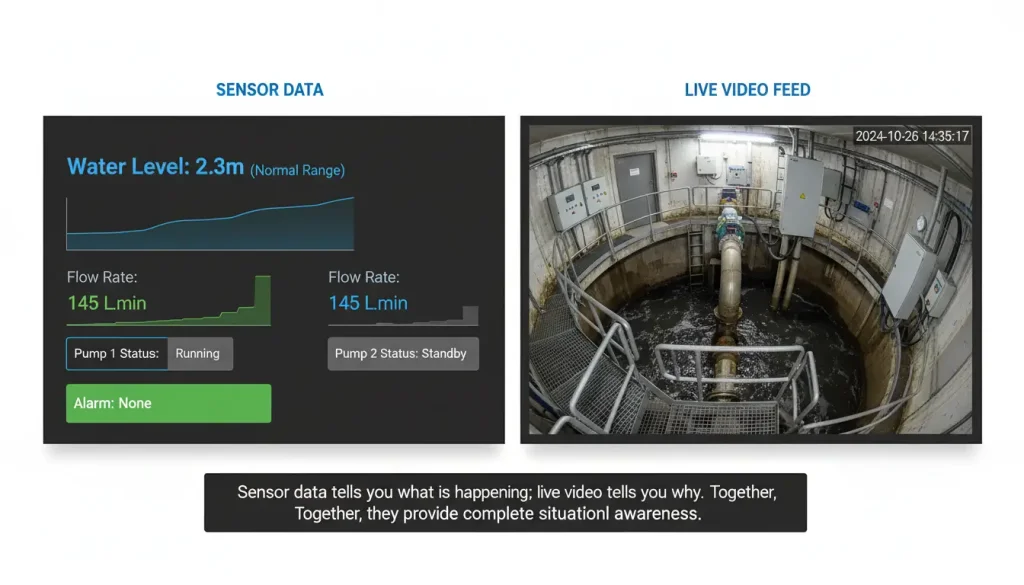
2. Video verification
An IP camera connects to the router’s LAN port or WiFi. Rather than streaming 24/7 (which consumes bandwidth and data), the system can be configured for:
- Event‑triggered video: When an alarm occurs (high water, pump failure), the camera sends a 30‑second clip.
- Scheduled snapshots: One image per hour gives visual confirmation of site conditions.
- On‑demand: Operators can request live view when investigating an alarm.
3. Local maintenance access
Maintenance technicians can connect to the router’s WiFi while on site, accessing the PLC and camera without opening the panel or plugging in a laptop. This reduces time spent on site and eliminates the need to carry specialized cables.
Deployment and long-term operation
From the point of setting up DIN-rail router design is really important. People often don’t think it is. It is. Installing on a rail keeps all the wires neat. Makes fixing things faster.
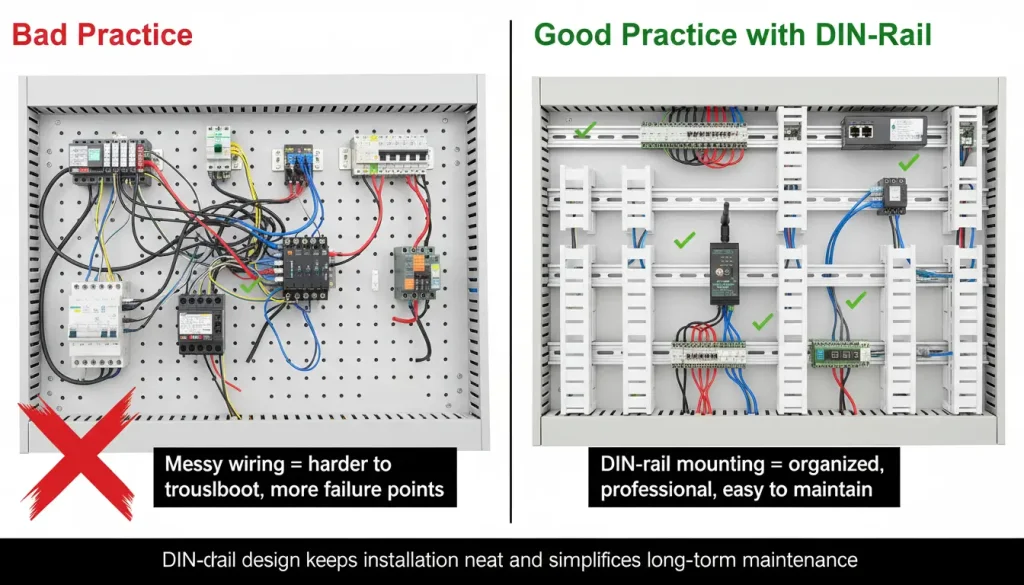
Over time things like setting up through the WEB and updating the software remotely save a lot of money on running costs. For sewage projects in rural areas this makes a big difference. It is especially helpful when devices are spread out over villages.
As a maker and supplier Valtoris also helps with custom options. They can make things to order or put their label on them. This is useful, for projects that need network rules or a private label.
Real‑World Deployment: What It Looks Like
Case example: 30 rural sites, one mid‑western county (anonymized)
There is a county in the Midwest that has thirty sewage lift stations all, over the place along rural roads. Each of these sewage lift stations has a PLC and some basic sensors. They do not have a network connection. The people who operate these sewage lift stations have to drive a way two hundred miles every week to check on each sewage lift station.
Deployment:
- Each station received an industrial 4G router with dual SIMs
- PLCs were connected via Ethernet to the router’s LAN port
- A small IP camera was added at each site, configured for event‑triggered recording
- All sites were configured to report to a cloud‑based SCADA platform
Results after 12 months:
- 80% reduction in emergency call‑outs (alarms detected remotely, issues resolved before overflow occurred)
- 45% reduction in planned site visits (most checks done remotely)
- 3 hours average response time to critical alarms (down from 6+ hours)
- Zero untreated sewage releases (compared to 4 the previous year)
The upfront hardware cost was approximately $15,000 (30 routers × $500). Annual cellular service added $7,200 ($20/month per site). Annual labor savings: over $85,000 —a payback period under three months.
Deployment and Long‑Term Operation
Installation matters as much as the hardware.
Mounting things on a DIN rail is really helpful because it keeps all the wires in order and makes it easy to add things later on. When you have a panel that’s easy to understand with labels, on all the cables and a clear map of the wires it is simple for any technician to figure out what is going on. This means that anyone can fix problems, not the person who originally set it up.
Remote management reduces ongoing costs.
Industrial routers with cloud management platforms allow:
- Remote configuration: Change settings without driving to the site
- Firmware over‑the‑air (FOTA): Security patches and new features deployed to all sites simultaneously
- Signal monitoring: Track cellular signal strength (RSSI) to identify sites that may need external antennas
- Data usage alerts: Avoid unexpected overage charges
According to industry data, remote management can reduce operational expenses by 30–50% over a five‑year deployment compared to manually managing each site.
What to Look For When Choosing a Router for Rural Sewage
If you’re specifying hardware for a rural monitoring project, these are the features that matter most:
| Feature | Why It’s Critical |
|---|---|
| Industrial temperature range (–40°C to 85°C) | Ensures operation in unheated cabinets year‑round |
| DIN rail mounting | Fits standard industrial panels |
| 4 Ethernet LAN ports | Connect PLC, camera, and local devices without extra switch |
| WiFi (access point mode) | Allows local technician connection without opening panel |
| Dual SIM with auto‑failover | Maintains connectivity if one carrier’s network goes down |
| VPN support (IPsec, OpenVPN) | Encrypts data and secures remote access |
| Modbus TCP support | Standardized communication with industrial PLCs |
| Cloud management | Remote configuration and monitoring across all sites |
| Event‑triggered video | Optimizes bandwidth; sends video only when needed |
From Pilot to Scale: Making It Work Across Many Sites
The biggest mistake that rural sewage projects make is treating the few sites as special cases. Each of these sewage projects gets a custom setup, a unique internet address and one of a kind problem solving.. When it is time to expand these rural sewage projects to fifty or one hundred sites this way of doing things becomes very hard to handle. Rural sewage projects need to think about this.
Better approach:
- Standardize hardware across all sites. One router model, one camera model, one PLC communication setup.
- Use DHCP with IP reservation or a consistent static IP scheme so every site follows the same pattern.
- Configure templates in the cloud management platform. Deploy new sites by copying an existing configuration.
- Document everything—wiring diagrams, IP addresses, configuration files—in a central location.
A standardized approach reduces deployment time per site from 4–6 hours to under 2 hours and makes long‑term maintenance predictable.
One Last Thing
Remote sewage monitoring isn’t about futuristic technology. It’s about solving a basic problem: how to know what’s happening at equipment that’s miles away from the people who operate it.
The tools exist today. Industrial 4G routers with built‑in VPN, Modbus support, and cloud management cost a fraction of what a single emergency response costs. The data plans are cheap. The installation is straightforward.
For rural communities with limited staffing and budgets, moving from weekly site visits to real‑time monitoring isn’t just an upgrade—it’s how you make limited resources cover more ground.
If you’re planning a rural sewage monitoring project, start with one site. Get it working reliably. Document the configuration. Then replicate it across the rest. The technology is ready; the business case is clear. The only question is how quickly you can get it deployed.