
The Market Shift: Why Cities Are Moving to Wireless Street Lighting
Street lighting accounts for 40–50% of municipal energy costs in many cities . According to industry data, the global smart street lighting market was valued at $8–10 billion in 2024 and is projected to grow at a CAGR of 20–25% through 2030 . he main things that make people want to use these systems are that they save energy, which can be up to 50 percent more than the systems and they also save money on maintenance because you can check on them from far away. The energy savings, from these systems and the reduced maintenance costs are really important.uced maintenance costs through remote monitoring
Traditional street lighting systems have three persistent problems:
- Limited control – basic on/off schedules with no dimming or adaptive response
- Ongoing costs – cellular solutions carry recurring monthly fees per modem
- Poor visibility – failures are discovered only when someone reports a dark street
LoRa technology solves these problems. It provides long-range sub-1GHz penetration (2–5 km in dense urban environments, up to 15 km in open areas), and requires zero communication wiring. This allows municipalities to retrofit existing lighting cabinets with wireless telemetry without trenching streets or paying recurring cellular data fees, and no recurring carrier fees for private networks. According to the LoRa Alliance , LoRa is deployed in over 100 countries for smart city applications, including street lighting, parking, and environmental monitoring.
This guide describes how a LoRa‑based smart lighting system works, why it’s cost‑effective, and what to look for when specifying hardware.
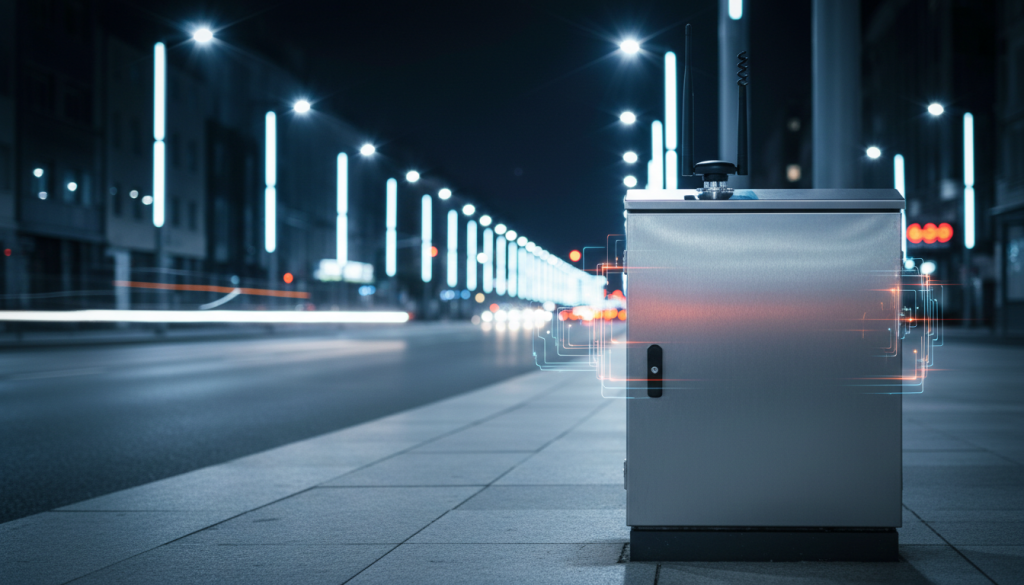
The Problem with Traditional Street Lighting
Fixed schedules
Most street lights run on timers. They turn on at dusk, off at dawn, regardless of weather, traffic, or actual need. Energy is wasted when lights are on but no one is around.
No visibility
A failed light stays dark until someone reports it. Maintenance crews drive routes to check lights, burning fuel and labor hours.
High connectivity costs
Cellular solutions work, but each light needs a SIM card and a monthly data plan. For hundreds or thousands of lights, the recurring cost is significant.
Complex wiring
Adding control to existing lights often requires new cabling. Retrofit projects become expensive.

How LoRa Solves These Problems
LoRa wireless networks are designed for exactly this type of application: many devices spread over a wide area, sending small amounts of data intermittently.
Range
A single LoRa gateway can cover 2–5 km in urban environments, handling hundreds of lights. No cellular towers, no recurring fees.
Two‑way communication
Commands go out to individual lights or groups: on, off, dim to 50%, adjust schedule. Status reports come back: “light 47 is on, drawing 120W.”
Low power
cabinet modem can run on batteries if needed, but in street lighting they typically use existing line power. The radio itself consumes very little energy.
No recurring fees
The network is private. Once the gateway and edge gateway are installed, there’s no monthly carrier cost.
System Architecture: What Goes Where
A complete LoRa smart lighting system has three layers:
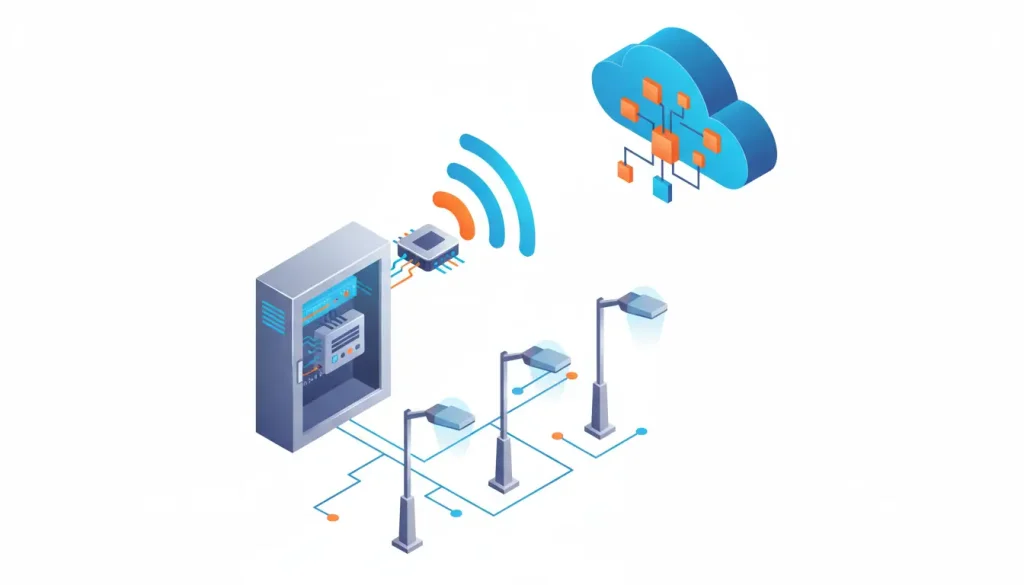
1. Cabinet-Level Edge Gateway (Field Layer)
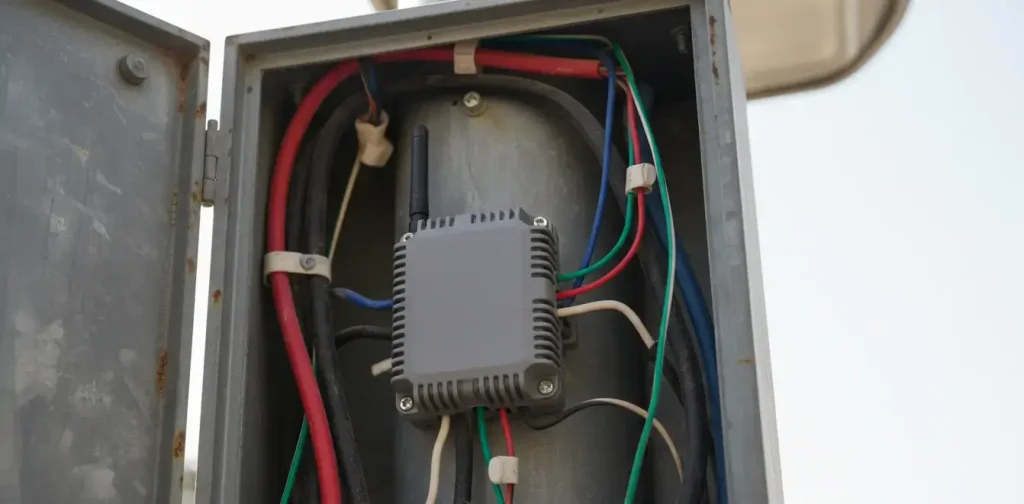
Unlike consumer-grade lamp-post cabinet mode, the Valtoris VT-LR600/601 series is engineered for Lighting Control Cabinet (LCC) integration. Instead of replacing every individual fixture, our industrial LoRa modems connect directly to the Master PLC or energy meters inside the distribution cabinet via RS485/232 or Ethernet ports. By utilizing the 410MHz–525MHz frequency band, a single VT-LR600 can transmit critical telemetry data from an entire street circuit across several kilometers, bypassing the need for expensive cellular SIM cards at every cabinet. This “Circuit-Level” control allows for bulk dimming, automated scheduling, and real-time power leakage detection with industrial-grade reliability.
2. Gateway Layer (Neighborhood)
One LoRa gateway covers a neighborhood or district. It:
- Receives reports from all cabinet mode in its area
- Sends commands to individual lights or groups
- Forwards data to the central management platform (over Ethernet or cellular backhaul)
3. Management Layer (Central Office)
The central platform (cloud or on‑premises) handles:
- Scheduling: when lights should be on, off, or dimmed
- Monitoring: real‑time status, power consumption, alerts for failures
- Analytics: energy usage reports, maintenance predictions
Real‑World Deployment Example
Scenario: A suburban community with 400 streetlights spread across 8 km of roads. The existing system runs on timers; failures are reported by residents.
Deployment:
- 400 LoRa edge gateway installed in existing light poles (one per light)
- 3 LoRa gateways placed at strategic locations (coverage overlap ensures redundancy)
- Central management platform accessible to operations staff
Results after 12 months:
- 42% reduction in energy consumption (dimming during low‑traffic hours, adaptive schedules)
- 80% reduction in maintenance dispatch (failures detected remotely; repairs scheduled efficiently)
- 3‑year payback on hardware and installation
- Zero cellular recurring costs (private LoRa network)
Data from recent deployments across Europe and Asia consistently demonstrate a 30% to 50% drop in energy usage, coupled with a 40% to 60% reduction in maintenance costs. This proven ROI makes LoRa the definitive choice for modern smart city infrastructure.
Technical Specifications for LoRa Street Lighting
When specifying hardware for a street lighting project, these specifications matter:
| Component | What to Look For |
|---|---|
| LoRa cabinet modem | Industrial temperature (–40°C to 85°C), weatherproof enclosure, external antenna option, power monitoring (voltage, current, wattage), dimming control (0–10V or PWM) |
| LoRa gateway | Coverage radius 2–5 km (urban), Ethernet or cellular backhaul, network management software, ability to handle hundreds of edge gateway |
| Frequency | Sub‑GHz bands (868 MHz in Europe, 915 MHz in North America) for better range and penetration |
| Security | AES‑128 encryption (Private LoRa Network standard) to prevent unauthorized access |
Why Private LoRa Networks Beat Cellular for Street Lighting
| Factor | Cellular (4G/5G) | Private LoRa |
|---|---|---|
| Recurring cost | $5–15 per edge gateway/month | $0 |
| Coverage | Dependent on carrier | Designed for the site |
| Battery life | Not applicable (lights have power) | Not applicable |
| Scalability | Per‑SIM cost adds up | Gateway handles hundreds of cabinet modem |
| Control | Over cellular network | Private, dedicated network |
| Security | Carrier‑managed | User‑managed encryption |
Consider the OPEX: A cellular deployment of 1,000 streetlights can incur $60,000 to $180,000 annually just in SIM card data fees. Conversely, a private LoRa network requires zero carrier subscriptions. Once the Valtoris gateways and edge gateway are deployed, your ongoing data transmission costs drop permanently to zero.
What to Look for in LoRa Hardware
When looking at industrial LoRa hardware for street lighting control cabinets (LCC), make sure your modems meet these important industrial standards:
✓ DIN-Rail Mounting Factor: The hardware needs to be very small and able to be mounted on DIN rails so that it can fit into small municipal distribution boxes that are already there.
✓ Sub-1GHz Penetration: For best penetration through obstacles in dense urban grids, choose modems that work in the 410MHz–525MHz band (like the VT-LR600) instead of Wi-Fi frequencies that are easy to disrupt.
✓ Edge Computing and Protocol Conversion: Check to see if it has built-in MQTT and JSON support. This lets the modem directly poll Modbus RTU meters and send data to the cloud without needing a second IPC (Industrial PC).
✓ Industrial-Grade Isolation: Make sure that the RS485/RS232 terminal blocks have strong ESD and optical isolation to keep them safe from lightning strikes that often hit street cabinets.
Common Questions
Q: Do I need to install a LoRa edge gateway on every single streetlight?
A: No, that is the advantage of Cabinet-Level integration. You only need to install one VT-LR600 industrial modem inside each Lighting Control Cabinet (LCC). It connects to the cabinet’s PLC or energy meter to control and monitor the entire street circuit, massively reducing hardware and installation costs compared to individual lamp cabinet modes.
Q: What frequency band does this system use?
A: The VT-LR600 series is optimized for the 410MHz to 525MHz Sub-1GHz spectrum (default 477MHz). This band provides exceptional obstacle penetration in dense urban environments, allowing a single gateway to cover multiple control cabinets across a city district.
Q: Can the modem send data directly to our municipal cloud server?
A: Yes. The VT-LR601 model has built-in support for MQTT and JSON. It can automatically check the Modbus RTU meters in your control cabinet, package the data into JSON, and send it straight to your AWS, AliCloud, or private MQTT broker without needing a separate protocol converter.
Q: What happens if the control cabinet is made of thick metal?
A: The VT-LR600 is made to work with external antennas because metal enclosures block RF signals. We strongly suggest using a magnetic-mount antenna with an extension cable. This lets you securely mount the modem inside the cabinet on a DIN rail while putting the antenna on the roof of the cabinet for the best range.
📖 Reference Sources & Industry Standards
To learn more about the underlying technologies and standards utilized in our smart lighting topologies, explore the resources below:
🤝 Why Source Smart City Hardware from Valtoris?
Transitioning to smart street lighting requires hardware that won’t fail in the field. Since 2014, Valtoris has engineered the industrial communication backbone for smart cities across Europe, Asia, and the Middle East.
- Direct Manufacturer Reliability: You get direct technical support from the engineers who built the hardware. We won’t disappear after your first order.
- OEM/ODM Ready: Need specific dimming protocols, custom enclosures, or white-labeled gateways for your municipality? We manufacture to your exact project specs.
- Extreme Durability: All our LoRa edge gateways and gateways are rigorously tested to withstand -40°C to 85°C environments and severe weather conditions.
👇 [Contact Our Engineering Team for a Smart Lighting Topology Review & Quote]