
What’s at Stake
A stalled elevator isn’t just an inconvenience. In a hospital, it delays emergency response. In a commercial tower, it triggers tenant complaints. In any building, it creates safety risk.
The global elevator market was valued at $80–90 billion in 2024, with connected elevators representing the fastest‑growing segment . According to industry data, 70–80% of elevator failures could be prevented with proper monitoring . Yet most elevators today are still treated as mechanical black boxes—inspected on a schedule, with nobody aware of a problem until it stops working.
This gap is where industrial 4G routers come in. They turn elevators into connected, observable systems without relying on building internet infrastructure.
The Limits of Scheduled Maintenance
Modern buildings are complex. A single tower can have a dozen elevators, each with its own controller, door sensors, leveling systems, and emergency brakes. Inspecting them on a fixed schedule means:
- Issues are detected after they cause problems
- Maintenance crews spend hours traveling to sites, only to find nothing wrong
- Early warning signs—like slow door response or subtle leveling drift—go unnoticed
According to field data, 30–50% of elevator service calls are for issues that could have been identified remotely . In some cases, a simple network alert could have triggered a fix before passengers were ever affected.verspeed risks, or sudden power failures before they escalate. This gap is exactly where real-time monitoring using industrial router architectures becomes essential.

How the Data Flows
A connected elevator monitoring system has four layers:
- Data acquisition – Elevator controllers (PLCs), door sensors, leveling devices, and emergency systems generate status data
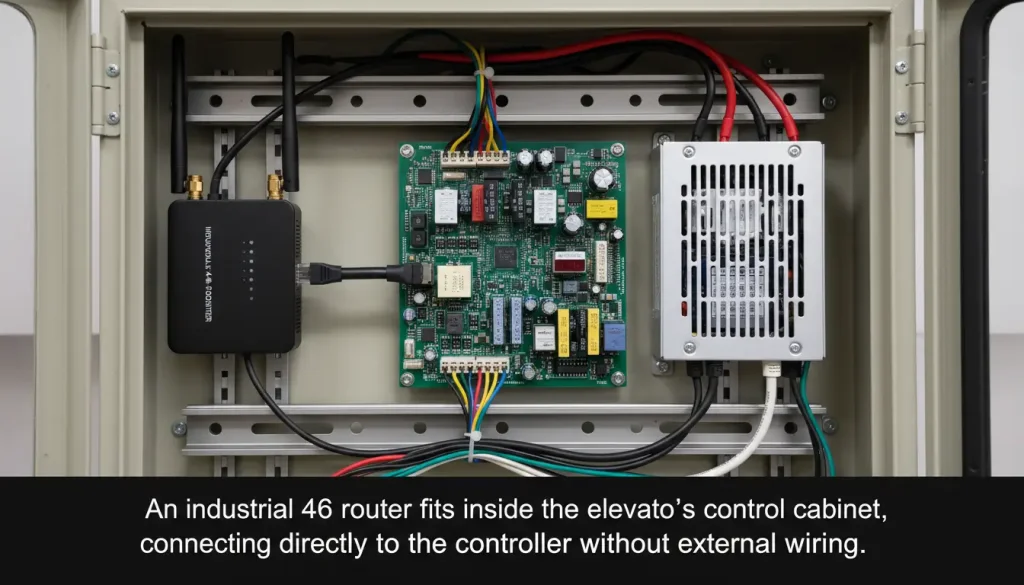
- Transmission – An industrial 4G router collects this data and sends it over cellular
- Processing – A cloud or on‑premises platform analyzes data for anomalies
- Application – Maintenance teams receive alerts, see dashboards, and respond remotely
At the transmission layer, the router connects to the elevator controller via Ethernet or serial (RS232/RS485) . It uses Modbus TCP or other industrial protocols to read status registers. Data is then packaged and sent over VPN‑encrypted cellular links to a central monitoring platform.
According to the International Organization for Standardization , elevator safety standards such as EN 81 and GB 7588 require that any monitoring equipment must not interfere with the elevator’s core safety functions . Industrial routers used in these applications are designed to be electrically isolated and fail‑safe.
Why Industrial Grade Matters Inside a Shaft
Elevator control cabinets are not climate‑controlled server rooms. Temperatures vary, electromagnetic interference from motors is constant, and vibration never stops.
| Feature | Consumer Router | Industrial Router |
|---|---|---|
| Operating temp | 0°C to 40°C | –40°C to 85°C |
| EMI protection | None | Built‑in shielding |
| Mounting | Desktop | DIN rail |
| Power input | 5V USB or 12V adapter | 9–36V DC terminal |
| Serial ports | No | RS232/RS485 |
| VPN | Optional | Built‑in |
| MTBF | <50,000 hours | >100,000 hours |
A consumer router in an elevator cabinet may fail in months. An industrial router is designed to run continuously for years, even with temperature swings and electrical noise.
Secure transmission is equally critical. Elevator data can reveal occupancy patterns, emergency events, and maintenance needs. A router with built‑in VPN (IPsec, OpenVPN) ensures that this data is encrypted from the cabinet to the monitoring center, preventing interception or tampering. According to ISO 27001 standards for information security, such encryption is considered best practice for critical infrastructure.

What Happens After Deployment
A building with 12 elevators installed industrial 4G routers to monitor:
- Door open/close cycles and timing
- Leveling accuracy at each floor
- Motor current and power draw
- Emergency brake status
- Car position and speed
Results after 12 months:
| Metric | Before | After |
|---|---|---|
| Mean time to detect issue | Days (after failure) | Minutes (real‑time alert) |
| Emergency stoppages | 14 per year | 5 per year |
| Maintenance visits | Monthly schedule | Condition‑based |
| Passenger reports | 8 per month | 2 per month |
The system found a problem, with the door timing that was making the doors jam sometimes. This was something that people had talked about now. Then. Nobody knew what was causing it. The door was fixed before it stopped working. The system caught the door timing issue with the doors before the doors failed completely.

Beyond Monitoring: Cameras and Displays
Modern elevators often include:
- Cameras for security and incident verification
- Display screens for building information or advertising
These devices need network access too. An industrial router with WiFi and multiple Ethernet ports connects cameras and screens without extra switches. Video from an incident can be viewed remotely, and display content can be updated without a site visit.
In buildings with internet the router uses it as the main connection. It also has 4G, as a backup. If the buildings network fails. And this happens often than you think. The elevator stays online.
The Cost Side of the Equation
According to industry data, remote monitoring can reduce elevator maintenance costs by 30–50% . The savings come from:
- Fewer routine site visits
- Faster troubleshooting (remote access reduces time spent on site)
- Preventive repairs (catching issues before they escalate)
- Reduced emergency call‑outs
For a building with 10 elevators, the annual savings often exceed the hardware cost within the first year. The router itself becomes an operating expense that pays for itself quickly.
Advantages for Elevator Manufacturers and Operators
Deploying an elevator monitoring solution based on a **Industrial Wireless Router** helps achieve measurable results:
- Reduced manpower through centralized monitoring
- 24/7 uninterrupted supervision with automated alerts
- Early warning for abnormal operating conditions
- Lower probability of major safety incidents
From an operational perspective, this approach transforms elevators from “black boxes” into manageable, data-driven assets.
Closing Thoughts
Elevator safety isn’t about regular inspections. It gets better when information flows smoothly consistently and safely from the elevator to those in charge.
Using a 4G router designed for industrial purposes*, like the one offered by Valtoris helps elevator makers and operators keep track of things in real-time respond quickly and sets the stage for integrating with smart building systems, in the future. This technology isn’t flashy.. For systems where safety is crucial, dependable and steady performance is exactly whats needed.