
The foundation of global food security and sustainable resource management relies entirely on effective AgIoT IT/OT integration. By the year 2050, global agricultural production must expand by an estimated 60% to sustain a population cresting 9.3 billion. Simultaneously, agriculture already monopolizes over 70% of global freshwater withdrawals, according to the Food and Agriculture Organization of the United Nations (FAO). We have crossed a critical ecological tipping point where scaling physical acreage is no longer viable. To combat rural poverty and ensure environmental sustainability, the agricultural sector must transition from manual resource management to closed-loop, automated conservation.
“Smart Farming” software has attracted significant investments over the last ten years. The market is full of shiny cloud dashboards, predictive AI algorithms and satellite-based Evapotranspiration (ET) mapping software. Yet, macro-economic reports indicate a persistent gap between digital innovation and actual field execution. Beautiful cloud dashboards do not conserve a single drop of water; physical valves do. The failure to achieve meaningful water conservation and yield enhancement at scale is rarely a lack of meteorological data. It is fundamentally an infrastructure and physical networking bottleneck.
This wide-ranging 2026 technical and agronomic roadmap will dissect the key bottlenecks preventing sustainable agricultural automation. We will explore the deep edge networking architectures needed to solve them once and for all, so both large scale corporate farms and smallholder communities can optimize yields and protect life’s most precious resource: water.
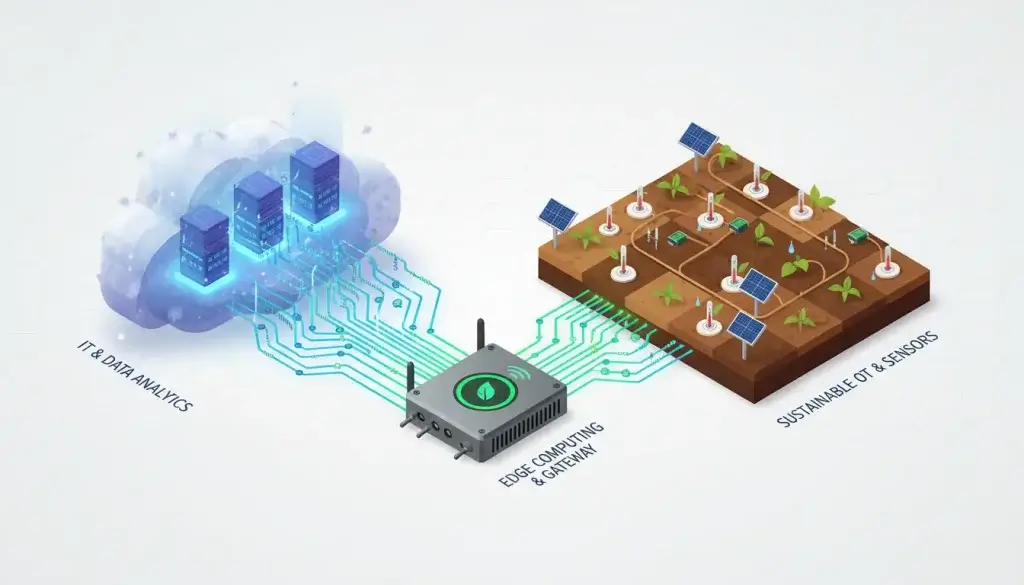
The Agronomic Foundation: Sensors as Agents of Sustainability
The installation of precision NPK (Nitrogen, Phosphorus, Potassium) sensors and multi-depth soil moisture probes turns farming from speculative to deterministic science. Farmers can ‘micro-dose’ water and nutrients based on the exact chemical and hydration profile of the root zone. But collecting this data is just the first step. The real challenge is to get that field data to the cloud analytics and then get the decisions back to the physical valves.
Protocol Hell: Bridging Cloud Dashboards with Legacy Field PLCs
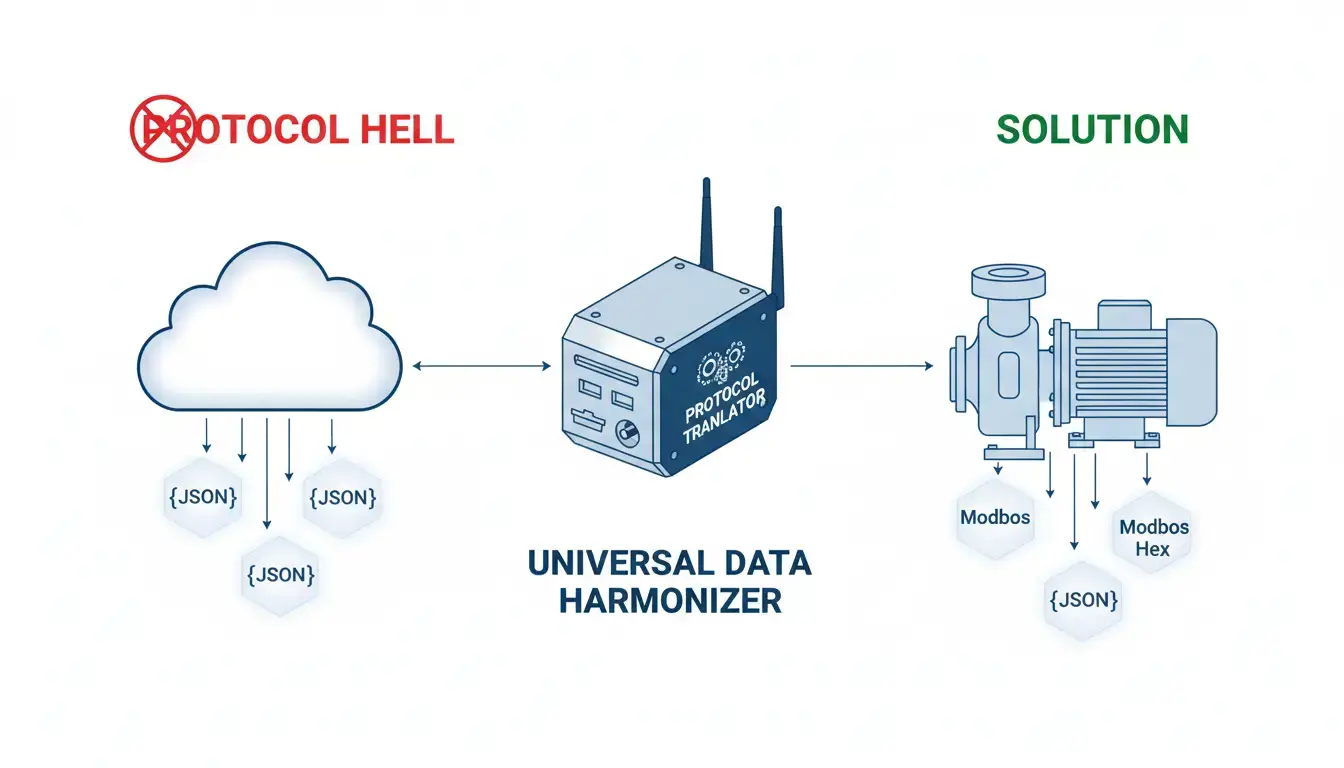
The biggest technical barrier in modern precision agriculture is affectionately called “Protocol Hell” by control engineers. This has to do with the large linguistic and structural gap between the modern cloud infrastructure (Information Technology) and the legacy field equipment (Operational Technology). Bridging this gap is crucial for the implementation of large-scale water conservation systems.
The Cloud IT Environment (MQTT & JSON)
From an IT perspective, modern cloud computing architectures thrive on lightweight, async, internet-native protocols. MQTT (Message Queuing Telemetry Transport) is the de facto standard in this space. MQTT is a very bandwidth efficient publish/subscribe model and is very well suited for rural areas with poor cellular coverage. The payloads of MQTT are almost exclusively formatted in JSON (JavaScript Object Notation). JSON’s human-readable key-value pairs make it incredibly elegant for web applications and big data analytics.
The Field OT Environment (Modbus RTU/TCP)
On the other hand, the execution layer (VFDs, PLCs, ultrasonic flow meters, solenoid valves) has not got the computing power to parse JSON, or connect to a MQTT broker. These devices speak in archaic, rigid, but very deterministic industrial languages.
The standard protocol for agricultural field hardware remains Modbus RTU (typically running over an RS485 physical two-wire layer) and Modbus TCP (running over standard Ethernet). Modbus does not use flexible key-value pairs; it uses strict hexadecimal register addresses and raw binary coils. When an algorithm publishes a JSON message to actuate a pump, the field PLC cannot interpret it without hardware-level translation.
The Hardware Translation Layer
Historically, bridging this gap required deploying fragile, consumer-grade microcomputers in junction boxes, relying on custom Python scripts to parse JSON into Modbus. These consumer devices are exposed to the severe humidity, dust, and electrical power fluctuations of a 110°F (43°C) greenhouse, and experience catastrophic failures.
To achieve scalable, zero-maintenance automation, agricultural infrastructure is standardizing on purpose-built industrial MQTT-to-Modbus TCP serial gateways. These embedded hardware modules act as dedicated, chip-level bilingual interpreters. They natively subscribe to the MQTT broker, ingest the JSON payload, automatically parse the variables, and instantly translate them into native Modbus RTU/TCP commands transmitted over the rugged RS485 bus to legacy PLCs.
“For agricultural development programs to succeed in rural economies, the infrastructure must outlast the grant funding. If your architecture relies on fragile, non-industrial boards to translate protocols, you are not building resilience; you are building technical debt. Sustainable conservation requires dedicated, hardware-level integration that operates flawlessly without human intervention for a decade.”
Edge Computing: Ensuring Failsafe Irrigation When Networks Drop
Farming occurs in remote, inhospitable environments that are vulnerable to extreme weather events. When a major storm takes out the regional cell tower, what happens to the automated irrigation system? The field is now completely disconnected from the cloud. This is a critical design question for any sustainable AgTech project.
If a system relies 100% on cloud processing to command valves to close, a network drop means valves will remain stuck in the “open” position. This results in flooded crops, massive water waste, and catastrophic financial loss. Robust AgIoT IT/OT integration demands a localized, highly resilient Edge Failsafe Networking strategy.
Cellular Redundancy and IC Hardware Watchdogs
Relying on standard cellular modems in rural environments is a critical vulnerability. Central farm control panels should utilize industrial cellular LTE routers featuring deep hardware watchdogs (IC watchdogs). An IC hardware watchdog runs on a separate physical circuit, constantly running ICMP ping tests to a reliable external IP address. If the cellular network silently degrades, the hardware watchdog detects the packet loss and physically pulls power to the modem module at the pin level causing an independent cold boot to restore the connection.
Physical Defense: RS485 Opto-Isolation
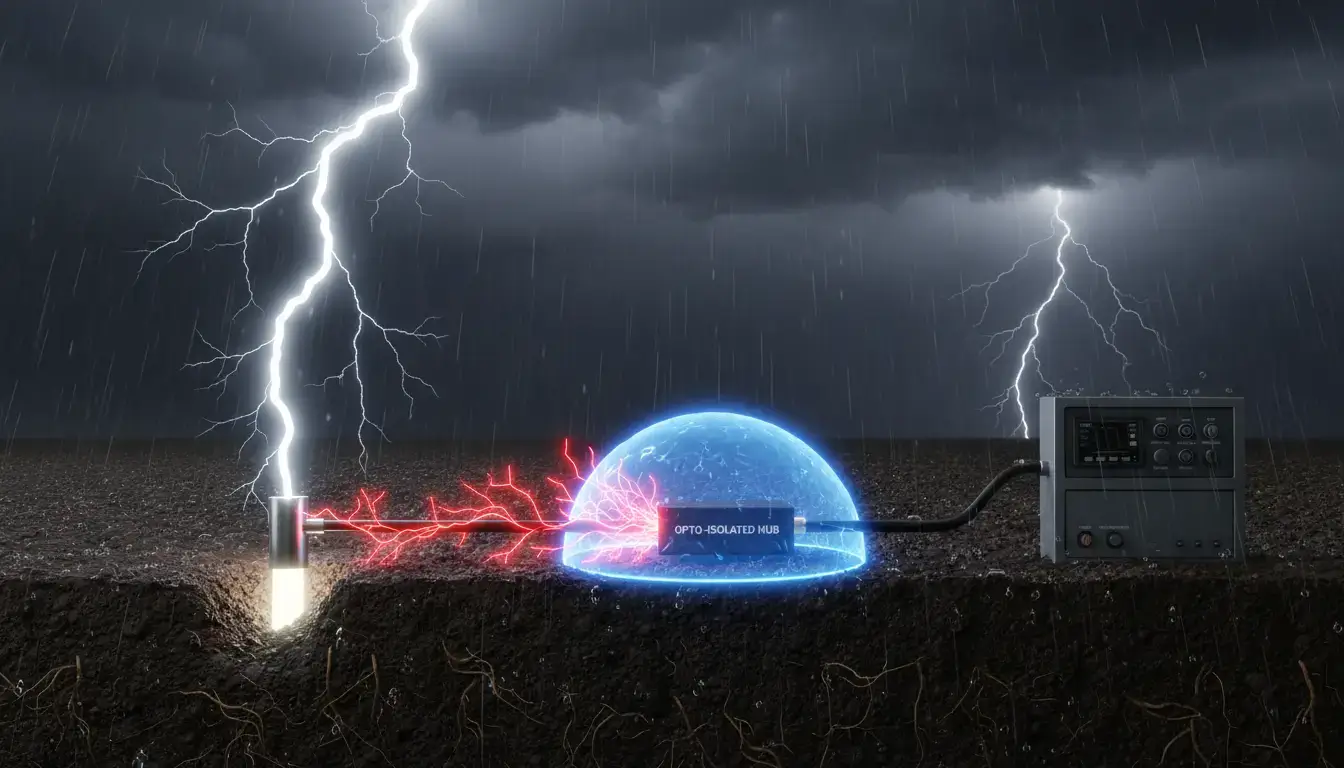
Running miles of copper wire across an open field acts as a massive antenna for severe electromagnetic interference (EMI) and lightning strikes. By utilizing opto-isolated RS485 hubs, the farm’s communication network is physically divided into safe, independent electrical zones.
Beyond Dashboards: Achieving Closed-Loop Automation
Visualizing data on a smartphone is helpful, but it still requires a human to interpret the graph, travel to the field, manually turn a heavy valve, and remember to turn it off hours later. Such manual intervention is susceptible to human error and labor inefficiencies. True, scalable water conservation is only achieved through Closed-Loop Control.
To physically turn a valve, a digital cloud command must ultimately become a physical electrical current. This is where advanced remote edge I/O (Input/Output) controllers bridge the final, crucial millimeter between the digital algorithm and the physical world.
- High-Fidelity Sensing (AI/DI): Modern edge controllers collect 4-20mA Analog Inputs (AI) directly from deep-soil moisture probes. Unlike 0-5V voltage signals, which suffer from voltage drop over long cable runs in massive fields, 4-20mA current loops can travel thousands of feet without losing accuracy. They also utilize Digital Inputs (DI) to count pulses from flow meters, measuring exact gallon usage.
- Mechanical Execution (DO): When the edge logic determines watering is necessary, the controller’s built-in relay—a Digital Output (DO)—physically closes an internal circuit. This sends a 24V DC electrical payload directly to the irrigation solenoid valve, snapping it open without human intervention.
Validating Socio-Economic Impact: Water Saved and Poverty Reduced
The convergence of IT and OT in agriculture is far more than technical engineering. It directly supports the core UN Sustainable Development Goals (SDGs), namely Goal 2 (Zero Hunger) and Goal 6 (Clean Water and Sanitation).
According to longitudinal studies compiled by agricultural extension programs like the California Irrigation Management Information System (CIMIS), shifting from traditional flood irrigation to a closed-loop, sensor-driven automated watering schedule reduces agricultural freshwater consumption by an average of 30% to 45%, while simultaneously increasing crop yields by 15% to 20% due to optimized root health.
| Sustainability & Economic Factor | Traditional Manual Farming | Integrated AgIoT Architecture |
|---|---|---|
| Resource Consumption | High waste (Significant runoff & aquifer depletion) | Precise Delivery (30-45% reduction in water use) |
| Ecological Preservation | High risk of toxic fertilizer leaching into water | Eliminates runoff, keeping chemicals in the root zone |
| Hardware Lifespan (ESG) | High e-waste from failing consumer microcomputers | Minimal e-waste (Ruggedized gateways last 10+ years) |
AgTech Implementation FAQ: Overcoming Field Challenges
Q: How are industrial edge gateways and remote I/O modules powered in the middle of a field without grid electricity?
A: This is a common hurdle for system integrators. Unlike consumer IT equipment that requires strict 5V or 12V AC adapters, true industrial AgTech hardware supports wide-voltage DC input (typically 9V to 48V). This allows gateways to be wired directly to standard 12V or 24V solar charge controllers and deep-cycle battery banks. The built-in voltage regulators protect the logic board from the natural voltage spikes that occur during peak solar charging hours.
Q: Many high-end soil moisture profiles use the SDI-12 protocol. How does this fit into a Modbus/MQTT architecture?
A: SDI-12 is excellent for low-power, multi-parameter soil sensors, but it is not natively suited for long-distance backhaul or cloud ingestion. The industry standard practice is to deploy a compact SDI-12 to RS485 (Modbus RTU) converter at the sensor node. Once the data is translated into Modbus registers, it seamlessly joins the local RS485 field bus and is pushed to the cloud via the central MQTT edge gateway, maintaining the integrity of the IT/OT bridge.
Q: Is MQTT truly reliable for actuating valves if the rural 4G cellular signal is unstable?
A: Yes, provided it is configured correctly. MQTT was specifically designed for unreliable networks. By utilizing MQTT Quality of Service (QoS) Level 1 or 2, the cloud broker guarantees that a command (like “close valve”) is acknowledged by the edge gateway. If the cellular connection drops mid-transmission, the broker holds the message and automatically delivers it the moment the gateway’s hardware watchdog re-establishes the connection, ensuring critical commands are never lost in the void.
Q: What if our existing irrigation pump is completely analog and doesn’t have a PLC or Modbus interface?
A: You do not need to replace the pump. You can bypass the data layer entirely by wiring an industrial Remote I/O controller directly into the pump’s electrical starter circuit. The cloud sends an MQTT command to the gateway, the gateway triggers the I/O module via Modbus TCP, and the module’s mechanical relay (DO) closes the circuit, physically engaging the pump’s contactor just as a manual switch would.
Empowering Sustainable Agriculture
Robust, failsafe physical infrastructure is the unseen foundation of global food security. Overcoming “Protocol Hell” is not merely an engineering challenge—it is an ecological imperative.
Continue exploring the standardized specifications of industrial edge computing solutions bridging the IT/OT divide.