

Industrial 4G LTE Modems: The Backbone of Remote Data Acquisition
When your critical infrastructure—whether it’s a remote pump station, a solar farm inverter, or a legacy PLC—is located miles away from the nearest Ethernet drop, traditional hardwiring is physically and financially impossible.
This is where an industrial 4G LTE modem becomes indispensable. Far beyond a simple consumer Wi-Fi hotspot, a true industrial cellular gateway acts as a secure, ruggedized bridge. It translates local serial or Ethernet telemetry (such as Modbus RTU/TCP) and transmits it securely over global cellular networks directly to your central SCADA system or IoT cloud dashboard.

In this guide, we break down how industrial cellular connectivity actually functions at the edge, the critical differences between commercial toys and carrier-grade hardware, and how deploying the right modem eliminates costly field service truck rolls.
1. The Core Mechanics: What a 4G LTE Modem Actually Does
At its core, an industrial 4G LTE modem establishes machine-to-machine (M2M) connectivity for remote assets lacking native WAN interfaces. It acts as a dedicated protocol translator and secure courier for your operational data:
- Physical Edge Integration: It interfaces directly with your edge devices (sensors, meters, or PLCs) through robust industrial ports like RJ45 Ethernet or RS232/RS485 terminal blocks.
- Protocol Packaging: It ingests raw local data streams (frequently Modbus RTU) and encapsulates them into routable TCP/IP packets suitable for internet transit.
- Cellular Uplink: Leveraging a standard M2M/IoT SIM card, it pushes these structured packets over high-speed LTE networks to your centralized monitoring infrastructure.
2. The Strategic Upside: Where 4G LTE Architecture Shines
The operational benefits of this technology are compelling, fundamentally altering how system integrators approach remote facility management.
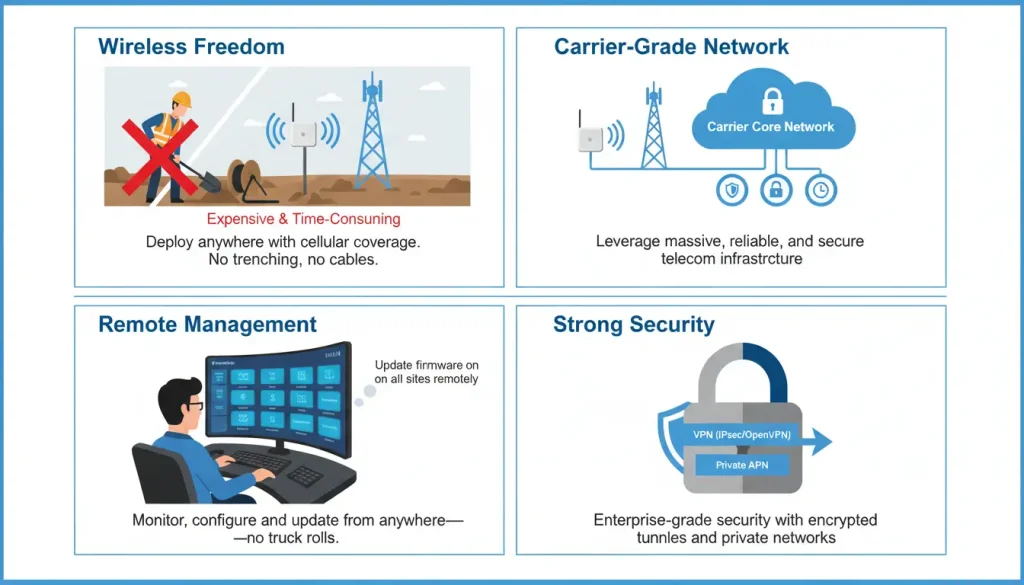
True Wireless Freedom and Deployment Agility
Bypassing the need for fiber trenching or complex localized RF networks (like 900MHz radios) drastically reduces capital expenditure and deployment timelines. LTE modems excel in:
- Geographically Challenging Topologies: Offshore platforms, agricultural irrigation pivots, and isolated forestry substations.
- Temporary or Mobile Assets: Rapidly establishing connectivity for construction site surveillance, mobile generators, or event kiosks.
- Brownfield Retrofits: Injecting cloud connectivity into legacy manufacturing equipment where pulling new Ethernet cables is highly disruptive to ongoing production.
Robust, “Carrier-Grade” Infrastructure
By leveraging established cellular networks, you are essentially renting billions of dollars of managed infrastructure. This provides:
- Mature Global Coverage: 4G LTE networks offer pervasive reliability across urban centers and expansive rural territories.
- Inherent Redundancy: Telecom operators maintain 24/7 network failover and base station backup systems, ensuring higher uptime than private radio links.
- Sufficient Bandwidth: LTE throughput easily handles dense SCADA polling, MQTT telemetry bursts, and even intermittent IP camera video streams.
3. Remote Management: Eliminating the “Blind Spot”
Once your remote assets are brought online via an industrial modem, the expensive cycle of reactive maintenance is broken.
- Continuous SCADA Visibility: Monitor tank levels, pressure thresholds, and fault alarms globally in real-time.
- Over-The-Air (OTA) Diagnostics: Execute remote PLC resets, adjust polling parameters, and deploy firmware updates without ever dispatching a field technician.
- Predictive Analytics: A constant data pipeline allows engineering teams to identify degradation trends (like a pump drawing excessive current) long before catastrophic failure occurs.
⚠️ Field Note: Beware of Consumer SIM Cards.
It is tempting to grab a standard smartphone SIM to save on monthly fees. However, consumer SIMs operate on dynamic, heavily-natted IP addresses (CGNAT) that block incoming SCADA polling requests. Always provision dedicated M2M/IoT SIMs from your carrier with Static IPs to ensure continuous, bi-directional remote access.
4. Security That’s Built-In, Not Bolted On
Pushing proprietary machine data across public cellular airwaves demands rigorous encapsulation. True industrial-grade modems provide defense-in-depth:
- Secure VPN Tunnels (IPsec / OpenVPN): Create encrypted, site-to-site virtual private networks that shield telemetry packets from public internet exposure.
- Private APN Integration: Provisioning a custom Access Point Name ensures your cellular traffic is logically segregated at the carrier level and routed directly behind your corporate firewall.
- Hardware Firewalls: Integrated packet inspection prevents unauthorized external IP addresses from querying your vulnerable edge PLCs.
🔒 Security Best Practice: Never Expose a PLC to the Public Web. Search engines like Shodan continuously scan the internet for exposed industrial controllers. Never configure port-forwarding to a raw Modbus TCP port over a public IP. Instead, mandate the use of your modem’s built-in VPN client, or configure it to push data securely outbound via MQTT.
An Honest Assessment: Challenges and Engineering Mitigations
Deploying cellular networks in harsh environments introduces specific engineering challenges. Success depends not on avoiding these obstacles, but on specifying hardware capable of mitigating them.
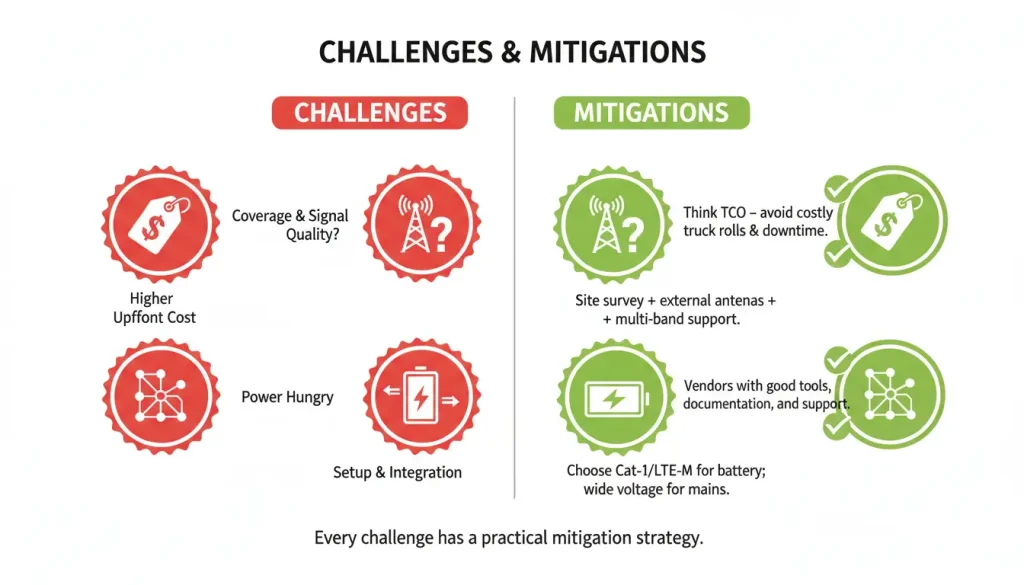
1. Higher Upfront Hardware Costs
- The Reality: Industrial 4G LTE modems require a higher initial capital expenditure than deploying consumer Wi-Fi dongles or running short local cable runs.
- The Mitigation (TCO Analysis): When a remote asset goes offline, the resulting “blind spot” forces an emergency truck roll. Dispatching a technician 50 miles simply to reboot a faulted controller costs hundreds of dollars per incident. Upgrading to ruggedized gateways eliminates these blind spots via remote reboot capabilities, dramatically lowering your Total Cost of Ownership.
2. Dependence on Cellular Coverage & Signal Integrity
- The Reality: Connectivity relies entirely on carrier signal strength. Metal control cabinets, basement deployments, or extreme rural locations can severely degrade RF penetration.
- The Mitigation:
1. External Antenna Arrays: Never rely on internal antennas inside a metal enclosure (Faraday cage). Specify modems with robust SMA connectors and deploy high-gain magnetic antennas outside the cabinet.
2. Link Resilience Logic: Select industrial hardware equipped with hardware watchdogs and ICMP heartbeat monitoring, ensuring the modem automatically re-establishes the cellular link if the carrier drops the connection.
| Potential Challenge | The Engineering Concern | Proactive Mitigation Strategy |
| Network Dependency | “Will the signal penetrate my metal pump station enclosure?” | 1. Route an external high-gain antenna outside the panel. 2. Enable modem watchdog timers for auto-recovery. |
| Power Fluctuations | Voltage drops in remote panels causing modems to freeze. | Specify wide-voltage input ranges (e.g., 9-36V DC) utilizing industrial terminal blocks instead of fragile wall adapters. |
| Configuration Complexity | Struggling to map serial Modbus registers to IP addresses. | Choose hardware with intuitive Web GUIs and built-in protocol translation engines. |
Making the Decision: A Simple Deployment Framework
A rugged 4G LTE modem is likely the optimal engineering choice if your topology involves:
- Remote or Mobile Assets where drawing physical WAN connections is impossible.
- Brownfield Equipment requiring legacy serial-to-IP conversion to join modern SCADA platforms.
- High-Stakes Telemetry demanding real-time alerts and remote troubleshooting access.
- Harsh Environments necessitating hardware tested from -40°C to 85°C.
Real-World Application: 5MW Solar Farm Telemetry
The Challenge: A utility client required a resilient monitoring backbone for a 5MW solar installation located in a high-desert environment. The site experienced severe dust ingress and ambient daytime temperatures exceeding 48°C. The field infrastructure consisted of string inverters communicating via RS485 (Modbus RTU), which needed to be aggregated and transmitted to a central control room miles away.
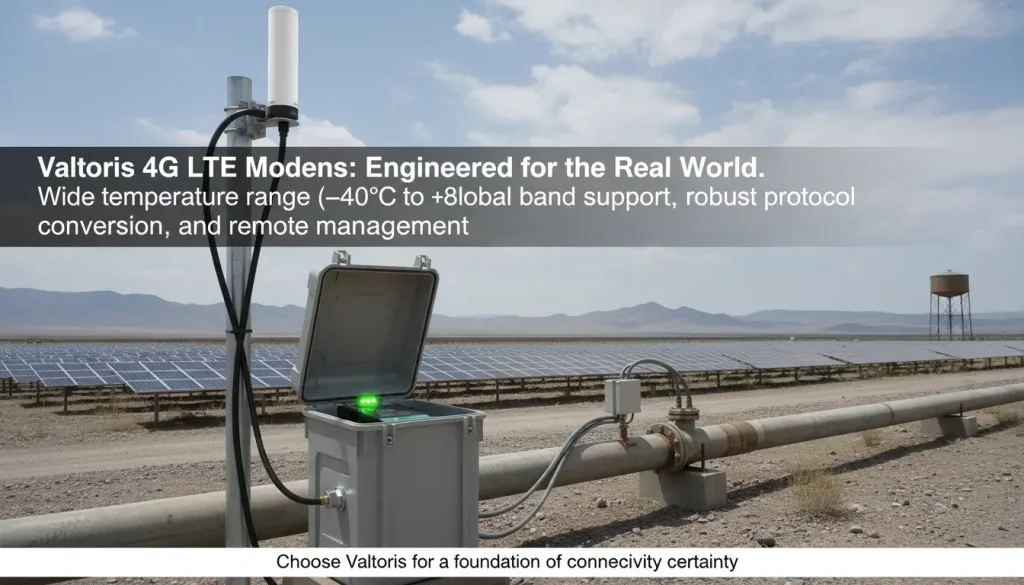
The Solution: Rather than attempting to trench vulnerable copper cabling across the abrasive terrain, engineers deployed industrial 4G LTE gateways at each major inverter cluster. By utilizing the modems’ integrated RS485 terminal blocks and active Modbus RTU-to-TCP translation, the local serial data was instantly encapsulated and pushed over the cellular network. Rated for extreme -40°C to 85°C operation, the hardware maintains a continuous telemetry pipeline despite the punishing thermal loads.
From a Manufacturer’s Perspective: What Defines Reliability?
When reviewing specification sheets, many cellular modems appear identical. Yet in the field, some fail within months while others run flawlessly for years. As engineers designing industrial connectivity at Valtoris, we prioritize the hidden architecture:
- Thermal Architecture: Utilizing high-tolerance industrial capacitors and cast-metal enclosures for passive heat dissipation, preventing thermal throttling.
- Firmware Resilience: Implementing deep-level hardware watchdogs that physically cut power and reboot the cellular module if the baseband processor locks up.
- EMC Immunity: Fortifying serial and power inputs to withstand severe electrostatic discharge (ESD) and voltage transients common in heavy manufacturing panels.
The ultimate goal of an industrial modem is invisibility—it should be a component so reliable that you never have to think about the link, allowing you to focus entirely on your operational data.
Frequently Asked Questions
Q: I installed a 4G modem, but I cannot remotely ping my PLC. Why is it offline?
Q: How much cellular data will my PLC actually consume polling via Modbus TCP?
Q: My main control panel is a sealed steel enclosure. Will the 4G modem still get a signal inside?
Q: With 5G expanding rapidly, is it still safe to invest in 4G LTE hardware for long-term projects?
Stop Risking Remote Assets on Consumer Hardware
Consumer hotspots will eventually fail in industrial panels, causing catastrophic blind spots and expensive truck rolls. Tell our engineering team about your SCADA topology below, and we will recommend the exact ruggedized LTE gateway to ensure your data flows uninterrupted.