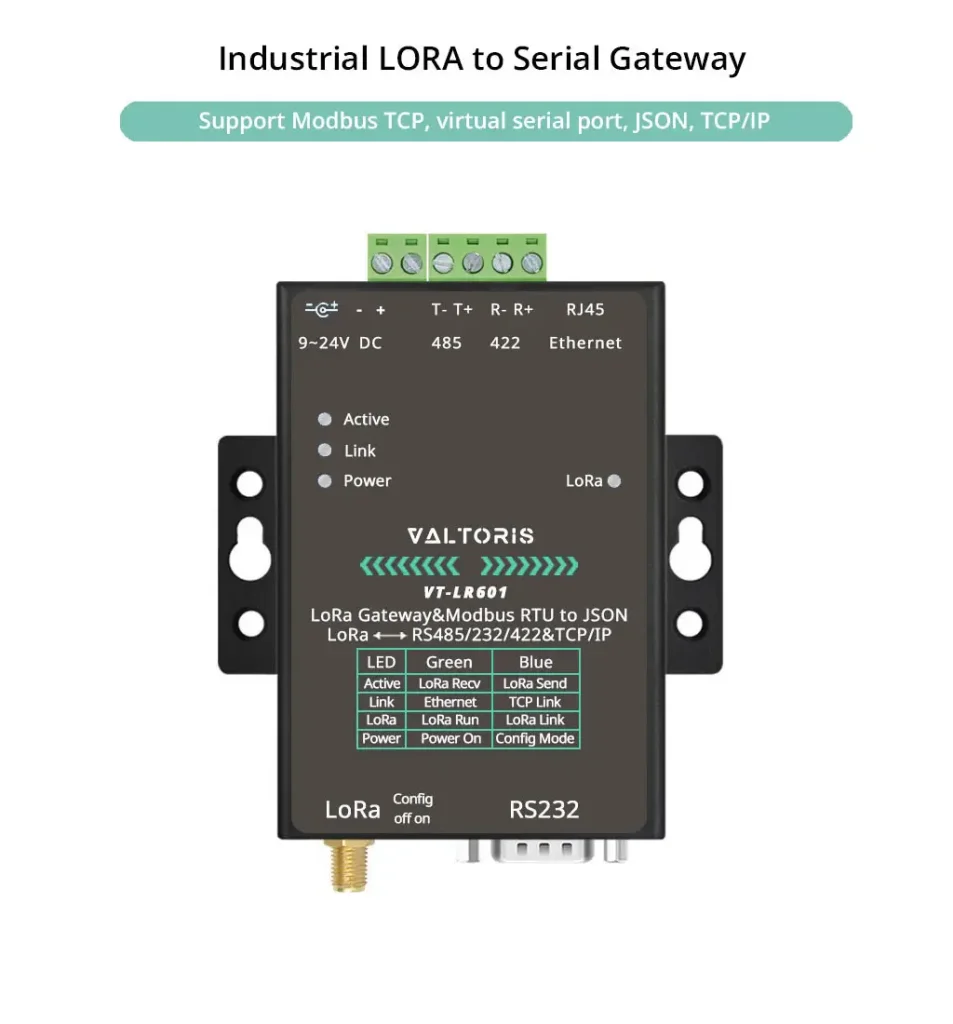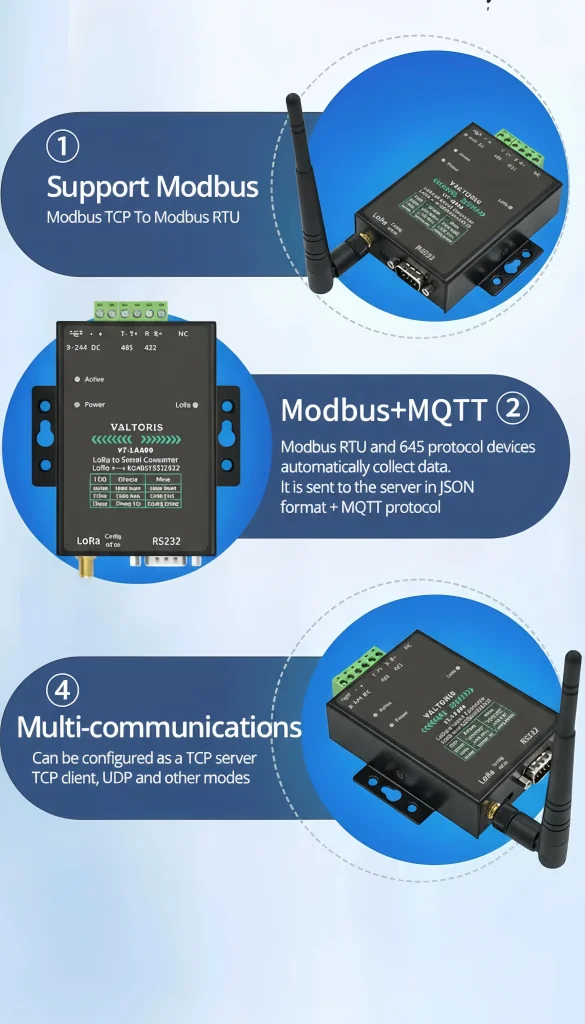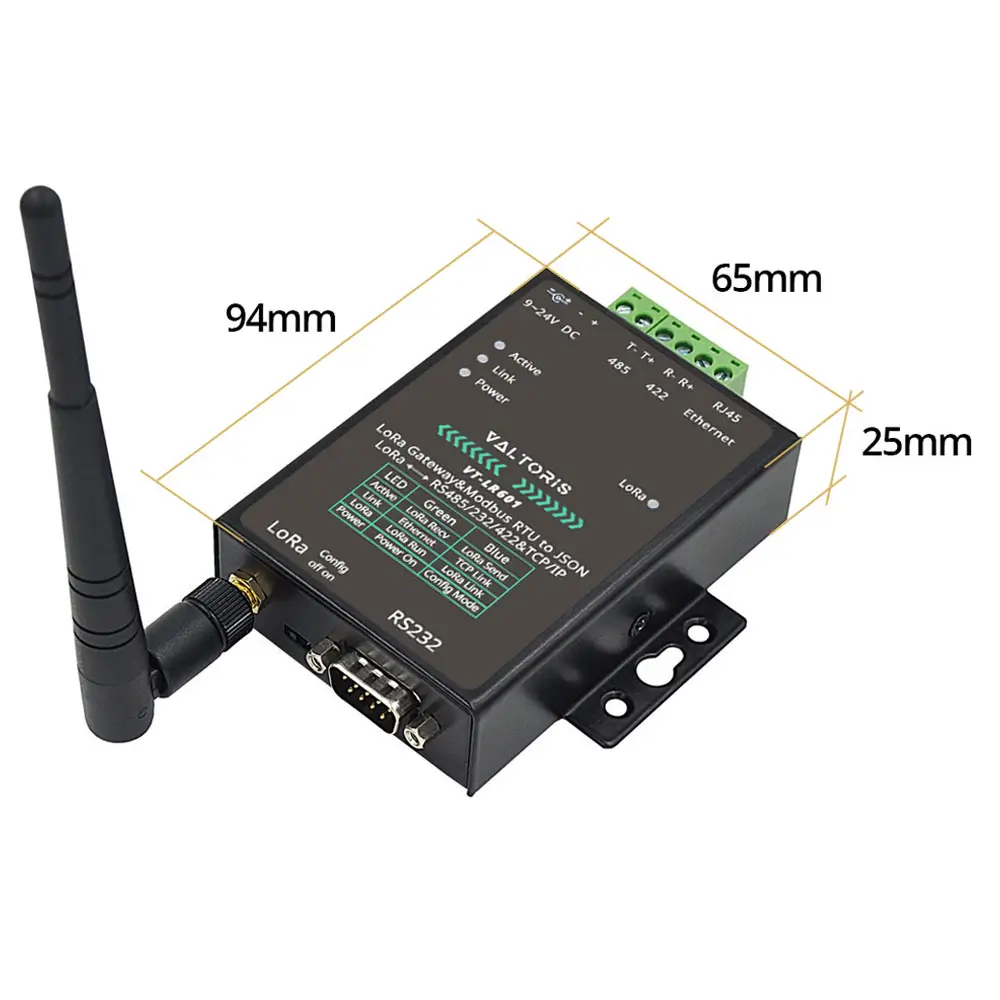
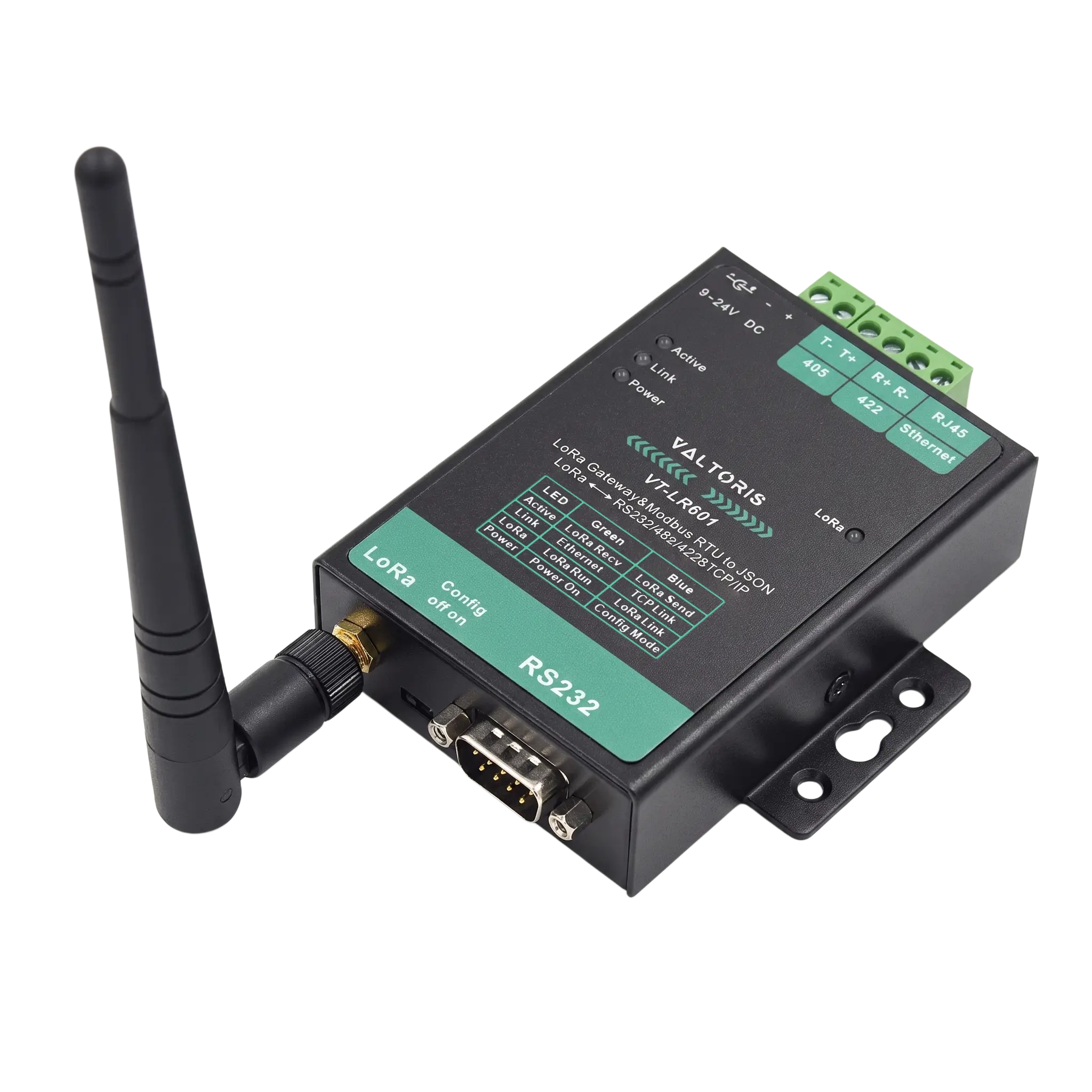
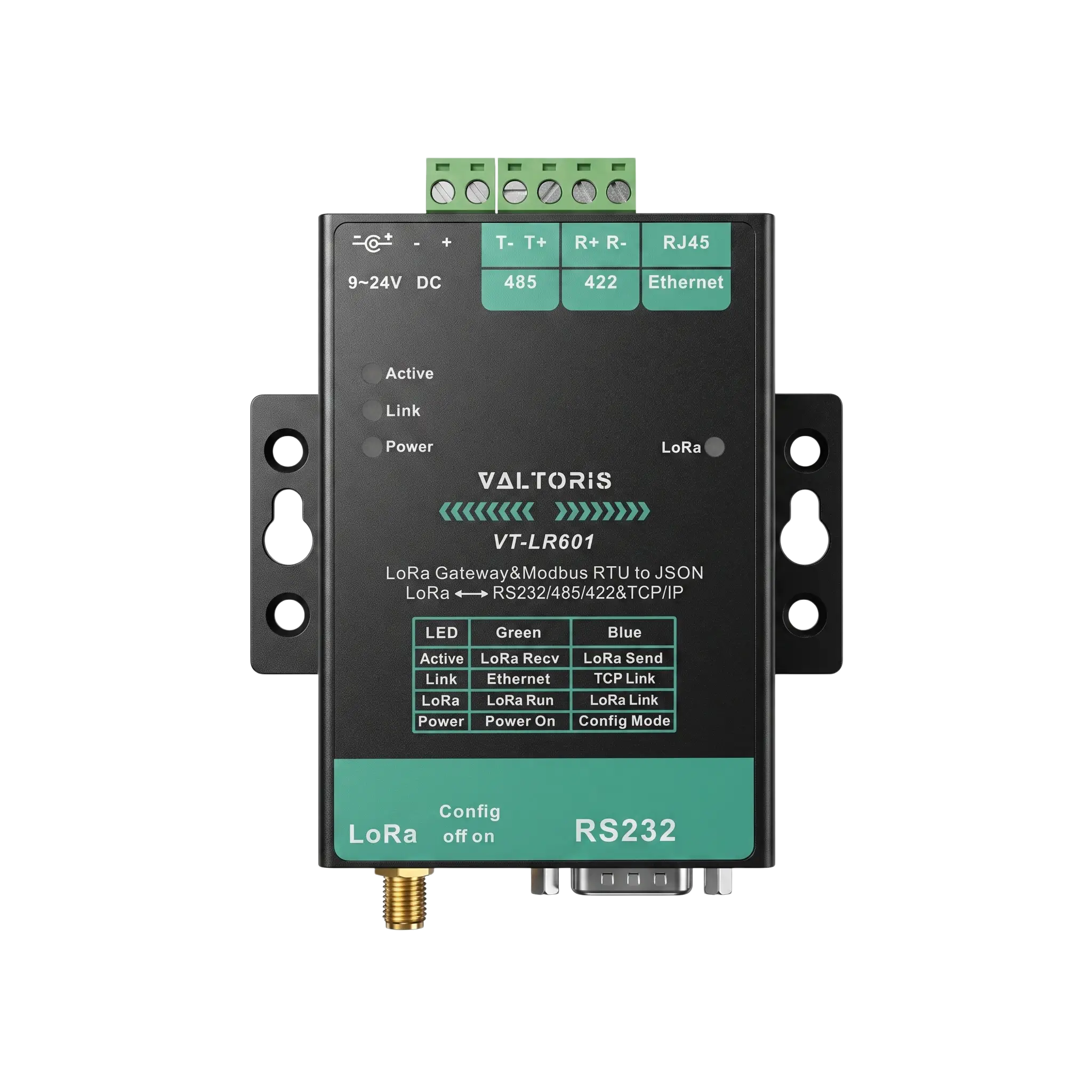
Engineered for zero-fee wireless telemetry, this industrial LoRa edge gateway securely bridges RS232/485/422 serial data and Ethernet into standard TCP/IP networks. It functions as a robust Modbus TCP to RTU converter, enabling seamless integration of remote legacy field devices into centralized SCADA systems without recurring cellular costs.
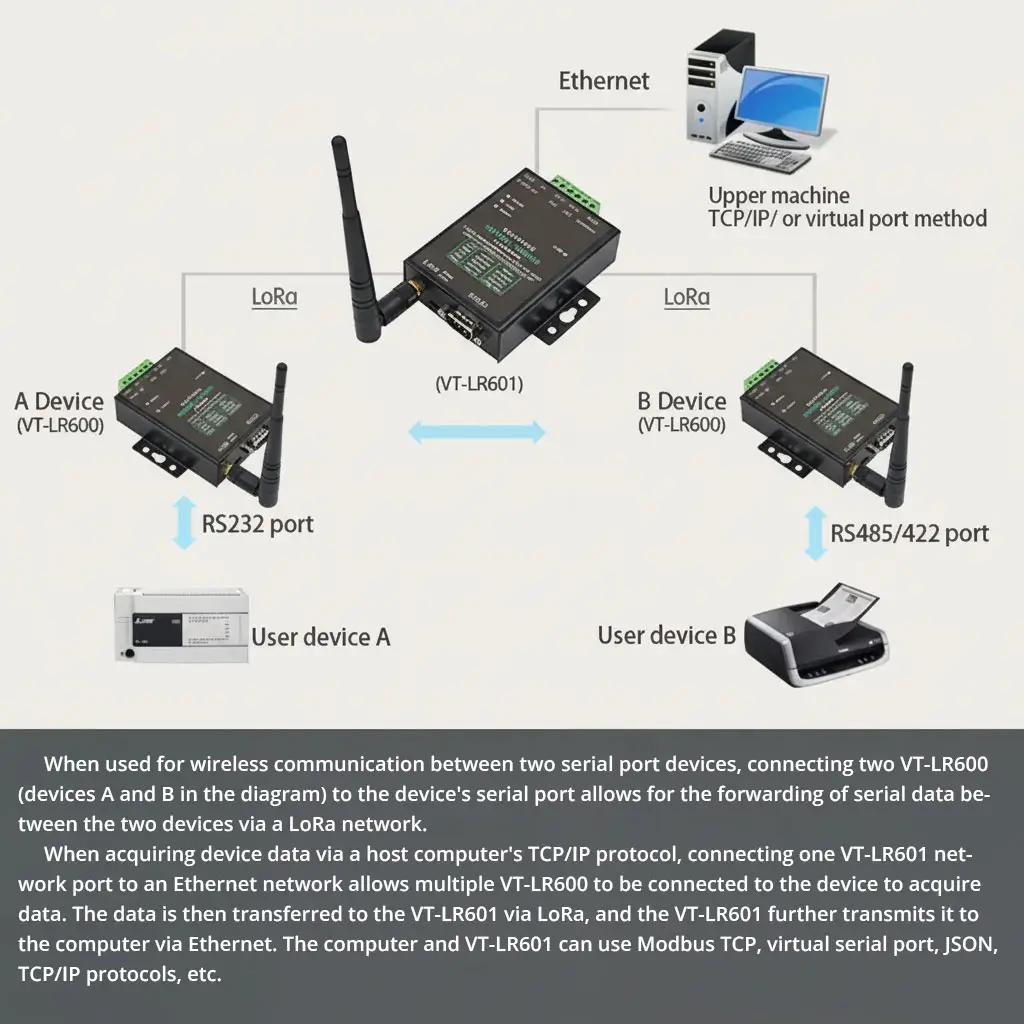
For RS485/232/422 to LoRa to RS485/232/422, we recommend VT-LR600 +VT-LR600.
For RS485/232/422 to LoRa to Ethernet adapters, we recommend VT-LR600 + VT-LR601.
Please purchase VT-LR600 at same time, purchase link as below:
The Valtoris LORA products can be applied to:
Power electronics, intelligent instruments;
Industrial automation system;
The Internet of things; Climate and geological monitoring
Building/access/security control system
Primary function
Long-distance LORA communication scheme, high performance, high stability Outdoor unshielded communication distance is 6km~8km
Stronger Wireless Function
VT-LR600 achieves high standards in wireless communication performance, including frequency range, wireless channel, receiver sensitivity, and transmit power
Rich indicator lights
Multi function
The VT-LR601, based on the VT-LR600, features multi-functional LoRa-to-Ethernet conversion, enabling LoRa to TCP/IP conversion
(Only VT-LR601 support TCP/IP protocol) ETHERNET, IP, TCP, UDP, HTTP, ARP, ICMP, DHCP, DNS
Environment
Operating temperature
-40~85℃
Storage temperature
-45~165℃
Humidity range
5~95% relative humidity
Summary:
LORA (Point-to-Point) is a long-distance wireless communication scheme. Compared with GPRS and 4G solutions, Lora does not require a monthly fee for access to the network, and it has a longer distance compared with WiFi and Zigbee. Therefore, LoRa is increasingly adopted for long-range, small-payload telemetry.
Features
LORA products adopt SX1287 chip and use Semtech’s patented LORA ™ modulation technology to achieve a receiving sensitivity of -140dBm and output power of +20dBm. The outdoor line-of-sight communication distance is 8km, featuring long distance, low power consumption and anti-interference.
Our LoRa product line consists of two main categories. The first is the serial-to-LoRa node (model VT-LR600), featuring three serial interfaces: RS232, RS485, and RS422. The second is the Ethernet (TCP/IP) to LoRa gateway (model VT-LR601), bridging LoRa networks with the Internet.
Q1: Do I need a third-party LoRaWAN Network Server (LNS) or cloud subscription to use this gateway?
A: Nope. The VT-LR series employs direct Point-to-Point (P2P) LoRa modulation, not the complex LoRaWAN protocol. The VT-LR601 is a stand-alone localized gateway. It takes radio telemetry and turns it directly into Modbus TCP/IP on your local Ethernet network, no external cloud servers, LNS configurations or monthly subscriptions required.
Q2: How does my central SCADA system address multiple remote serial nodes through this single Ethernet gateway?
A: The VT-LR601 operates as a transparent Modbus TCP to RTU bridge. Your SCADA system simply connects to the VT-LR601’s local IP address and uses standard Modbus Slave IDs to target specific remote sensors. The gateway automatically routes the TCP query over the LoRa network to the correct remote VT-LR600 node, and returns the serial response back as a TCP packet.
Q3: The spec indicates an 8km range, but will it work through thick concrete walls in an industrial plant?
A: The 8km rating applies to pure Line-of-Sight (LoS) outdoor environments. In heavy industrial settings with steel structures and concrete, the range decreases. However, thanks to the VT-LR601’s exceptional -140dBm receiving sensitivity, it can reliably penetrate approximately 5 standard building floors. For optimal indoor performance, we always recommend mounting the magnetic suction cup antenna outside of your metal control cabinets.
[What is an Industrial LoRa Device?] – Learn how to plan your RF network, bypass physical obstacles, and deploy P2P LoRa in heavy industrial environments.