Industrial EtherCAT Switches & Junctions
Nanosecond Precision for Motion Control & Star Topologies
Build resilient EtherCAT tree topologies without compromising servo sync. Featuring dedicated ESC chips, Distributed Clocks (DC), and nanosecond transmission delay to protect your critical automation rings from single-point cable failures.
EtherCAT Junction Modules Selection Guide
Dedicated EtherCAT Slave Controllers (ESC) for reliable line-to-star topology conversion.
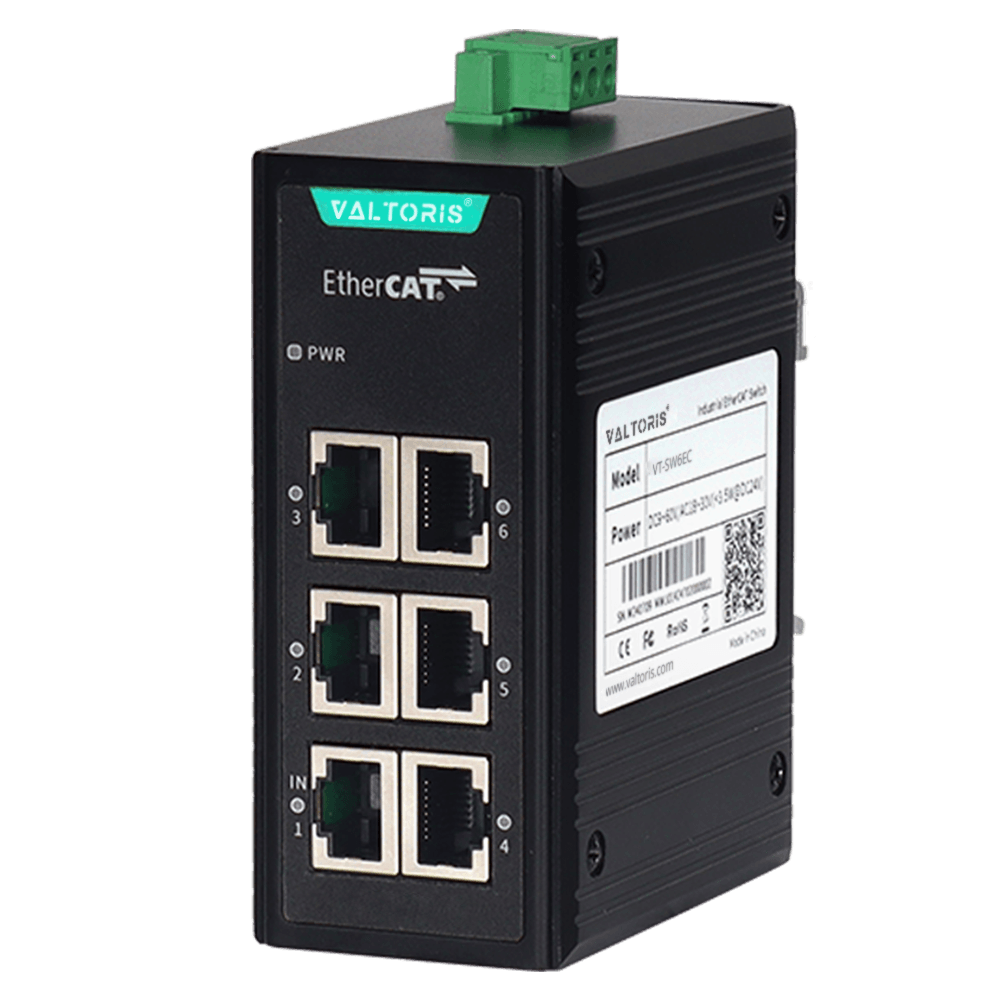
| Basic Branching VT-SW3EC 3-Port (1 In, 2 Out) EtherCAT Junction. | High Density Star VT-SW6EC 6-Port (1 In, 5 Out) EtherCAT Hub. | |
|---|---|---|
| Core Processing & Topology | ||
| Topology Support | Line, Tree, Star | Line, Tree, Star |
| EtherCAT Slave Controller (ESC) | Yes (Hardware Processing) | Yes (Hardware Processing) |
| Distributed Clocks (DC) | Supported | Supported |
| Processing Latency | Nanosecond Delay | Nanosecond Delay |
| Hardware Specification | ||
| EtherCAT Ports (RJ45) | 3 x 100Base-TX (1 IN, 2 OUT) | 6 x 100Base-TX (1 IN, 5 OUT) |
| Power Input (Non-Polarity) | DC 9~60V / AC 24V | DC 9~60V / AC 24V |
| Power Consumption | < 1.5W @ DC24V | < 3.5W @ DC24V |
| Enclosure & Temp | IP40 Aluminum, -40°C to +75°C | IP40 Aluminum, -40°C to +75°C |
| View Details | View Details | |
Break the Daisy-Chain Vulnerability
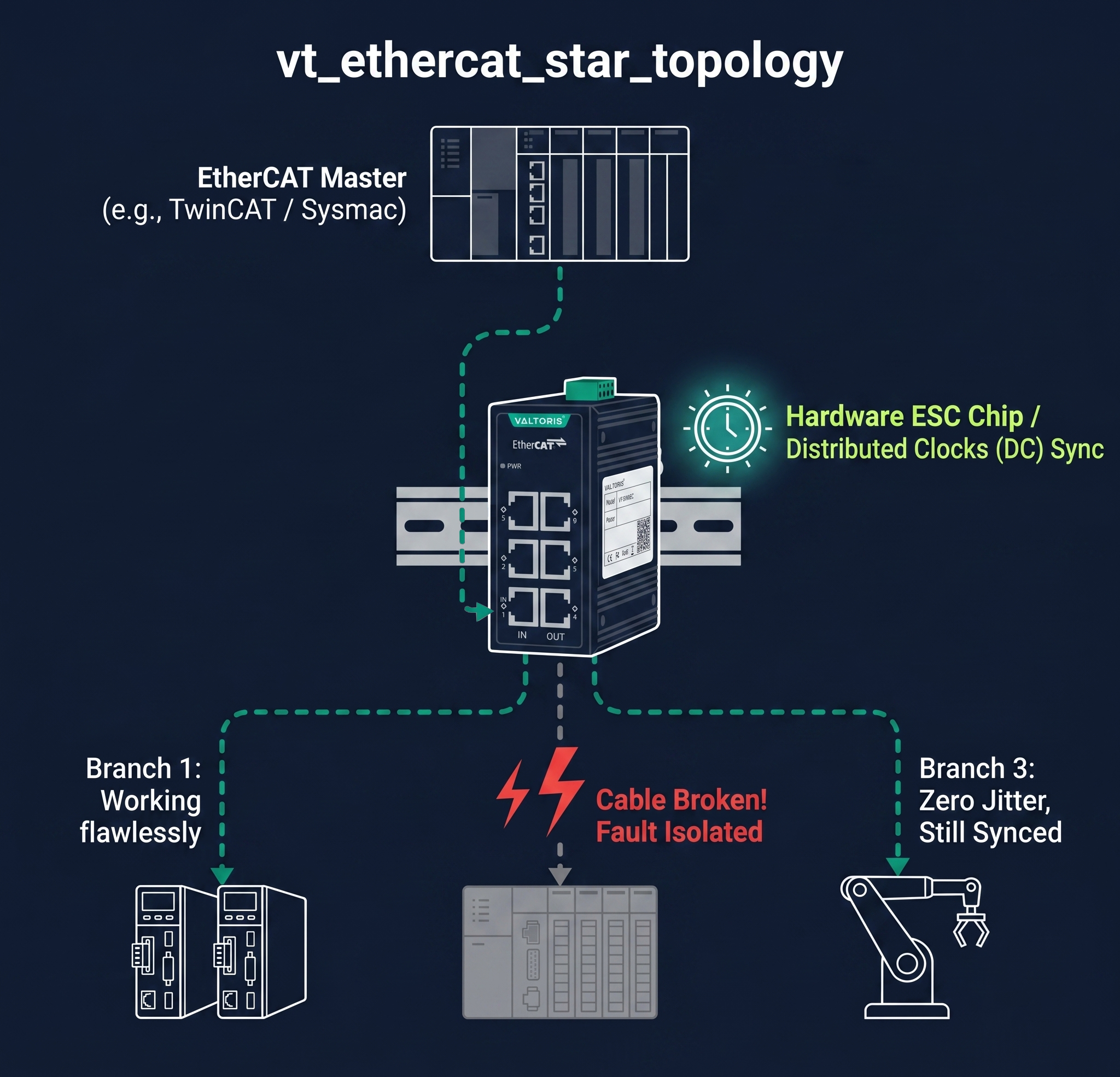
Native EtherCAT line topologies drop the entire network if one cable breaks. Our EtherCAT junction modules allow you to build resilient tree and star topologies, isolating faults to single branches while preserving nanosecond servo sync.
True ESC Hardware Chip
Unlike standard switches that buffer frames and destroy timing, Valtoris junctions utilize dedicated EtherCAT Slave Controllers for instantaneous “on-the-fly” data extraction.
Nanosecond Synchronization
Full support for Distributed Clocks (DC) guarantees that high-speed multi-axis CNC machines and robotic servos receive commands with zero jitter.
Flexible Node Expansion
Support seamless cascading. Expand your complex factory networks effortlessly; each network segment safely accommodates up to 65,535 EtherCAT slave nodes.
Non-Polarity Wide Voltage
Accepts flexible DC9~60V or AC24V inputs. Built-in non-polarity connections mean technicians can wire it up blindly without fearing reversed polarities.
Level 3 EMC Protection
Industrial-grade shielding isolates network data from massive EMI/RFI noise generated by nearby servo drives and variable frequency drives (VFDs).
DIN-Rail & Fanless IP40
Ultra-compact rugged aluminum alloy design saves valuable cabinet space and operates reliably in -40°C to +75°C without active cooling maintenance.
Applications Of EtherCAT Junctions
Engineered for time-critical automation systems requiring strict deterministic timing.

CNC Machining Centers
Ensuring microsecond-level synchronization across multiple axes for high-precision milling and cutting operations.

Robotic Arm Integration
Providing flawless Distributed Clocks (DC) alignment for complex 6-axis joint movements in automotive assembly lines.

High-Speed Packaging
Executing split-second I/O triggering and motion commands to prevent jamming in rapid bottling and sorting machines.
Semiconductor Fabs
Building isolated tree topologies to prevent single-point cable failures from halting multimillion-dollar wafer processing batches.

Wind Turbine Pitch Control
Reliable nanosecond communication between the nacelle controller and blade pitch drives in extreme -40°C vibration environments.

Automated Storage (AS/RS)
Branching out long-distance EtherCAT rings across massive warehouse aisles without compromising synchronization speed.
What Our Clients Say
Real-world reliability verified by field systems integrators.
“We use TwinCAT to run a 24-axis packaging line. Previously, one damaged cable would drop the whole downstream line. Installing the VT-SW6EC allowed us to split the topology into 5 independent branches. Now, a fault on one branch doesn’t stop the entire machine.”
“I was a bit leery about adding a junction, I thought it would add jitter to our servo drives. The Valtoris module uses a real ESC chip and our Distributed Clocks (DC) are perfectly synced within nanoseconds. “Brilliant hardware.””
Procure EtherCAT Junctions for Your Projects
Build resilient star topologies without sacrificing servo synchronization. Contact us for direct-from-manufacturer volume pricing.
Request Custom QuoteDownload the EtherCAT Switches Line Card
Get a quick offline comparison of port configurations, power inputs, and EMC ratings across the VT-SW EtherCAT series.
Frequently Asked Questions
Do I need to import an ESI (XML) file to configure this junction in TwinCAT/Codesys?
Yes. Because the junction module acts as an active router equipped with its own EtherCAT Slave Controller (ESC) chip, your Master PLC must recognize it to properly map the network topology. We provide the standard ESI (EtherCAT Slave Information) XML file. Simply drop it into your master software directory, and the branch ports will populate automatically.
Does installing this junction consume one of my EtherCAT slave node addresses?
Yes. Unlike a transparent ethernet hub, the VT-SW series junctions actively process Distributed Clocks (DC) and route data frames. Therefore, your EtherCAT Master will assign it a distinct, independent slave node ID on the bus.
Does this junction support EtherCAT “Hot Connect” for active maintenance?
Yes. This is one of the primary benefits of building a star topology with our junctions. By defining a specific port as a “Hot Connect Group” within your Master software, you can physically plug or unplug a servo drive from that branch port while the machine is running, without dropping the sync of the entire EtherCAT network.
Is this junction strictly for Beckhoff/TwinCAT, or can I use Omron/Keyence masters?
It is 100% brand-agnostic. Because our junction modules strictly adhere to the ETG (EtherCAT Technology Group) conformance standards and utilize authentic ESC chips, they are fully compatible with any certified EtherCAT master, including Omron Sysmac, Keyence, Codesys, AMK, and Trio.