
Embedded UART/TTL to Ethernet Modules & Chips
Accelerate Your IoT Hardware R&D with Zero-Code TCP/IP Integration
Valtoris industrial grade SoC chips and embedded modules have totally integrated MAC/PHY and native TCP/UDP/MQTT protocol engines. Simply solder them to your PCB, connect your MCU’s UART pins and instantly bring enterprise level networking to your hardware.
Embedded Hardware Selection Matrix
Compare integration levels, power consumption, and network capabilities to find the exact drop-in replacement for your PCB.
| Form Factor / Series | Network Interface | Baud Rate & Power | Core TCP/IP Capabilities | Action |
|---|---|---|---|---|
| VT-CHIP100 Single-Chip SoC Solution | Integrated MAC/PHY | 110~921.6 kbps ~25mA @ 3.3V | TCP/UDP, Modbus TCP/RTU, MQTT, HTTP, 8 configurable GPIOs. | View Specs |
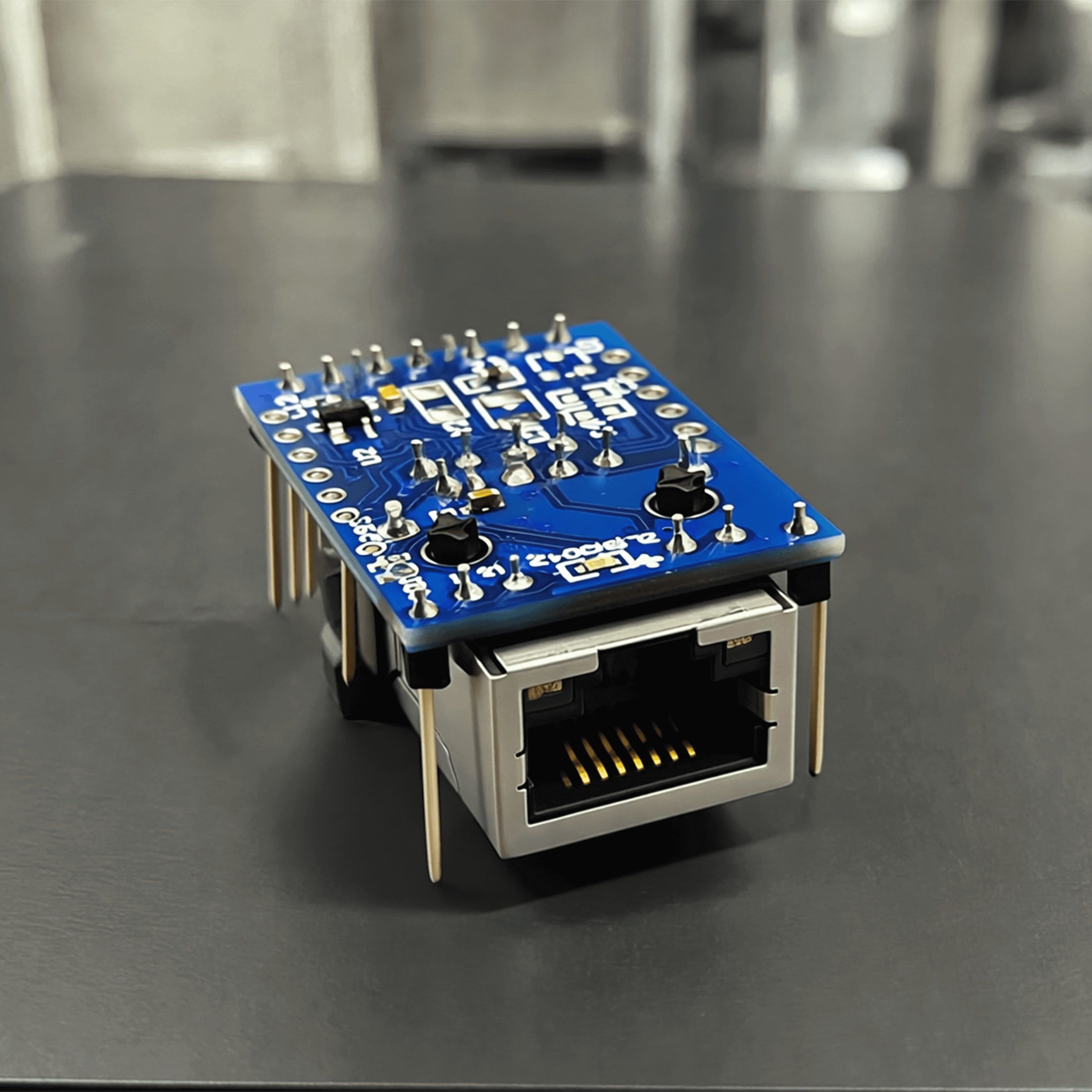
| Pin-Header Module Direct PCB Soldering | Built-in RJ45 & Transformer | Up to 921600 bps ~50mA @ 3.3V | TCP Server (up to 30 clients), TCP Client, UDP, Multicast modes. | View Specs |
| Flush-Mount Module Seamless PCB-fit Design | Built-in RJ45 & Transformer | Up to 921600 bps ~50mA @ 3.3V | 7th-Gen Architecture, Zero packet loss, Full-duplex data transfer. | View Specs |

RS232 to RS485 Passive Converter
Advanced passive interface converter built with a 4-channel charge pump. Steals power directly from TXD/RTS pins—requiring zero external power. Supports up to 230400bps without error codes. Perfect for legacy RS232 instrument bridging.
View Specs →Why Outsourcing the Network Stack is a Competitive Advantage
Stop reinventing the wheel. See how our embedded solutions compress your go-to-market timeline from months to days.
| Development Phase | Valtoris Zero-Code Integration | Traditional In-House R&D (MCU + PHY) |
|---|---|---|
| Hardware Design | Drop-in ready. Solder the module or VT-CHIP100 directly. Impedance matching and transformers are pre-solved. | Requires complex PCB layout for high-frequency MAC/PHY lines and external isolation transformers. |
| Software Engineering | Zero coding required. Send data via standard UART/TTL. The chip autonomously handles all TCP/IP and Modbus framing. | Engineers must manually port LwIP, manage socket connections, handle memory allocation, and write CRC logic. |
| Testing & Debugging | Proven stability. 7th-Gen architecture running in millions of industrial nodes. No memory leaks. | Months of troubleshooting connection drops, buffer overflows, and watchdog resets under heavy network loads. |
| Time to Market | Hours to Days. Your core engineering team stays focused on your product’s actual application logic. | 3 to 6 Months. Diverts critical engineering resources into reinventing basic communication infrastructure. |
Industrial-Grade Specifications for Mission-Critical Hardware
Our silicon and modules are engineered for IEC 62443 compliance and continuous operation in demanding environments.
Ultra-Low Power Footprint
Ideal for embedded systems. Our SoC chip consumes merely ~25mA at 3.3V, while the integrated modules peak at ~50mA, ensuring minimal thermal dissipation.
Deterministic Speed
Enjoy stable, full-duplex data transmission at baud rates up to 921.6 kbps with strictly zero packet loss, critical for high-speed sensor polling.
Complete Protocol Suite
TCP Server/Client, UDP, Modbus TCP/RTU, HTTP, DNS, DHCP, and secure MQTT tunneling are all natively supported. No need for external libraries.
Ready for RS485
Dedicated control pin optimized RS485 Transmit / Receive direction switch. Create multi-drop nodes easily.
Hardware Engineering Resources
Access reference designs, pinout specifications, and integration guides.
Accelerate Your PCB Prototyping Today
Want to add enterprise-grade Ethernet to your embedded system? For full datasheets, reference circuit diagrams or to request a development evaluation kit, please contact our application engineers at.
R&D Integration FAQ
Q1: Do I need to write a TCP/IP stack on my host MCU to use the VT-CHIP100?
A: Absolutely not. The VT-CHIP100 is a fully integrated SoC with an embedded hardware TCP/IP stack and MAC/PHY. Your host MCU simply communicates with our chip using standard UART (TX/RX) serial commands. We handle all Ethernet packet framing, ARP, ICMP, and TCP retransmission autonomously.
Q2: How do I configure the IP address and network parameters on the embedded module?
A: There are three ways. You can use our provided PC software (VirCom) over the LAN to search and set the IP; you can access the module’s built-in Web Server via a standard browser; or, for deep integration, your host MCU can send AT commands over the serial port to dynamically configure the module’s network settings on the fly.
Q3: Does the module support Auto-MDI/MDIX for Ethernet cables?
A: Yes. Our modules and the VT-CHIP100 support Auto-MDI/MDIX (auto-crossover). So end-users can plug in a normal, straight-through Ethernet cable or a crossover cable and the physical layer will auto-detect and auto-negotiate the correct link without breaking the network.
Q4: Can the chip handle RS485 transmit/receive direction control automatically?
A: Yes. If you are designing an RS485 interface, you do not need to write complex timing code on your MCU to toggle the MAX485 driver chip. The VT-CHIP100 has a dedicated pin for hardware control that goes high on transmission and low on reception, for perfectly timed half-duplex RS485 communication.