
Hardware Migration Brief:
Evaluating the VT-LTE500 as a Digi WR21 Replacement
End-of-Life Digi WR21 necessitates OT teams to migrate legacy SCADA connections. The goal of this guide is to provide an unbiased technical assessment of the VT-LTE500, an industrial router with native dual RS485 and integrated Modbus polling engine, to determine whether it is a valid 1:1 drop-in replacement for your specific cabinet topology.
1. The EOL Compliance Challenge
Hardware in OT environments often goes untouched for a decade or more. However, an End-of-Life (EOL) notice for a network gateway comes with major cybersecurity liabilities.
As the legacy operating systems these routers run on lose the ability to receive critical security patches, enterprise IT departments utilizing Zero-Trust architectures will begin to flag these unsupported devices in their regular vulnerability scans.
IT compliance policies mandate the patching of unpatched gateways on a live SCADA network as this represents a high-severity attack vector.
Internal IT/OT Migration Justification Template:
2. Modbus Polling: The Role of Deterministic Latency
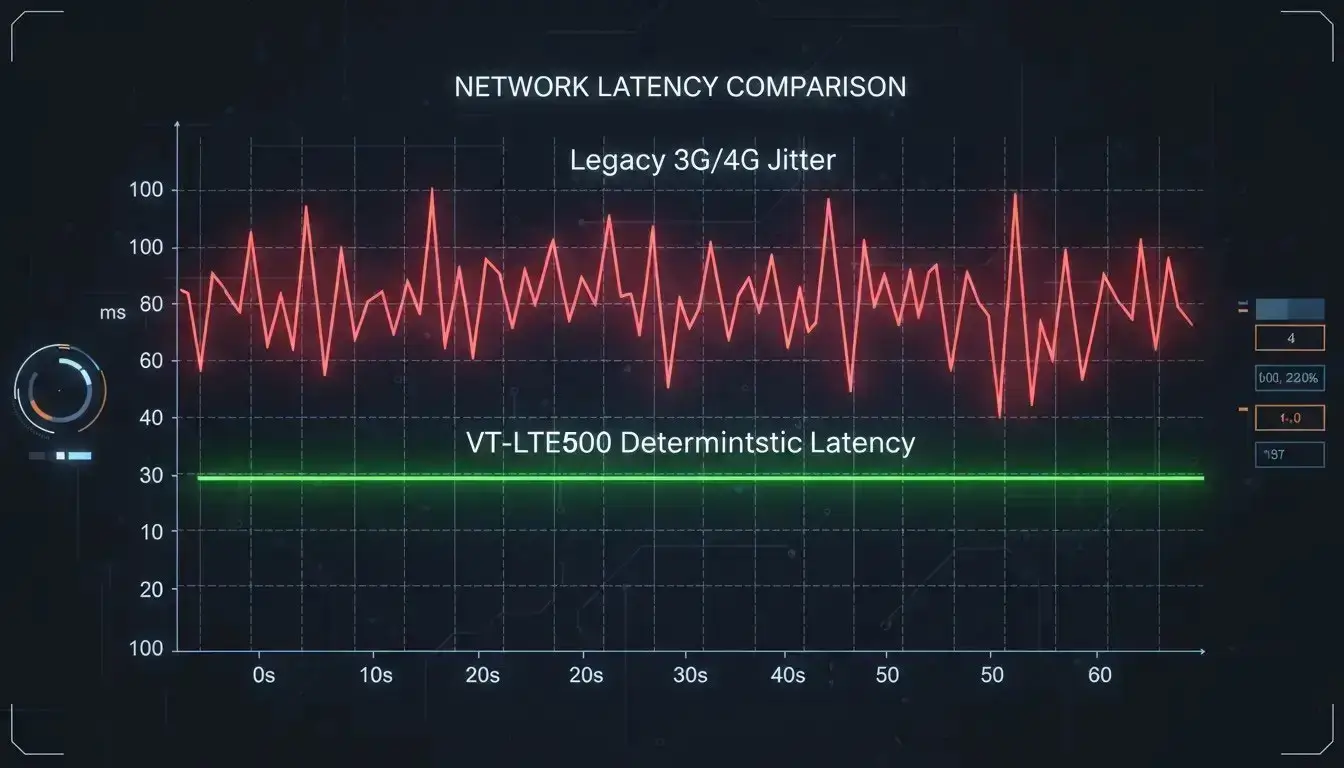
Network jitter is a common operational problem when choosing a replacement router. Many engineers are purchasing commercial-grade routers only to find that as carriers reallocate spectrum for 5G, the early 4G bands experience significant signal degradation.
In SCADA polling, the primary engineering constraint is deterministic latency and packet delivery reliability, rather than peak bandwidth. When a central historian polls a remote Modbus RTU PLC over TCP, a latency spike caused by a consumer cellular module results directly in timeout errors (Exception Code 0x0B).
The VT-LTE500 overcomes this by integrating an industrial LTE Cat-4 module designed for M2M data processing. It gives the strict latency control needed for continuous SCADA polling without packet dropping, making it a viable industrial alternative.
3. Deployment Boundaries: Is the VT-LTE500 a Technical Fit?
To ensure a seamless migration, verify your field requirements against the VT-LTE500’s native capabilities before requesting an evaluation unit.
Ideal Drop-In Scenarios:
- Native RS485 Reliance: The site polls legacy meters or PLCs via RS485. The VT-LTE500 natively provides dual independent RS485 interfaces.
- Modbus Data Structures: Your SCADA system utilizes Modbus RTU or TCP. The router features a built-in Modbus Collect engine for local arbitration and MQTT/TCP upload.
- Cabinet Space Constraints: You require an all-in-one footprint to avoid mounting secondary serial-to-ethernet protocol gateways.
- Wide-Voltage Operations: The existing power supply runs between 9V and 36V DC.
Do NOT select this unit if:
- RS232 Physical Interfaces: Native RS485 only on this hardware For an RS232 PLC you would need external converters which defeats the purpose of a 1:1 drop-in replacement.
- Custom Python Execution: If your legacy architecture requires running custom Python scripts directly on the router’s OS, be aware that the VT-LTE500 runs a GUI-configured embedded polling engine – not an open Python environment.
- High-Bandwidth 5G Needs: The unit uses an LTE Cat-4 modem (150 Mbps DL / 50 Mbps UL) It is intended for deterministic SCADA polling, not 4K CCTV multi-channel streaming.
4. Core Edge Capabilities Overview
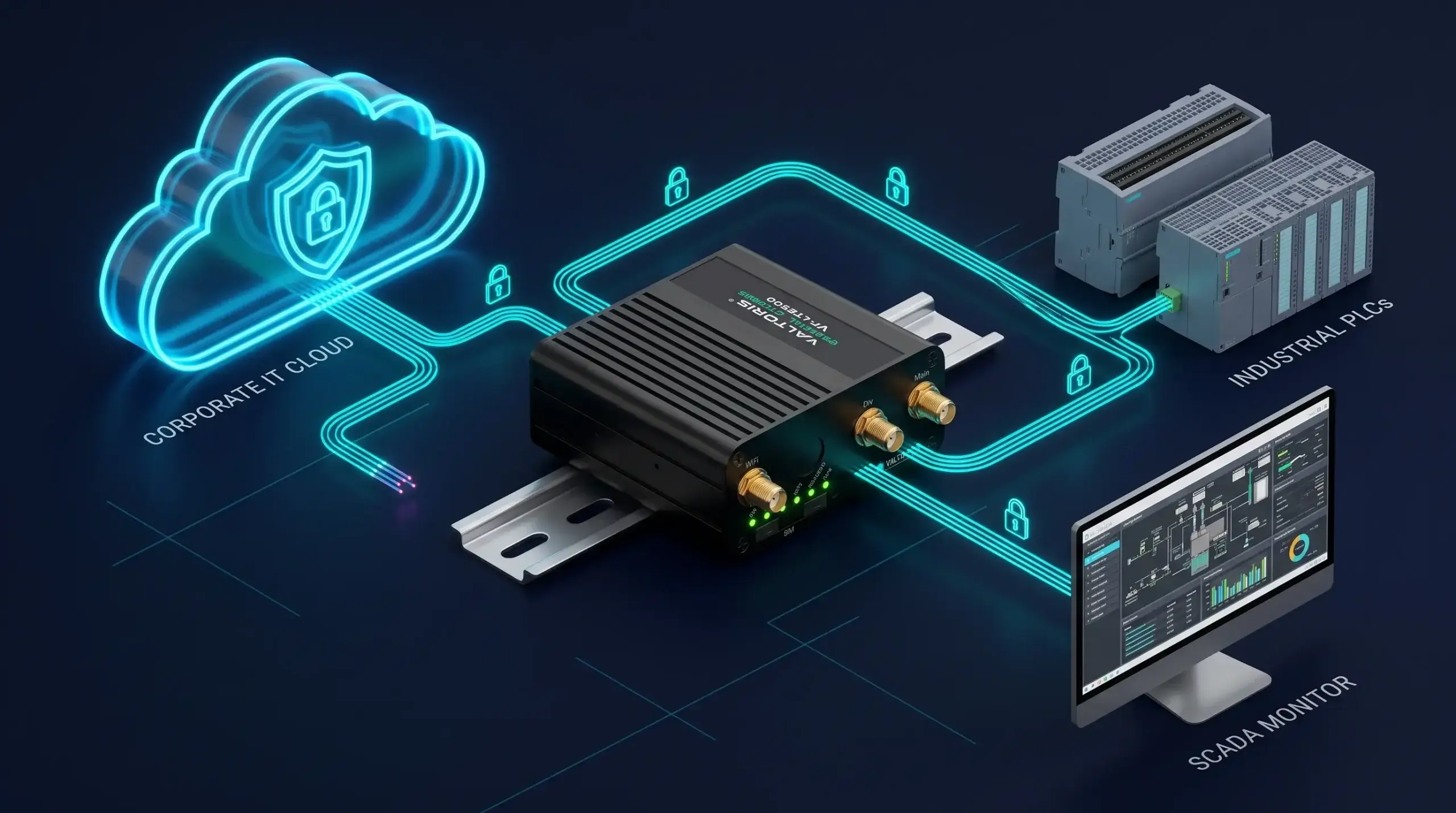
For sites meeting the physical deployment criteria, the VT-LTE500 consolidates routing, serial processing, and secure tunneling into a single DIN-rail chassis.
Native Dual RS485 Integration
Eliminate external protocol converters. The VT-LTE500 integrates two independent RS485 industrial serial interfaces and two Gigabit Ethernet ports natively into the chassis, faithfully replicating the physical footprint of legacy SCADA routers.
Embedded Modbus Engine
Operating as an active edge host, the built-in Modbus Collect engine autonomously polls field Modbus RTU/TCP slaves. It caches register states locally and pushes payloads northbound via MQTT, TCP, or UDP, reducing the polling burden on the central historian.
Zero-Config Remote Access
Equipped with the m2mCloud service protocol. Once a SIM is inserted and the account bound, engineers can establish an outbound SD-LAN tunnel to remotely monitor or program PLCs without requiring static public IPs or complex firewall NAT rules.
5. Physical Migration & Interface Mapping
Engineered to utilize your existing infrastructure. Transfer the 9-36V DC power lines and the RS485 terminal blocks directly from the legacy unit to the VT-LTE500.
WR21
Smart Edge
Demonstration: Direct transfer of standard RS485 terminal blocks.
Matched Power Interfaces
Legacy cabinet deployments heavily utilize 12V or 24V DC. The VT-LTE500 supports a wide-voltage input range of DC 9V~36V with reverse-polarity protection via standard industrial terminal blocks.
Standardized RF Connectors
Field technicians do not need to replace roof-mounted or cabinet-mounted antennas. The VT-LTE500 utilizes standard 50Ω/SMA interfaces for both main cellular and WiFi antennas, ensuring direct compatibility with existing cabling.
Integrated DIN-Rail Chassis
Unlike multi-module deployments that require external patch cables and multiple power drops, the VT-LTE500 consolidates routing and serial processing into a single IP30 industrial enclosure that mounts directly to your existing 35mm DIN-rail.
| System Specification | Legacy Hardware (e.g. Digi WR21) | Valtoris VT-LTE500 Edge Router |
|---|---|---|
| Data Architecture | Standard Network Routing | Integrated Modbus Engine (Local Cache & MQTT Upload) |
| Serial Interfaces | Single Serial Port | 2 x RS485 (Native, supports DTU & Modbus Master) |
| Local Networking (LAN) | 10/100 Mbps Ethernet | 2 x Gigabit Ethernet (10/100/1000 Mbps) |
| Remote Accessibility | Requires Static IP or Manual VPN | Native m2mCloud Zero-Config SD-LAN Tunneling |
| Security & Patching | EOL (No Security Updates) | Actively Maintained OS (Continuous CVE Patching) |
6. Migration CapEx Estimator
Compare the financial impact of utilizing a multi-device approach (Router + Protocol Gateway) versus standardizing on the VT-LTE500’s integrated architecture.
Estimated cost of a standard 4G router plus a separate Modbus serial gateway
Cost of the single, all-in-one Edge Router
7. Technical FAQ
Does the VT-LTE500 require changing the connected PLC’s IP address?
How does the device handle remote connectivity if we don’t have a public IP?
What happens if the cellular network temporarily stalls?
Our site only requires raw serial passthrough without edge polling. Is this supported?
Validate the Migration Topology.
If your site requirements align with the capabilities listed above, review the full technical specifications or contact us to verify terminal compatibility in your own SCADA lab.