
Surviving the RV50X EOL:
Stop Over-Provisioning Your OT Network
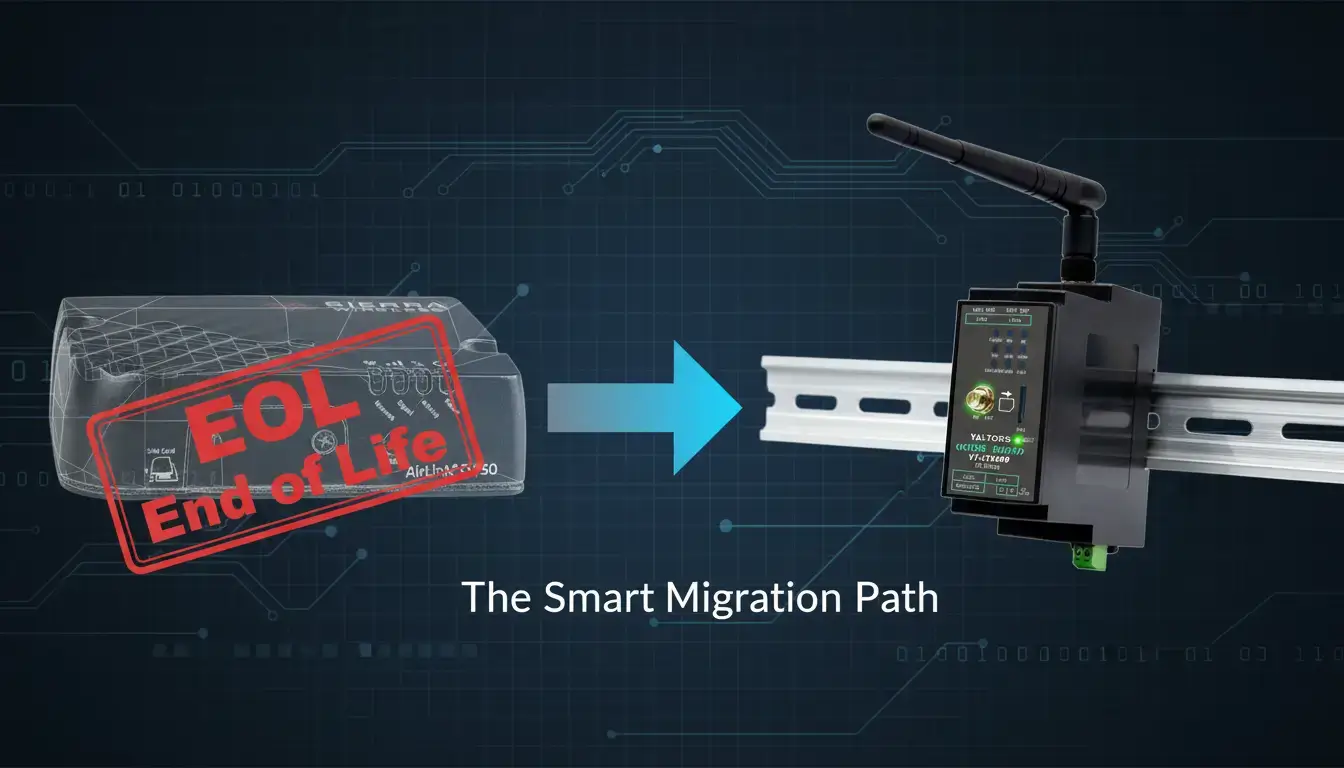
The Sierra AirLink RV50 and RV50X series have reached End-of-Life. Don’t get caught up in expensive CAT6 hardware and mandatory cloud subscriptions. Explore the Valtoris VT-LTE400, a right-sized SCADA router rated for 85°C with an integrated 4-port switch.
Engineered for seamless physical and logical integration
1. The Port Advantage: Eliminate the External Switch
If you open an existing RV50X cabinet, you will almost always find a “hidden cost”: an external 5-port industrial switch because the RV50X only has a single LAN port.
(1 Port)
(4 Ports)
Deploying an external switch creates three major engineering headaches in a SCADA cabinet:
- Increased Failure Points: Every extra patch cable and power lead is a potential point of failure.
- Space Constraints: On a standard 35mm DIN rail, every millimeter is precious. An RV50X plus a switch occupies over 150mm.
- Power Complexity: You must wire and protect power for two separate devices.
The VT-LTE400 solves this instantly. It integrates 4x 10/100M LAN ports and 1x WAN port directly into its compact chassis. You connect your Master PLC, HMI, and IP camera directly to the router, drastically simplifying your panel design.
2. The CAT1 Reality: Don’t Pay for Bandwidth You Don’t Use
One of the most persistent myths in IIoT procurement is that “higher category equals better performance.” The RV50X utilizes an LTE CAT6 modem. In contrast, the VT-LTE400 is purpose-built with LTE CAT1 (10 Mbps Down).
To the untrained eye, this looks like a downgrade. To a senior network engineer, this is critical optimization.
A typical Modbus TCP poll or MQTT payload is in the range of 200 bytes to 2 kilobytes. Stuffing this over a 300 Mbps CAT6 pipe is like using a 16 lane highway to move a bicycle. CAT6 chipsets need complex MIMO processing, which generates a lot of internal heat. CAT1 chipsets run much cooler which translates directly to a higher MTBF.
(300 Mbps)
(10 Mbps)
Visualizing SCADA telemetry: A 2KB Modbus payload utilizes identical physical time over both CAT1 and CAT6 networks. CAT6 simply generates more unused headroom and excess thermal stress.
3. Surviving the Furnace & The Faraday Cage
Industrial environments destroy commercial hardware. Learn why physical resilience matters more than theoretical speeds.
True 85°C Thermal Rating
A sealed metal cabinet in direct summer sun isn’t just warm; it’s an oven. While the RV50X has a maximum limit of 70°C, the VT-LTE400 is rated for -40°C to 85°C. That extra 15°C prevents thermal throttling and emergency shutdowns in unventilated enclosures.
Zero “Sierra Tax” (No SaaS)
Engineers are sick of forced subscriptions for AirLink Management Service (ALMS). VT-LTE400 has a fully unlocked Local Web UI (192.168.8.1) and supports native IPsec/WireGuard. You have the hardware, and no ongoing cloud fees.
Sacrificial Serial Isolation
The RV50X combined RS-232 and routing in one chassis. If a field surge hits the serial line, the entire router dies. We separate them. By pairing the VT-LTE400 with a low-cost Serial-to-Ethernet Gateway, the serial module acts as a sacrificial isolator. If lightning strikes, you replace a cheap gateway, not your core LTE router.
Standard SMA Antennas: Escaping the Faraday Cage
The VT-LTE400 uses standard 50Ω/SMA antenna connectors. You do not need to buy new antennas; simply unscrew your existing external cabinet cables from the RV50X and connect them directly to the new chassis to escape signal blocking.
4. Future-Proofing: The Path to 5G
A common question we receive from project managers is: “Should I skip 4G and go straight to 5G?”
For industrial telemetry, the answer is usually “Wait.” 5G mmWave and Sub-6 architectures offer incredible peak speeds, but their penetration through heavy industrial walls and their power consumption are still inferior to mature LTE Cat 1 networks. Furthermore, global carriers have committed to maintaining LTE networks well into the 2030s. LTE Cat 1 is currently the most efficient, cost-stable technology for 24/7 monitoring.
| Critical Specification | Sierra RV50X (Legacy) | Valtoris VT-LTE400 |
|---|---|---|
| Cellular Modem | LTE CAT6 (High Heat) | LTE CAT1 (Low Heat, SCADA Optimized) |
| Ethernet Ports | 1x Gigabit LAN (Needs Switch) | 4x LAN, 1x WAN (Built-in Switch) |
| Operating Temperature | -40°C to +70°C | -40°C to +85°C |
| Device Management | ALMS (Paid Cloud SaaS) | Local Web UI (No Recurring Fees) |
| Local Maintenance WiFi | None (Requires external AP) | Built-in 2.4G (Supports AP, Mesh, Roaming) |
The “Right-Sizing” CapEx Calculator
Calculate the massive impact of dropping high-end CAT6 hardware, external switches, and forced SaaS subscriptions across your entire SCADA fleet.
Est. cost per node for Enterprise CAT6 + Ext. Switch + SaaS
Cost of VT-LTE400 (Built-in Switch, No SaaS)
5. Migration FAQ & Technical Considerations
Can I reuse my existing Sierra Wireless RV50X antennas and power supplies?
How do we migrate our IPsec/WireGuard tunnels without the ALMS cloud platform?
How do we migrate our legacy RS-232 devices if the VT-LTE400 only has Ethernet ports?
Does the VT-LTE400 support Dual-SIM failover like the RV50X?
Will the VT-LTE400 work with my carrier if it lacks PTCRB or Verizon certification?
Stop Over-Provisioning Your Hardware.
When evaluating viable Sierra Wireless alternatives, standardizing your BOM is critical. Eliminate external switches, stop paying SaaS fees, and upgrade to true 85°C industrial stability.
Evaluate the VT-LTE400
Order an evaluation unit today to validate thermal stability and 4-port LAN integration. Once validated, the full price of this evaluation kit will be deducted directly from your project invoice upon your first bulk deployment order (20+ units).
* Need legacy RS-232 support? Mention it in your request. We will bundle a dedicated Serial-to-Ethernet gateway for full-protocol evaluation.