
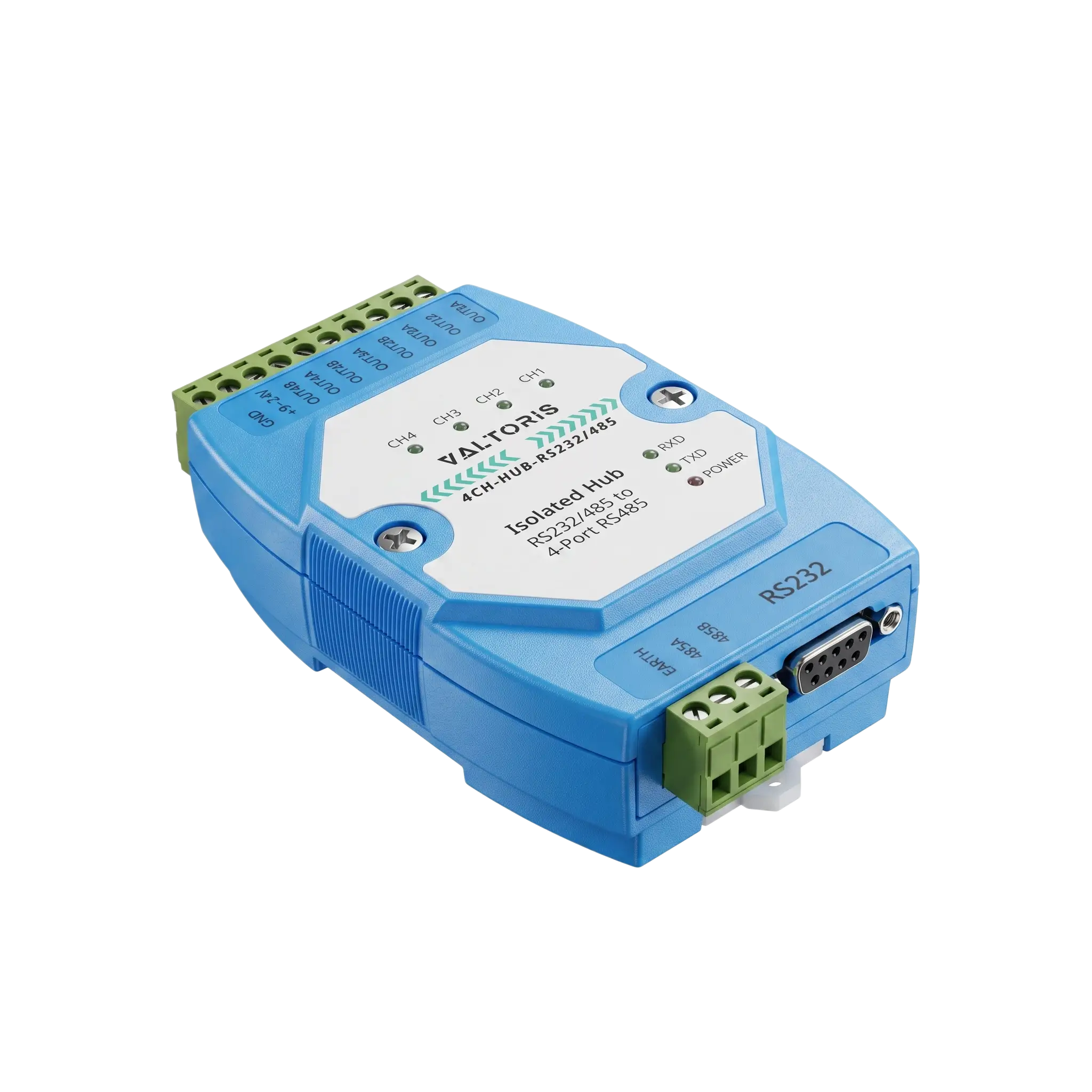
Concentrador industrial RS485 de 4 puertos con aislamiento
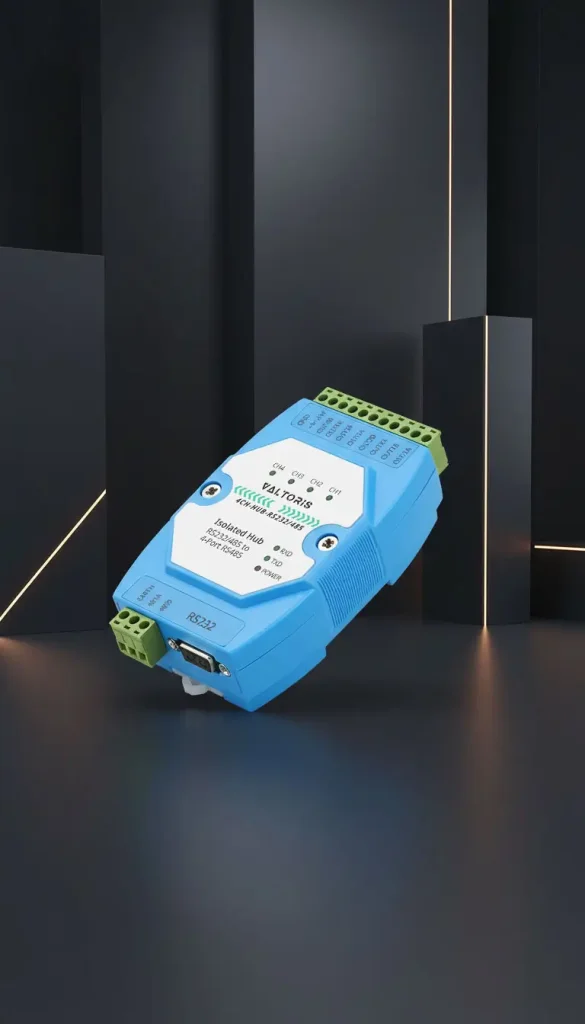
Diseñado para ampliar y proteger redes serie complejas, este concentrador industrial RS485 aislado permite topologías en estrella flexibles en lugar de las tradicionales cadenas tipo margarita, proporcionando un sólido aislamiento óptico de 2500 V y repetición de señales para proteger los dispositivos de campo heredados en sistemas de adquisición de datos SCADA a gran escala.
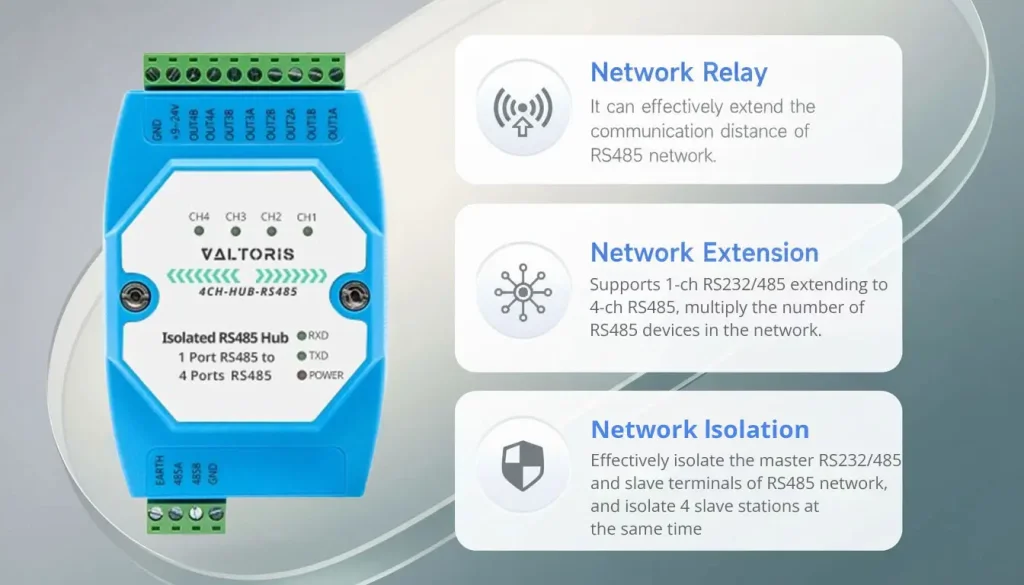
Función principal
Admite funciones de relé de red RS485 , extensión y aislamiento
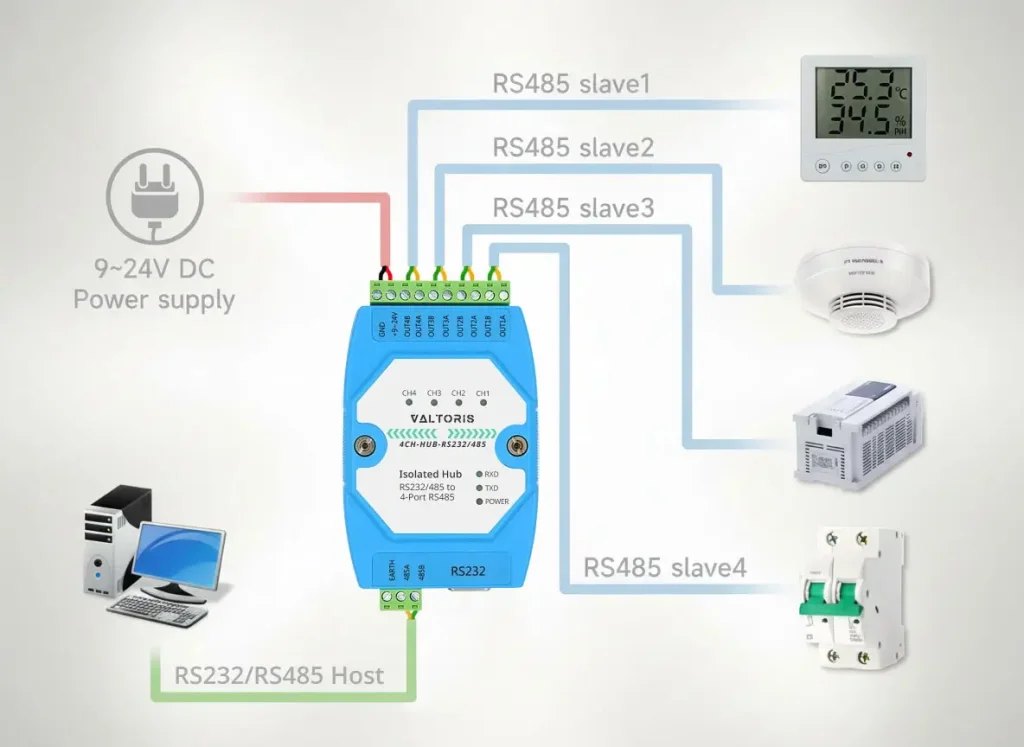
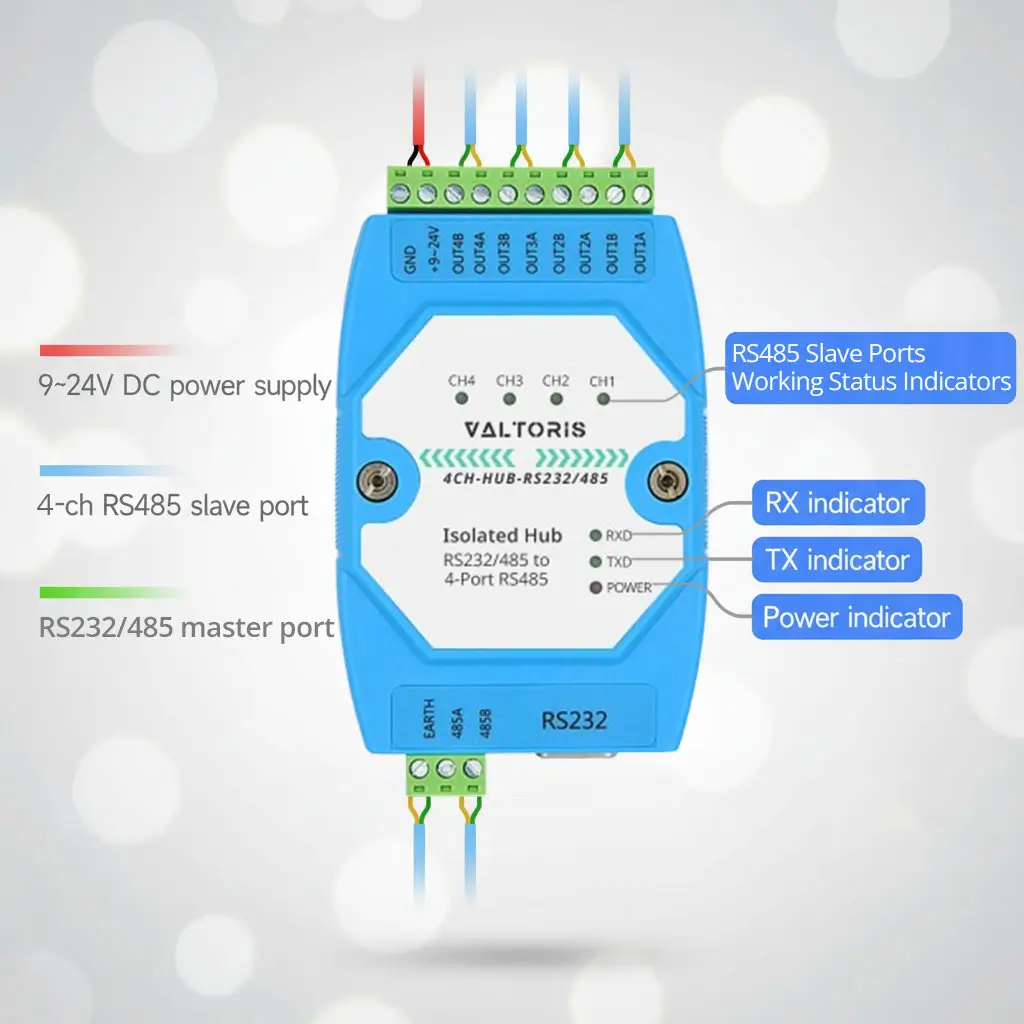
Esquema de conexión
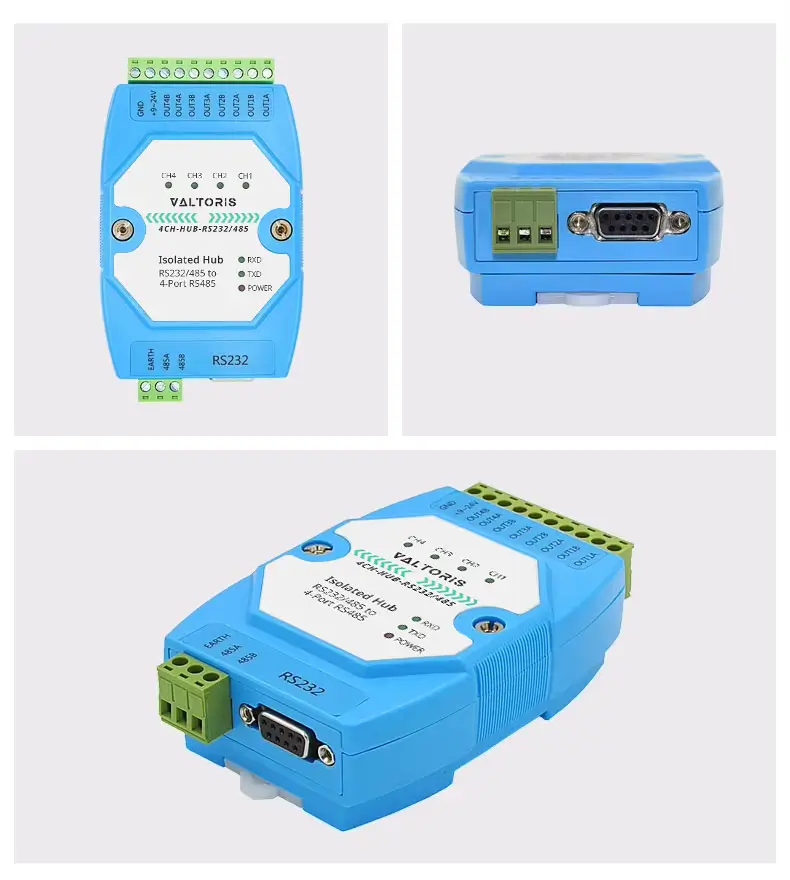
El puerto maestro RS232/485 aislado puede conectarse al dispositivo host RS232/485, y el puerto RS485 aislado de 4 canales ampliado puede conectarse a varios dispositivos esclavos RS485, como sensores RS485, etc.
Protección contra el aislamiento industriala
El circuito de protección de aislamiento fotoeléctrico incorporado puede aislar eficazmente los dispositivos maestro y esclavo RS485 para evitar el daño de la diferencia de potencial de tierra entre los dispositivos, anti-electrostática, a prueba de rayos y anti-sobretensiones, que es adecuado para el entorno industrial con alta fiabilidad y requisitos de seguridad.
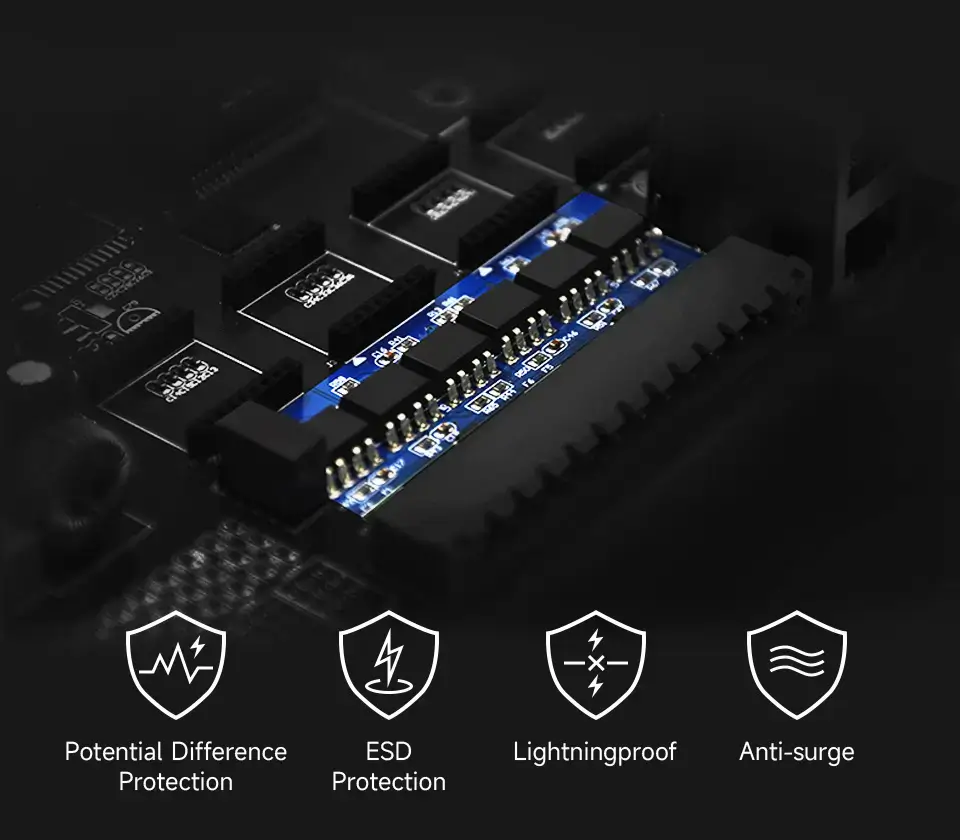
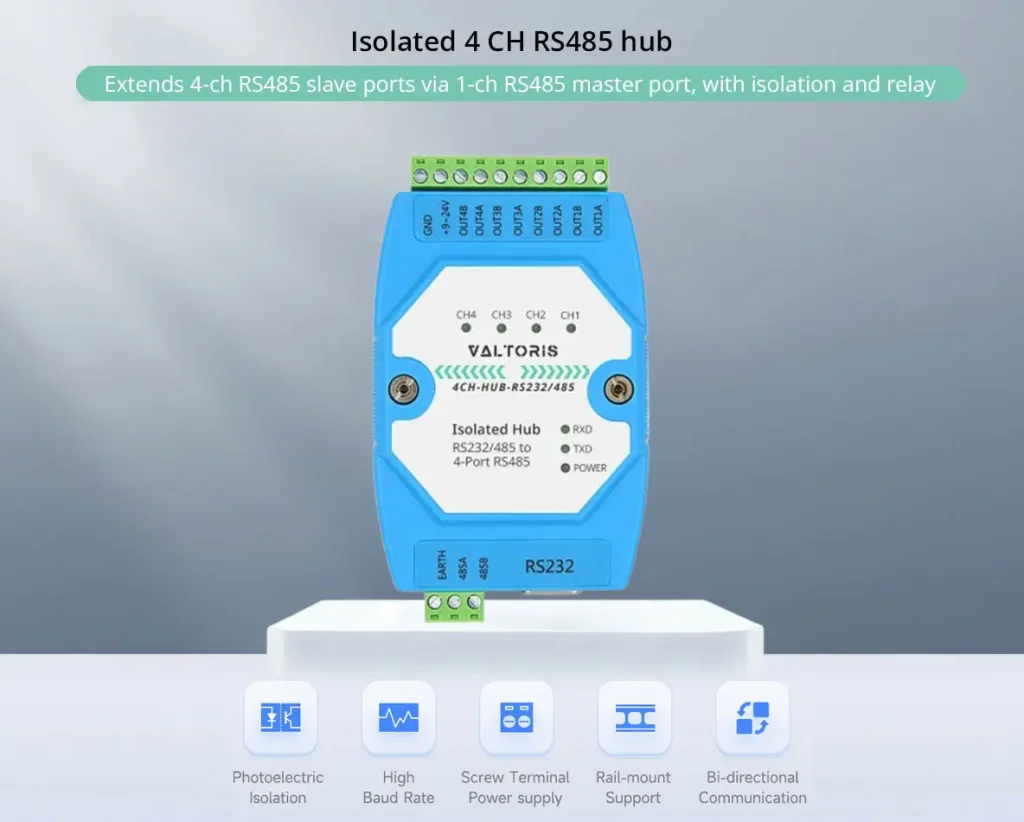
Amplia gama de velocidades en baudios
Admite un amplio rango de comunicación de 0~200 kbps de velocidad en baudios (adaptativa)
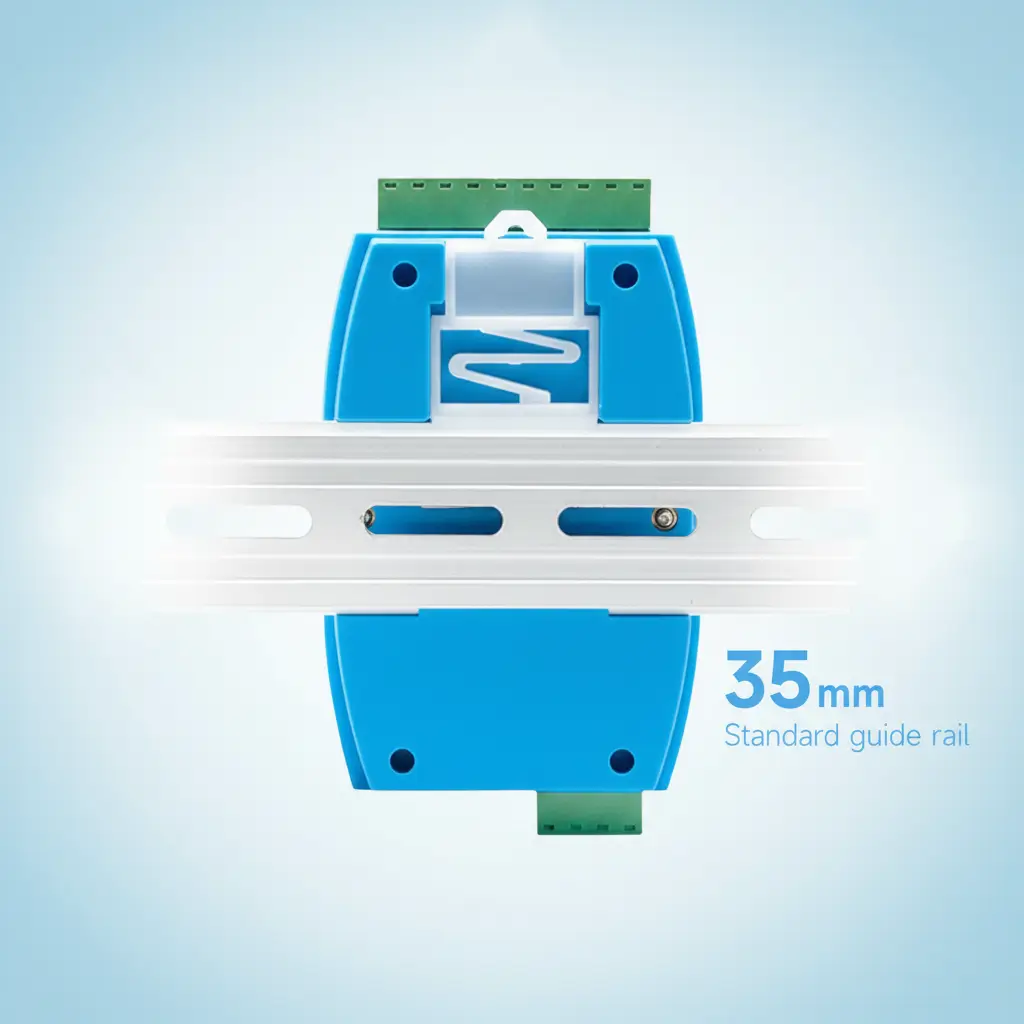
Soporte de montaje en carril
Admite carril guía estándar de 35 mm con hebilla de montaje en carril, fácil de instalar.
Introducción de la interfaz
Productos
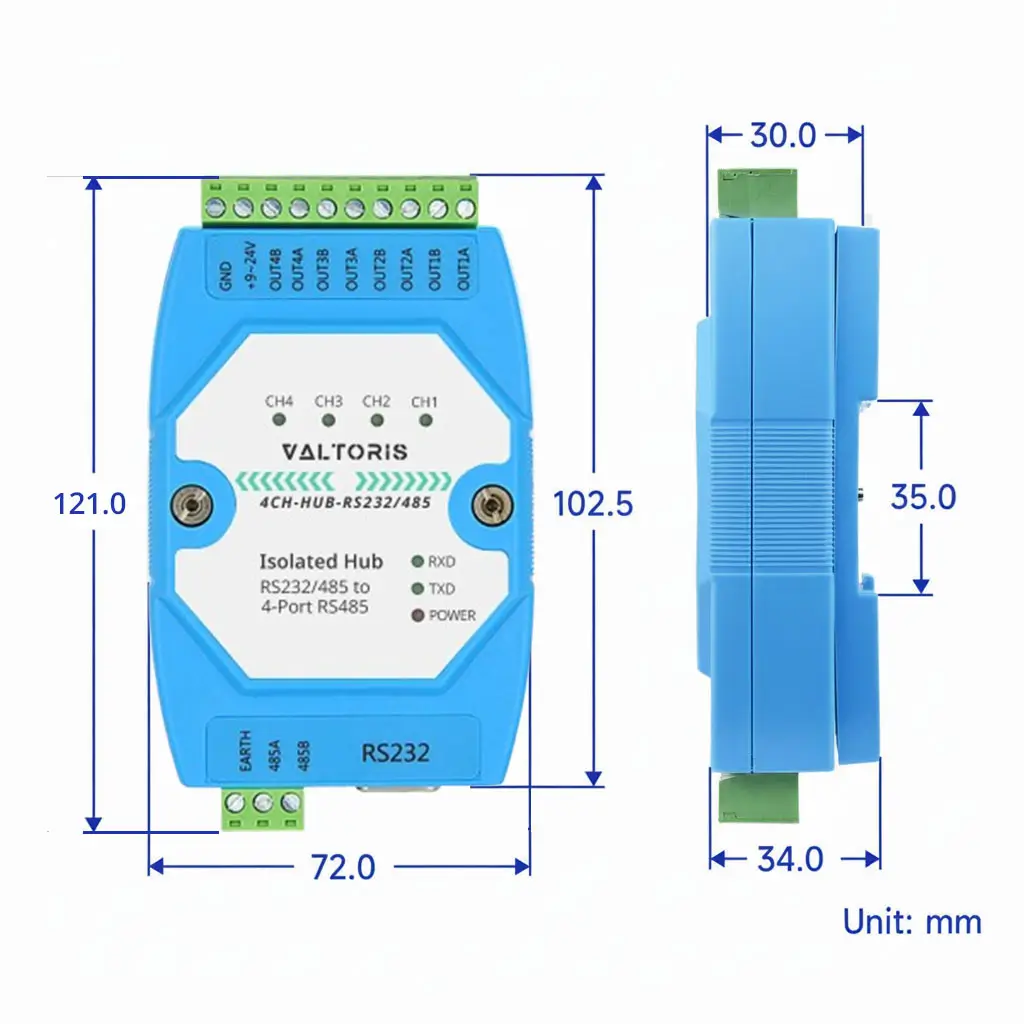
Dimensiones generales
Guía de selección de cubos
Modelo | ||||
Resumen del producto | Concentrador caché RS485 activo de 2 canales | Concentrador de aislamiento de expansión RS485 activo de 4 canales | Concentrador de aislamiento de expansión RS485/232 activo de 4 canales | Concentrador de aislamiento de expansión RS485 activo de 8 canales |
Interfaz física | Puerto RS-485 3PIN cabeza de brida*3 | Puerto RS-485 2PIN cabeza de brida*5 | Extremo RS-232C DB9 cabeza hembra (tipo agujero)*1, puerto RS-485 2PIN cabeza con brida*5 | Puerto RS-485 2PIN cabeza de brida*9 |
Velocidad de transmisión | 1200~460800bps | 300-460800bps (adaptable) | 0~200Kbps (adaptativo) | 300-460800bps (adaptable) |
Protección contra el aislamiento | / | Tensión de aislamiento RS485 Tensión de aislamiento: 2500V Protección estática RS485: 12KV | Tensión de aislamiento RS485 Tensión de aislamiento: 2500V Protección estática RS485: 12KV | Tensión de aislamiento RS485 Tensión de aislamiento: 2500V Protección estática RS485: 12KV |
Parámetros de interfaz | Bit de datos 8 Bits de control Ninguno/Impar/Par/Marca/Espacio | |||
Nodos de apoyo | Cada puerto RS485 admite un máximo de 32 nodos | |||
Distancia de transmisión | RS232C:15m; RS485: 1200 metros (a 9600bps); Cuanto mayor sea la velocidad de comunicación, menor será la distancia. | |||
Medio de transmisión | Cable ordinario, par trenzado o cable apantallado | |||
Método de trabajo | Semidúplex asíncrono | |||
Consumo de energía | DC9-24V 12V@30mA | |||
Temperatura de funcionamiento | -45℃~+85℃ | |||
Humedad | <95%HR | |||
Tamaño(Longitud x Anchura x Altura) | 121mm * 72mm * 34mm | |||
Interface standard | Compliant with RS485 standard |
Physical interface | RS485 screw terminals |
Baud rate | 0~200Kbps (adaptive) |
supported nodes | Each RS485 port supports up to 32 nodes |
Communication distance | RS232: 15m; RS485: 1200m (9600bps), the higher rate the shorter distance |
Operating mode | RS485 two-wire (A, B), half-duplex transparent transmission |
Power supply | DC 9~24V |
Operating temperature | -45 ~ +85℃ |
Environment humidity | <95%RH |
Transmission medium | Normal parallel cables/twisted-pair cables |
Bypass Daisy-Chain Limits with Star Topologies
Traditional RS485 networks strictly require a daisy-chain wiring method. The Valtoris 4-Channel Isolated Hub shatters this limitation. Acting as an active splitter and repeater, it allows you to deploy highly flexible star topologies in complex industrial environments.
Fail-Safe Isolation for SCADA Systems
By isolating one master port into four independent slave channels, this DIN-rail hub localizes electrical faults. If a lightning strike or ground loop shorts out one field instrument, the 2500V optical isolation ensures the surge is contained, keeping your primary PLC and the other three data channels running flawlessly.
Q1: Can I use different baud rates for each of the 4 output ports?
A: No. The VT-4CH-HUB is a repeater that works at the physical layer, not a protocol converter. It sends the same signal from the master port to all four slave ports at the same time. So, the master station and all the devices on the four branches must be set up with the same baud rate and parity settings.
Q2: What happens to the rest of the network if a short circuit occurs on one specific branch?
A: This is where the 2500V isolation pays off. Unlike a passive splitter, this active hub «segments» the network. If one branch suffers a ground loop or a physical short, the fault is contained within that specific port. The master port and the other three branches will continue to communicate without interruption, preventing a single faulty sensor from taking down your entire SCADA system.
Q3: Does this hub require a termination resistor on every port?
A: Impedance matching is very important in a star topology. You need to turn on or install a 120-ohm termination resistor at the end of each of the four branches. Resistors are usually only needed for the hub itself if the cable run between the Master PLC and the Hub is long. For exact placement, see our [RS232 to Ethernet Cable Pinout: Two Common Wiring Diagrams], which shows the standard ways to end RS485 connections.
Q4: Can I use this hub to exceed the standard 32-device limit of an RS485 bus?
A: Yes. Since each of the 4 output ports acts as a signal repeater, the hub effectively «refreshes» the RS485 signal. This allows you to add up to 32 additional devices per port (totaling 128 slaves), provided your polling software can handle the addressing. If you need to scale beyond physical wiring limits entirely, consider our [Point-to-Point Wireless RS485 Converters] to bridge data across different buildings or zones.
Q5: Is this a passive splitter, or does it require an external power supply?
A: This is an active hub. Passive RS485 splitters often cause signal reflection and impedance mismatches that lead to data corruption. The VT-4CH-HUB requires a 9-24V DC power supply to drive the isolation circuitry and signal amplification.


🔌 Wiring & Engineering Guides
[RS232 to Ethernet Cable Pinout: Two Common Wiring Diagrams] — While the Hub uses fiber or copper for the main trunk, your field devices still need correct serial wiring. Use this guide to verify your RS485 A/B pinouts and shield grounding.
[Star Topology vs. Daisy-Chain: A Field Engineer’s Comparison] — Learn why the VT-4CH-HUB is required to bypass the limitations of standard serial buses and how to correctly place termination resistors in a branched network.
🛠️ Related Solutions
[Explore All Industrial RS485 Hubs & Repeaters] — View our full range of 2-port, 4-port, and 8-port isolation and expansion hardware.