
Digi TransPort WR21 EOL Alternative:
Decoupled Hardware Migration Strategy
The Digi WR21 has reached End-of-Life, and legacy OS patching has ceased. Stop replacing vulnerable all-in-one routers with overpriced all-in-one routers. Discover the Valtoris Decoupled Serial Bundle—securing your SCADA networks without modifying cabinet wiring or PLC logic.
1. Navigating the EOL Crisis & IT Compliance
In industrial settings, equipment often sits unused for decades under the philosophy of “if it ain’t broke, don’t fix it.” However, an End-of-Life (EOL) notice in the Operational Technology (OT) space is mostly a cybersecurity liability, not a hardware problem.
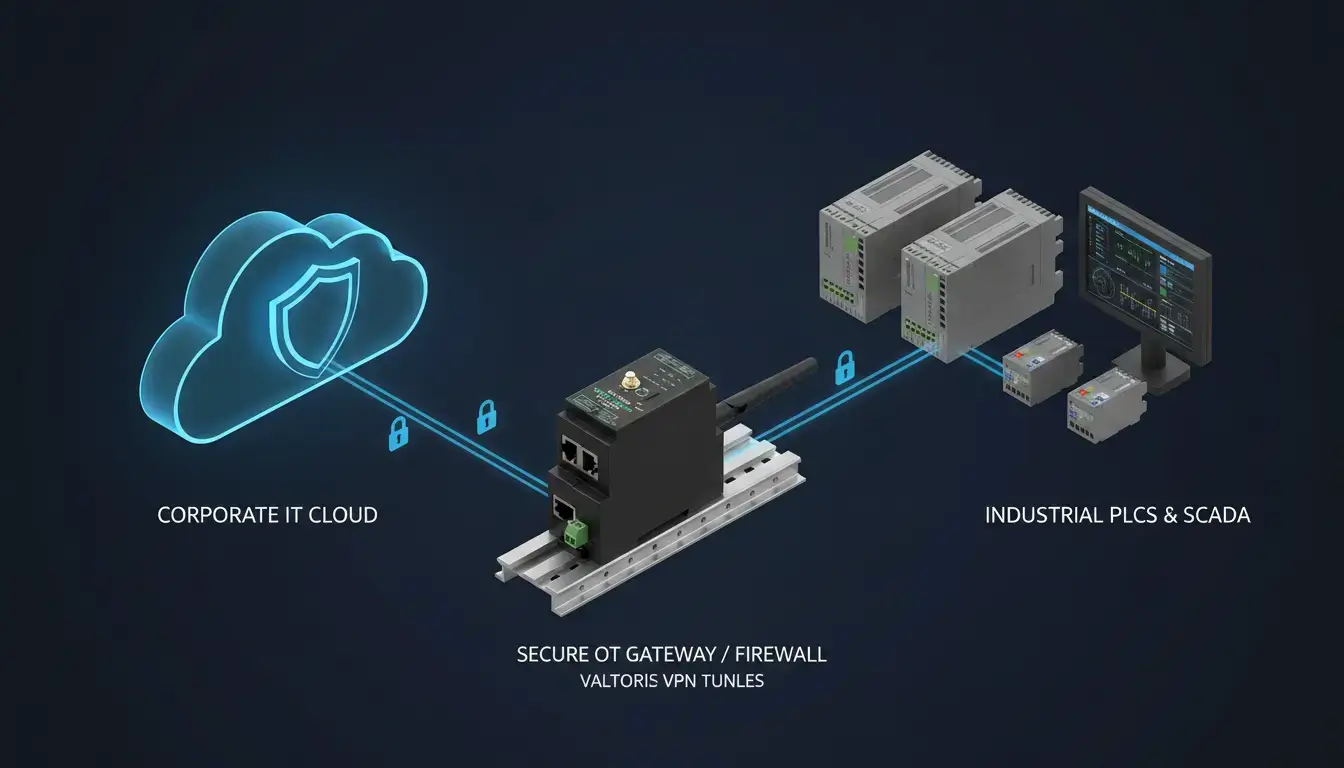
The biggest risk is the underlying legacy operating systems (e.g. SarOS) will be deprecated. Once a platform hits EOL it doesn’t get critical security patches. As enterprise IT departments adopt Zero-Trust architectures, frequent vulnerability scans on OT networks will flag these unsupported devices.
According to ICS advisories published by the Cybersecurity and Infrastructure Security Agency (CISA), operating unpatched gateways represents a high-severity attack vector.
Need to justify this upgrade to your IT or Procurement department?
2. Modbus Polling: Why Consumer LTE Fails as a Digi Alternative
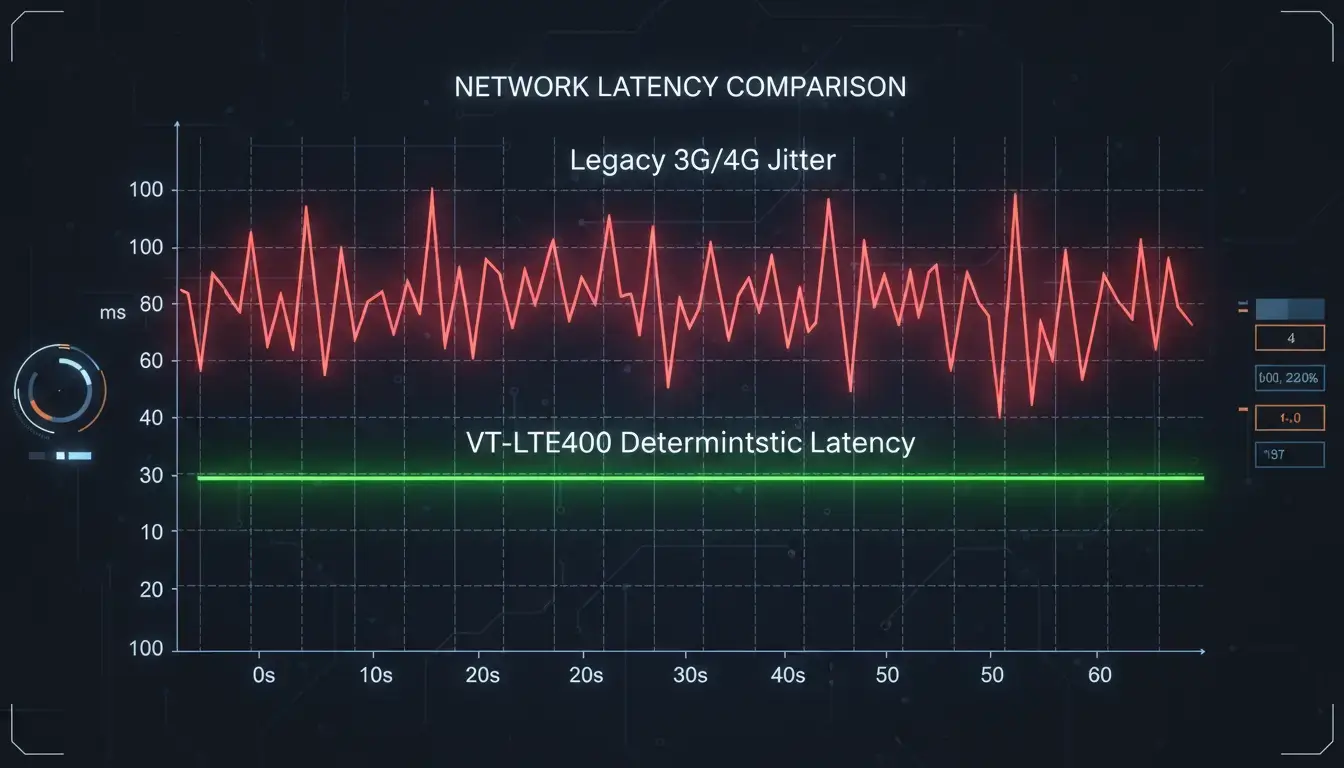
Network jitter is a common operational problem when choosing a replacement router. Many engineers are purchasing commercial-grade routers only to find that as carriers reallocate spectrum for 5G, the early 4G bands experience significant signal degradation.
In SCADA polling, the primary engineering constraint is deterministic latency and packet delivery reliability, rather than peak bandwidth. When a central historian polls a remote Modbus RTU PLC over TCP, a latency spike caused by a consumer cellular module results directly in timeout errors (Exception Code 0x0B).
The VT-LTE400 overcomes this by integrating an industrial LTE CAT1 module designed for M2M data processing. It gives the strict latency control needed for continuous SCADA polling without packet dropping, making it a true industrial alternative.
3. Stop Buying All-in-One Points of Failure
The Decoupled Architecture Advantage
The legacy WR21 forced routing, cellular basebands, and serial processing into a single motherboard. If the modem died, you threw away the serial port. Valtoris utilizes a decoupled Industrial Serial Bundle to eliminate single points of failure.
The 4-Port Switch Advantage
The VT-LTE400 features an integrated 4-port 10/100M LAN switch. One port connects seamlessly to our standalone Modbus Gateway, leaving three dedicated LAN ports for your PLCs, HMIs, and IP cameras without needing external DIN-rail switches.
Isolated Serial Processing
This architecture decoupling allows the VT-LTE400 to dedicate 100% of its CPU to IPsec encryption and LTE routing. The included 1CH-RS485-ETH Serial Server handles all Modbus RTU arbitration on its own so heavy traffic telemetry will not crash the router.
Future-Proof Independent Upgrades
Once 5G networks are mandatory, you will just have to swap out the VT-LTE400 router. Your PLC configuration, terminal wiring and Modbus Gateway are unaffected. That’s the real power of decoupled hardware.
4. Physical Deployment: The Serial Bundle Architecture
No splicing, no soldering, no SCADA rewrites. Our migration bundle allows you to transfer your existing 9-24V power and RS485 terminal blocks directly to the decoupled system.
WR21
Gateway
Demonstration: Transferring the standard RS485 terminal block to the Decoupled Bundle.
Pre-Configured Interconnects
The VT-LTE400 Serial Bundle includes a custom, short-length ethernet patch cable. Snap both the Router and the 1CH-RS485-ETH gateway next to each other onto your 35mm DIN-rail and wire them together. They communicate instantly on the local subnetwork.
Compatible Power Supply Interfaces
Legacy deployments utilize 12V or 24V DC power. Both the VT-LTE400 and the Serial Gateway support a wide-voltage input range of DC 9V~24V via standard industrial terminal blocks. The existing bare wires can power both units in parallel.
Standardized Antenna Connections
Roof-mounted cellular antennas do not need to be replaced by field technicians. The VT-LTE400 uses standard 50Ω/SMA interfaces. The 3G/4G antenna cables from the old unit will connect directly on the new chassis.
| Critical Specification | Legacy Router (e.g., Digi WR21) | VT-LTE400 + 1CH-RS485-ETH (Bundle) |
|---|---|---|
| Architecture Type | All-in-One (Single Point of Failure) | Decoupled (Independent Routing & Serial) |
| Serial Interface | Internal Embedded Port | Dedicated 1CH-RS485-ETH Module (Included) |
| Firmware Security / OS | EOL (No CVE Patches) | Actively Maintained (Lifetime Updates) |
| Local Networking (LAN) | Typically 1 to 2 Ethernet Ports | 4 x LAN + 1 WAN (Integrated Switch) |
| Modbus Handling | Basic Serial Forwarding | Advanced Edge Arbitration & Caching |
| Operating Temperature | -20°C to +70°C | -40°C to +85°C |
The “Right-Sizing” CapEx Calculator
Stop overpaying for High-End 5G routers just to get a serial port. Calculate your exact hardware budget savings by migrating to the Valtoris Decoupled LTE Bundle.
Cost of a High-End All-in-One router
Combined cost of VT-LTE400 + 1CH-RS485-ETH Gateway
5. Migration FAQ & Technical Considerations
Stop Overpaying for All-in-One Failures.
Evaluate the modern Decoupled Architecture. Request the VT-LTE400 Router + 1CH-RS485-ETH Gateway Bundle to test in your own SCADA lab.
Acquire the Complete Migration Bundle
Request an evaluation bundle today to verify zero-rewiring compatibility with your PLCs. Once validated, when you place your first bulk deployment order (20+ bundles), the full cost of this evaluation kit will be credited directly against your project invoice.
* Have legacy RS232 devices? Mention it in your request. We also offer the 2CH-RS232/485/422-ETH gateway for full-protocol evaluation.