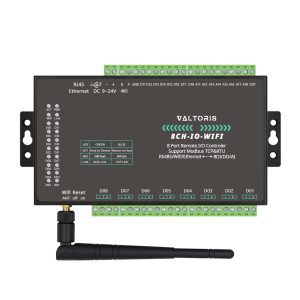
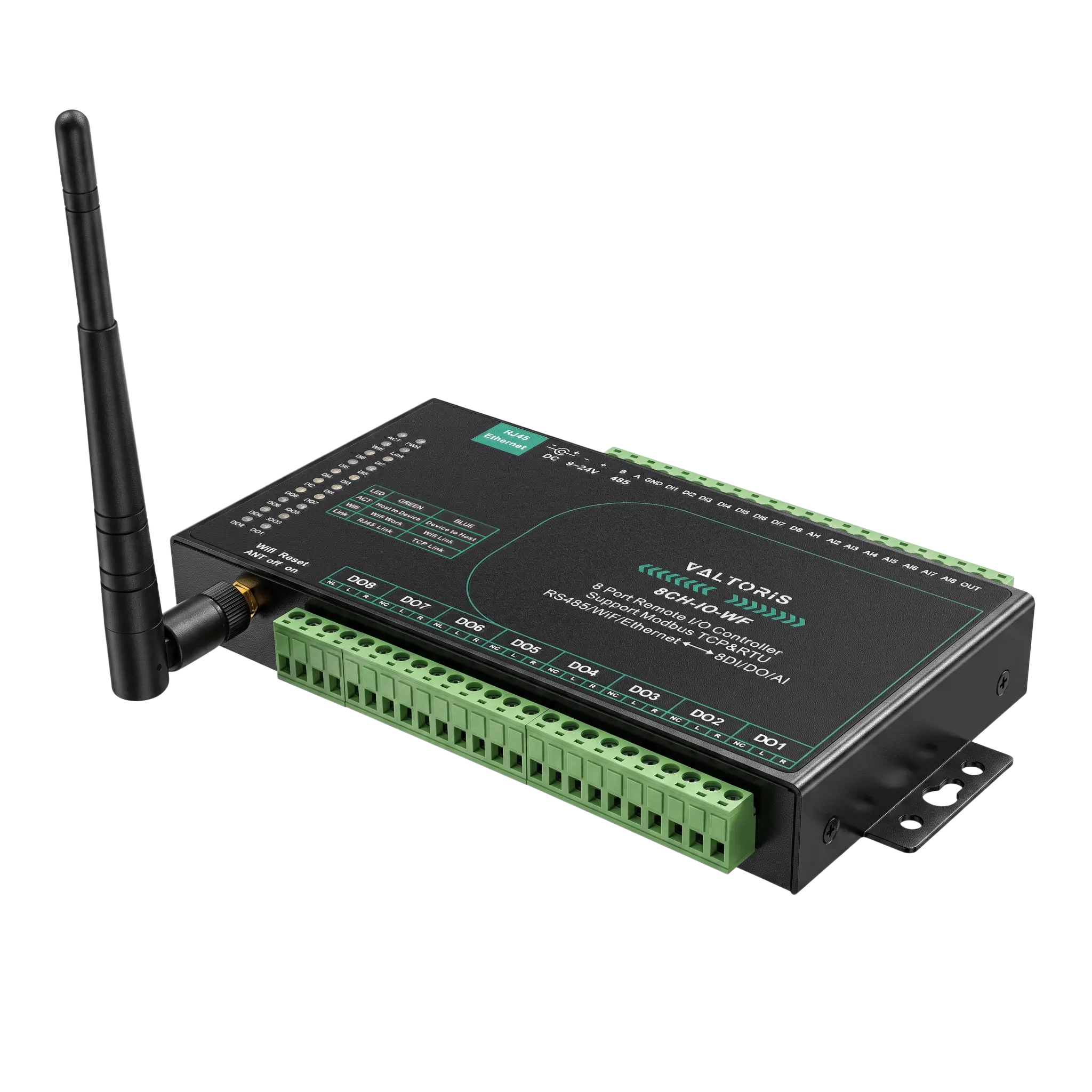
Module industriel d'E/S sans fil à 8 canaux (8DI/8AI/8DO), protection contre l'isolement

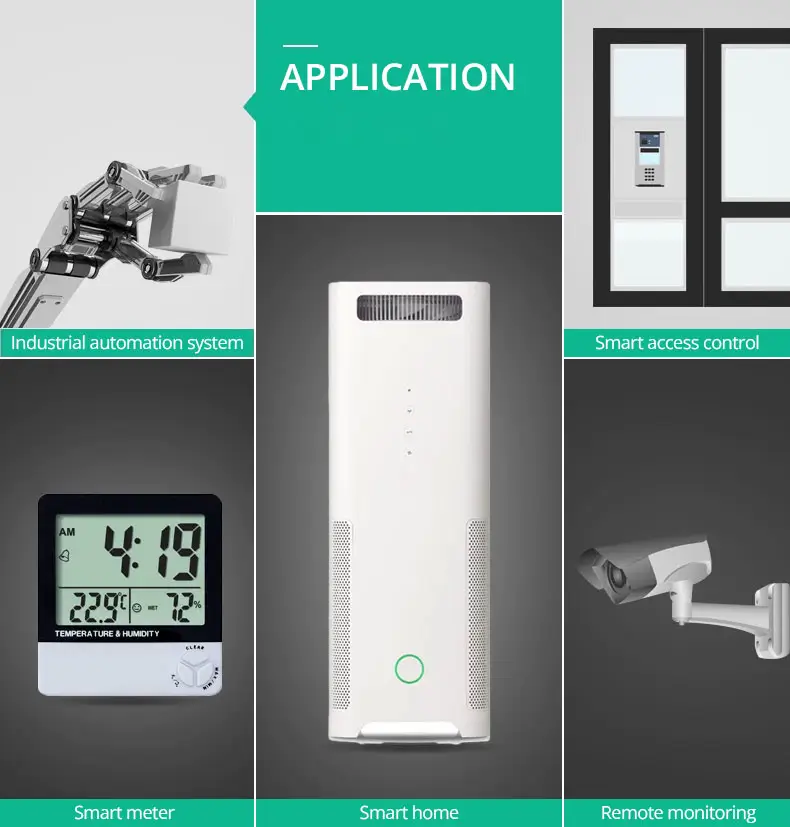
Éliminez les coûts prohibitifs de tirage de câbles dans votre installation. Ce module d’E/S à distance sans fil à 8 canaux (8DI/8AI/8DO) est conçu pour l’automatisation distribuée, prenant en charge les connexions pair à pair (Pair) qui permettent à un signal DI dans un bâtiment de déclencher directement un relais DO dans un autre – aucun automate central n’est nécessaire. Il combine les signaux numériques, analogiques et de relais importants en un seul nœud de périphérie , doté d’une conversion Wi-Fi, Ethernet et Modbus TCP/RTU pour garantir que toutes les données de télémétrie atteignent de manière transparente les environnements SCADA complexes.

 
sku :
INSTANT QUOTE

Fonction principale

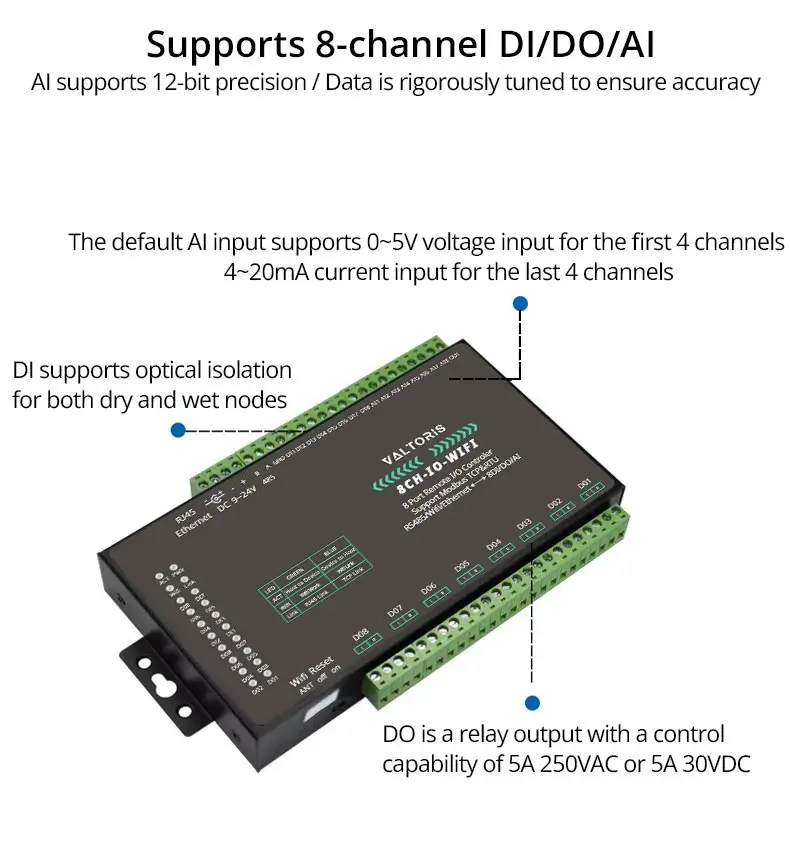
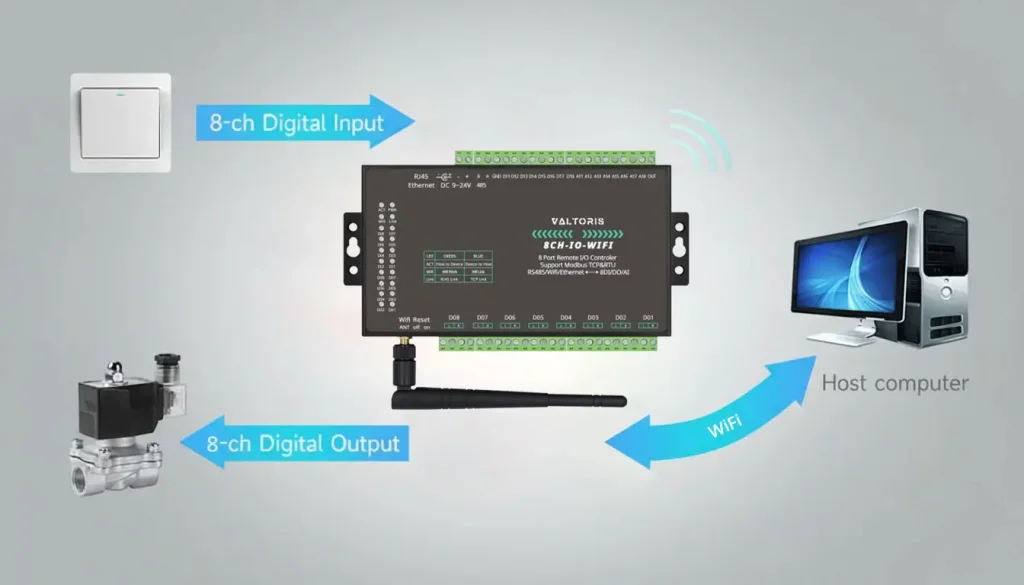
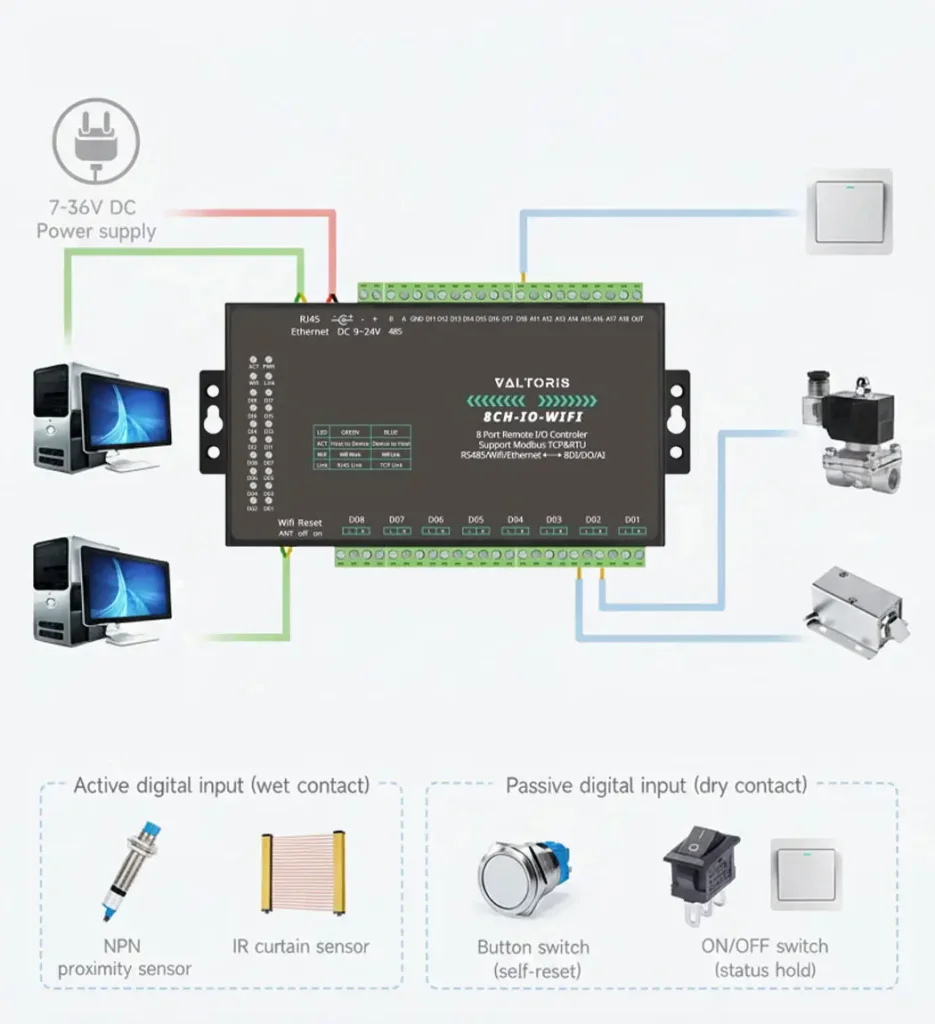
Permet de lire les entrées numériques en envoyant des commandes du protocole Modbus TCP/RTU via WiFi/Ethernet pour le contrôle des sorties numériques.
Protocole de communication ModBus

Supporte ModBus TCP ou ModBus RTU, peut être sélectionné manuellement

Contrôlé par WiFi et Ethernet
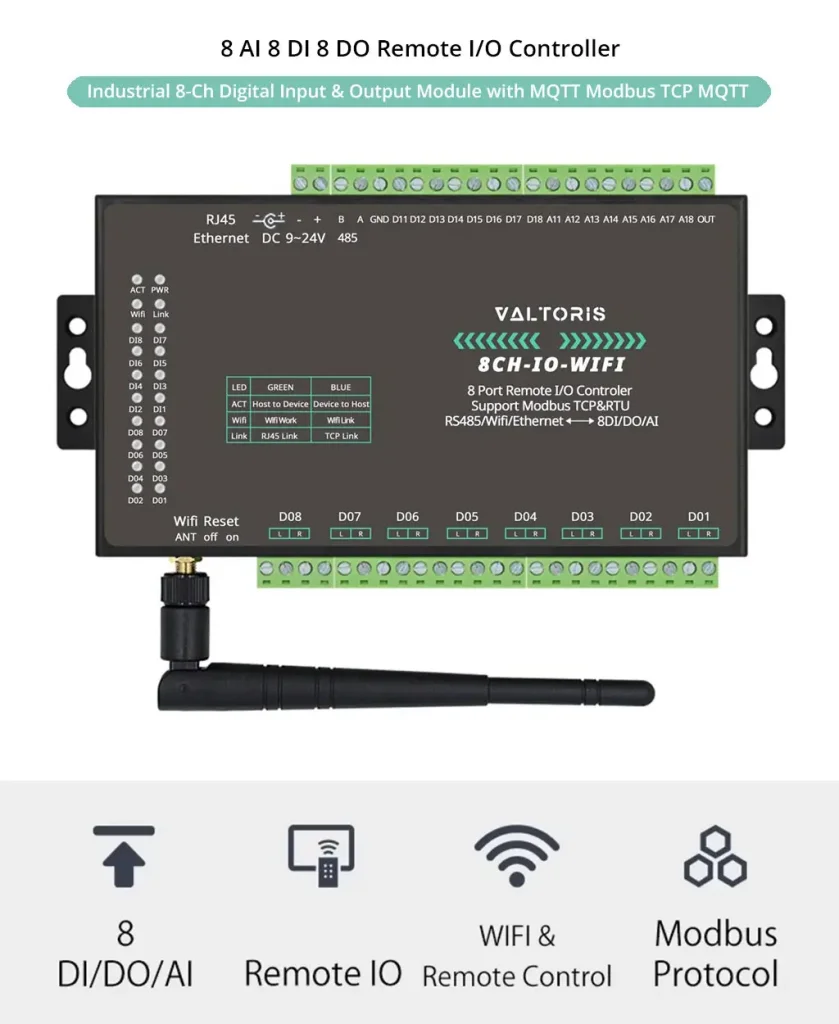
Témoin de richesse
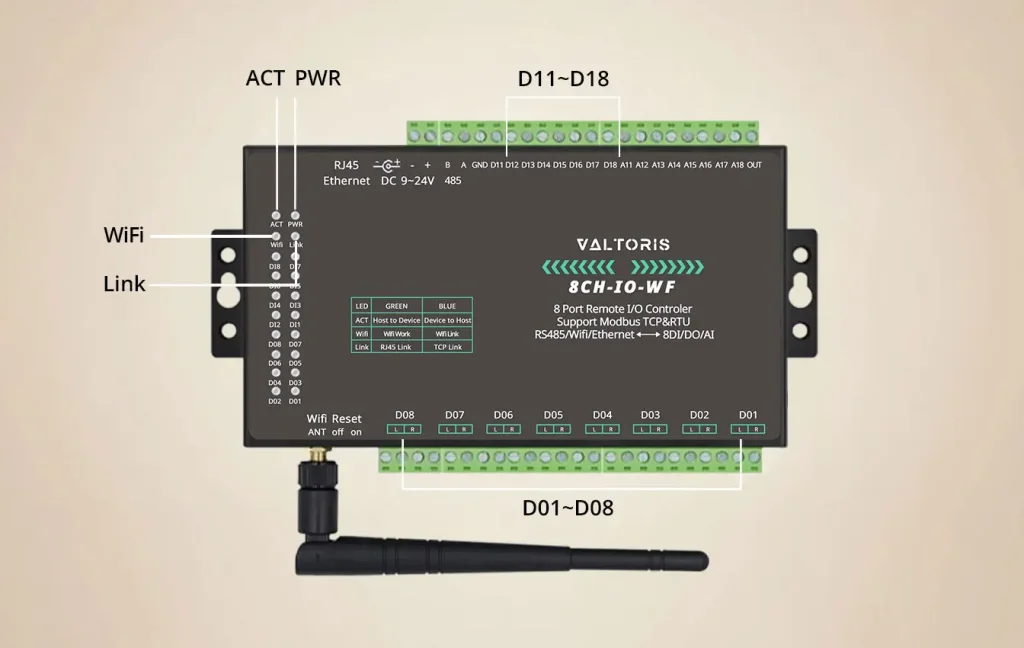
Témoin lumineuxNom de l'indicateurVertBleu
PWRVoyant d'alimentation  
ACTLumière activeL'appareil a reçu des instructions d'Ethernet/WiFi au lieu d'être bien identifié.Instructions identifiées et renvoyées à l'expéditeur
LIENIndicateur de lienEthernet connecté lorsque le voyant devient vertL'appareil supérieur a établi une connexion TCP avec l'appareil lorsque le voyant devient bleu, il peut fonctionner maintenant.
WiFiIndicateur WiFiLe WiFi fonctionneConnexion WiFi intégrée
DI1~DI8Témoin lumineux DIOn indique que l'entrée est basse ou fermée. 
DO1~DO8Témoin lumineux DOAllumé : Le relais est fermé. 

Télécommande WiFi

Connexion WiFi pour éviter les problèmes de connexion au réseau
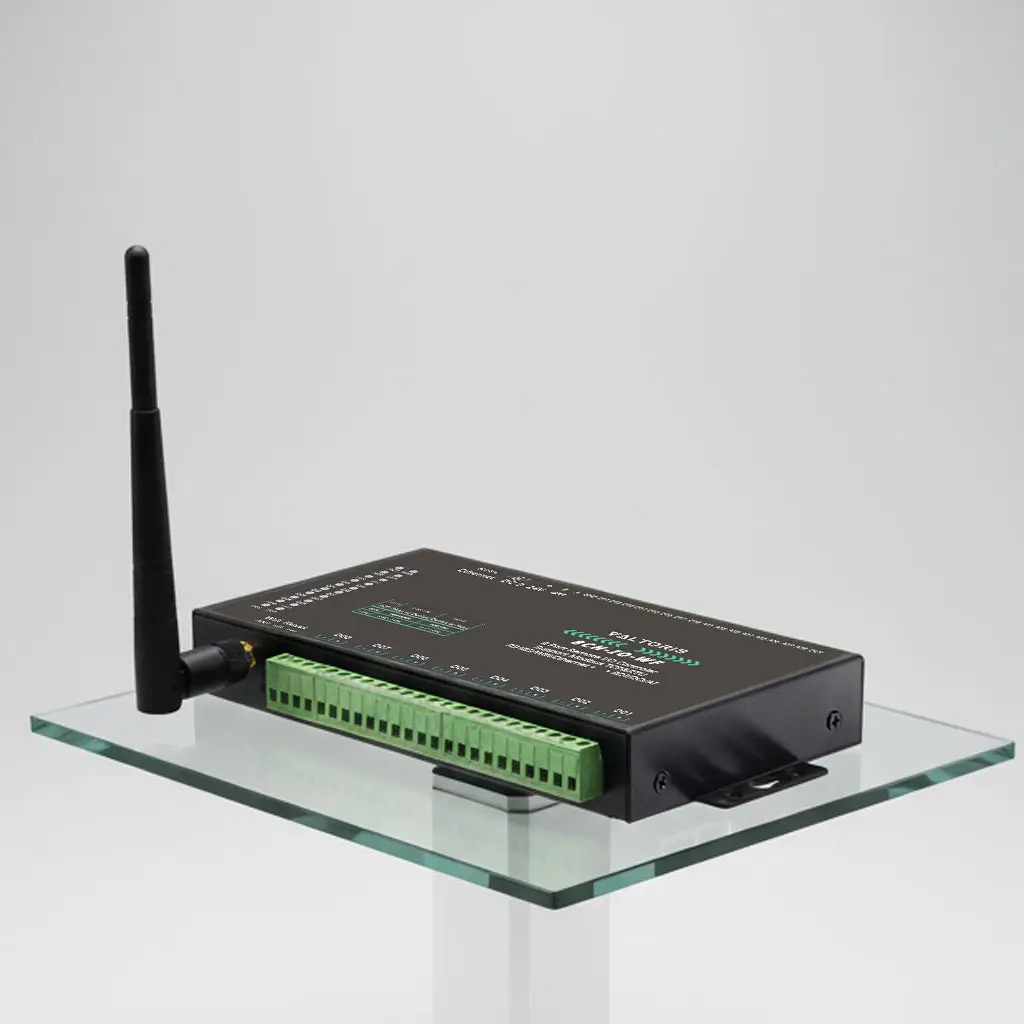
Présentation du produit
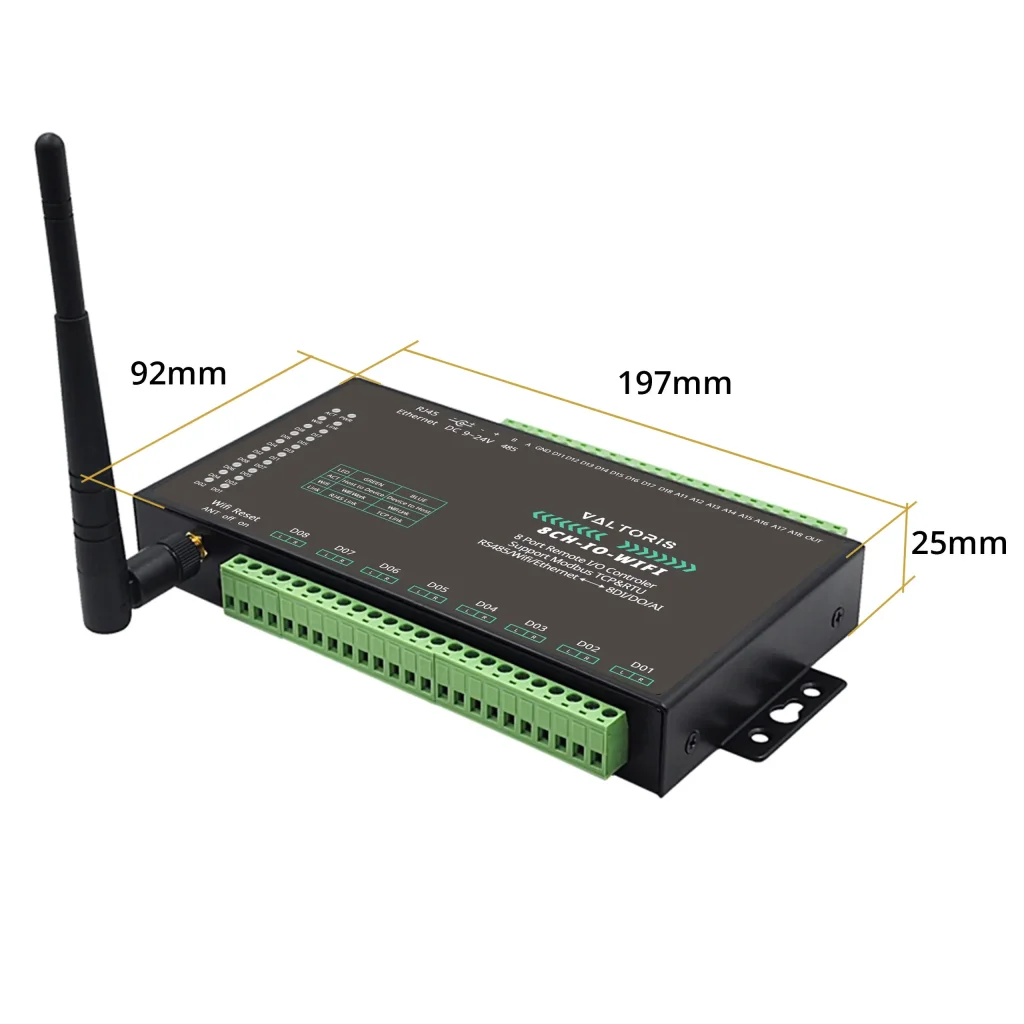
Dimensions générales
Guide de sélection du contrôleur d'E/S à distance

Modèle

TYPE D'E/S À DISTANCE

Méthode de communication

Alimentation électrique

Plage de tension

Dimensions (L × L × H)
(L × L × H)

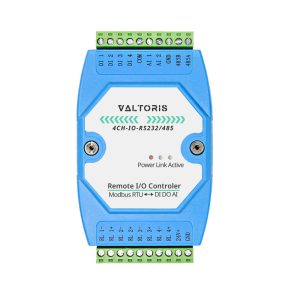
4CH-IO-RS232/485

2 AI 4 DI 4 DO Contrôleur d'E/S à distance

RS232/485

Borne à vis

DC 9~24V

121*72*34mm

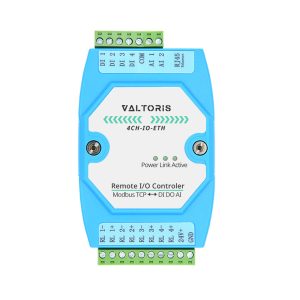
4CH-IO-ETH

2 AI 4 DI 4 DO Contrôleur d'E/S à distance

Ethernet

Borne à vis

DC 9~24V

121*72*34mm

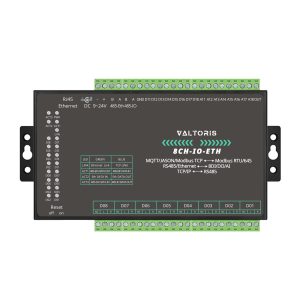
8CH-IO-ETH

8 AI 8 DI 8 DO Contrôleur d'E/S à distance

Ethernet

Borne à vis + port d'alimentation DC 5.5

DC 9~24V

197*92*25mm

8CH-IO-WE

8 AI 8 DI 8 DO Contrôleur d'E/S à distance

WIFI

Borne à vis

DC 9~24V

197*92*25mm

8CH-IO-LTE

8 AI 8 DI 8 DO Contrôleur d'E/S à distance

4G

Borne à vis + port d'alimentation DC 5.5

DC 9~24V

197*92*25mm

Prêt à moderniser vos panneaux de contrôle ? L'intégration d'E/S sans fil dans les réseaux d'automates existants exige de la précision.

External interface
Size:L x W x H =9.2cm×19.7cm×2.5cm
Software
Network protocolModbus TCP/ Modbus RTU
Under protocolWiFi
Baud rate1200~115200bps (normal 9600bps)
Parity bitnone
Data bit8 bits
Stop bit1 bit
Response Time< 30ms
AI Input Format
Current: 4~20mA,0~20mA

Votage: 0~5V,0~10V

Resister: 0~10K, temperature/humidity sensor

Power Consumption
< 220mA@24V
Communication
Wireless standard802.11b /g
Frequency range2.412GHz-2.484GHZ
Transmit power802.11b:+20dBm(Max.);802.11g:+18dBm(Max.);
Receiving sensitivity802.11b:-89dBm; 802.11g:-81 DBM;
Environment
Operating temperature-40~85℃
Storage temperature-45~165℃
Humidity range5~95% relative

The 8CH-IO-WF Wireless Remote I/O Module lets you get digital and analog data over Wi-Fi and Ethernet connections that are always reliable. This remote I/O node connects to your network without any problems and has built-in Modbus TCP to Modbus RTU conversion.

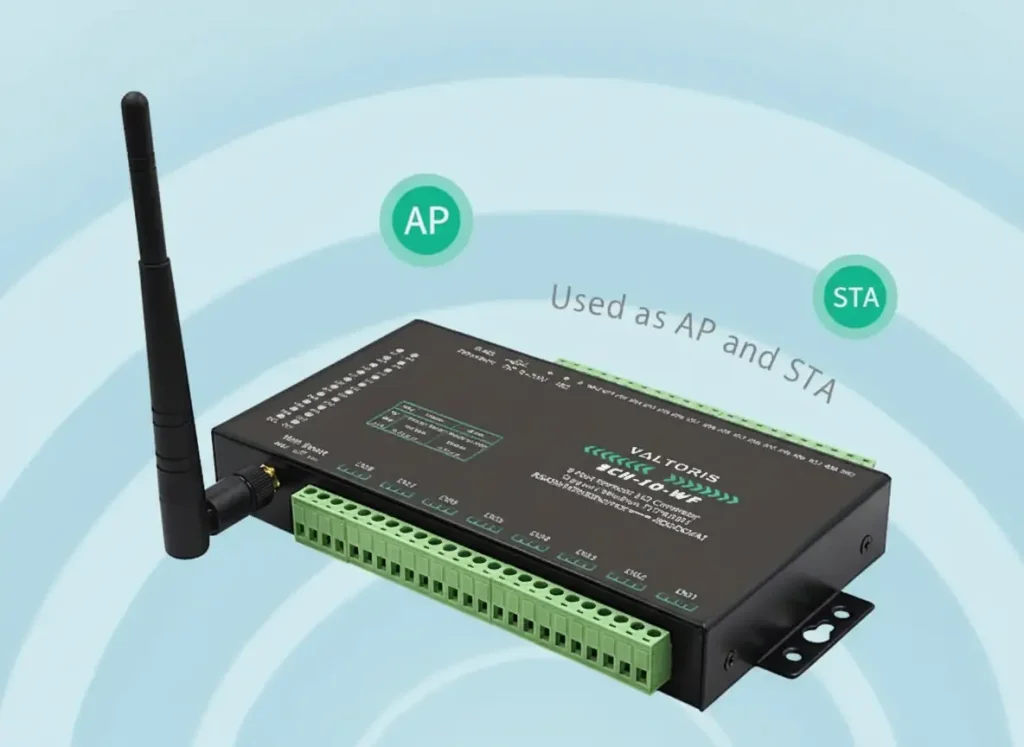
It simultaneously monitors 8 digital inputs (DI) and 8 analog inputs (AI), while actively controlling 8 relay outputs (DO). The built-in Wi-Fi can work in both Access Point (AP) and Station (STA) modes, so you can connect your existing industrial routers and data acquisition systems wirelessly in a variety of ways.

Q: Can I install this Wi-Fi module inside a closed metal control cabinet?

A: If you place the module inside a sealed metal enclosure, it will act as a Faraday cage and severely degrade the 2.4GHz Wi-Fi signal. For optimal performance, you should either use a non-metallic (polycarbonate/fiberglass) enclosure or route an external Wi-Fi antenna with a magnetic base to the outside of your metal cabinet.

Q: What is the practical difference between AP (Access Point) and STA (Station) modes for my SCADA setup?

A: * STA Mode (Most Common): The module acts like a client (just like your smartphone) and connects to your factory’s existing wireless network. This is ideal when you want multiple I/O nodes reporting back to a central SCADA server via a central router.

  • AP Mode: The module creates its own Wi-Fi hotspot. This is useful for localized troubleshooting, allowing an engineer with a laptop or Wi-Fi HMI to connect directly to the I/O module in the field without needing a broader factory network.

Q: Is the Wi-Fi connection fast and reliable enough for real-time PLC control loops?

A: For data acquisition, monitoring (temperature, tank levels), and slow-response control (turning on a pump), it is highly reliable. However, because Wi-Fi inherently involves minor packet jitter and latency (typically 10-50ms), we do not recommend using any wireless I/O for high-speed, deterministic safety loops or fast motion control. Keep your SCADA polling rates above 100ms for stable wireless telemetry.

Q: I have three older RS485 power meters at the same remote site. Can this module transmit their data over Wi-Fi too?

A: Yes. The 8CH-IO-WF features a built-in Modbus TCP-to-RTU gateway. You can daisy-chain those existing meters to the module’s RS485 serial port. The module will bridge their RTU data over your Wi-Fi network to the SCADA system, eliminating the need to pull hundreds of feet of new serial cables. (If you have multiple branches of meters, consider using an [Isolated RS485 Hub] to organize the local wiring before connecting to the I/O node).

Q: Does it support Wi-Fi roaming if installed on a moving vehicle like an AGV?

A: The standard 802.11b/g protocol supports basic connection handoffs, but it isn’t designed for seamless roaming between different factory routers with no delay. If your app uses fast-moving AGVs (Automated Guided Vehicles), we suggest making sure that there is strong, overlapping Wi-Fi coverage or asking us for help with AGV networking solutions.


📖 Definitive Guide: [ The Ultimate Guide to Remote I/O: Basics, Specs, and Selection ]

🔄 Concerned about severe wireless interference? If your factory environment cannot support Wi-Fi reliably, discover our [ Wired Ethernet Remote I/O Modules ] for rock-solid, cable-based Modbus communication.

REQUEST A QUOTE

SKU/Part No.